

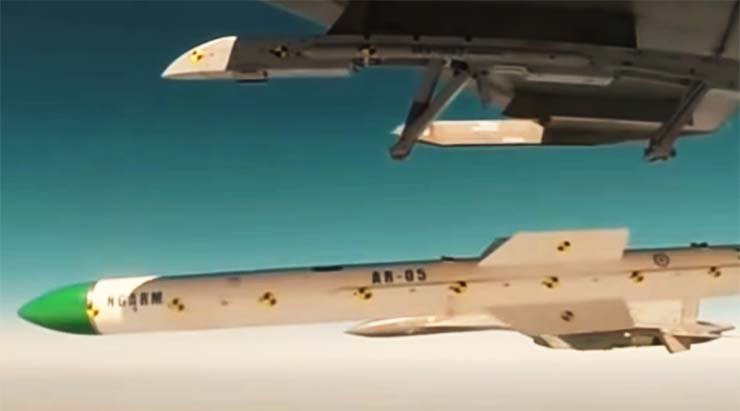
New Delhi: Strengthening its defence capabilities, India has successfully test-fired its first indigenous anti-radiation missile, the Rudram-1. Developed by the Defence Research and Development Organisation (DRDO) for the Indian Air Force (IAF), the successful test-firing of Rudram-1 is a significant milestone and places India among a select group of nations with advanced anti-radiation missile technology.

Serving as the launch platform, Rudram-1 is integrated with the IAF’s Sukhoi-30MKI fighter jets and features INS-GPS navigation and a Passive Homing Head for final attack, allowing it to accurately hit radiation-emitting targets. This precision is crucial for Suppression of Enemy Air Defence (SEAD) operations, enabling the destruction of enemy radars and communication sites from long standoff ranges.
India’s development of indigenous anti-radiation missiles enhances its strategic deterrence. The integration of Rudram-1 with Su-30MKIs allows the IAF to conduct SEAD operations deep within enemy territory, neutralising critical air defence installations. Rudram-1’s INS-GPS navigation and Passive Homing Head provide a technological edge, enabling accurate targeting over a wide range of frequencies. The missile can be launched from varying altitudes, ranging from 500 metres to 15 kilometres, and has a range of up to 250 kilometres depending on the launch conditions. This flexibility allows the IAF to adapt to different operational scenarios, enhancing its combat effectiveness.
The induction of Rudram-1 into India’s arsenal is a noteworthy development in regional defence dynamics. While China and Pakistan have their own anti-radiation missile capabilities, Rudram-1 adds a new dimension to India’s strategic toolkit. The missile’s capability to suppress enemy air defences from long standoff ranges reduces the risk to Indian aircraft, providing a significant operational advantage.
Demonstrating its growing defence technology prowess, India has joined the ranks of nations with indigenous anti-radiation missile capabilities. Rudram-1 enhances the IAF’s ability to conduct SEAD operations, ensuring air superiority in contested environments. Amidst the geopolitical tensions, India’s focus on strengthening its defence capabilities through indigenisation continues to be a crucial aspect of its national security strategy.