
Relations between India and Pakistan continue to be defined by deep mistrust, recurring security crises, and a fundamental lack of progress towards normalisation. As of late April 2026, more than a year after the intense events of 2025, there remains no meaningful improvement in bilateral ties. A fragile ceasefire established in May 2025 following India’s Operation Sindoor still holds, but it represents little more than managed hostility rather than reconciliation. Cross-border terrorism concerns persist, diplomatic engagement stays minimal, and India maintains its firm policy of strategic disengagement coupled with punitive deterrence.
The turning point came with the deadly terrorist attack in Pahalgam, Jammu and Kashmir, on April 22, 2025. Militants targeted tourists in the scenic Baisaran Valley, killing 26 civilians, the majority of whom were visitors from other parts of India. India promptly attributed the strike to Pakistan-based outfits, including Lashkar-e-Taiba (LeT) and its front, The Resistance Front (TRF). Pakistani leaders, including Prime Minister Shehbaz Sharif, strongly denied any involvement and proposed joint or international investigations. Despite these denials, New Delhi viewed the incident as further evidence of state-enabled terrorism.

India responded with a multi-pronged strategy. On April 23, 2025, it announced that the Indus Waters Treaty (IWT) of 1960 would be placed in abeyance with immediate effect. This landmark agreement, long regarded as one of the few enduring successes of India-Pakistan cooperation, governs the sharing of the Indus River system. India linked the suspension directly to Pakistan’s alleged continued support for terrorism, declaring that “terror and water cannot flow together.” Shortly afterwards, on the night of May 6-7, 2025, Indian forces executed Operation Sindoor, launching precise missile and drone strikes on nine alleged terrorist infrastructure sites linked to LeT and Jaish-e-Mohammed (JeM) in Pakistan-occupied Kashmir and deeper inside Pakistani territory.
Defence Minister Rajnath Singh described the operation as “focused, measured, and non-escalatory,” targeting only terror-related facilities while avoiding direct military installations initially. He later warned that India would take “unprecedented and decisive” action against any future misadventure by Pakistan. Prime Minister Narendra Modi addressed the nation after the ceasefire, stating firmly: “We have only paused the fight. India will retaliate on its own terms if terrorism continues. Terror and talks cannot go together.” He reiterated that patience had limits and that nuclear blackmail would not deter India from protecting its security.
“We have only paused the fight. India will retaliate on its own terms if terrorism continues. Terror and talks cannot go together. Nuclear blackmail will not deter India from protecting its security,” Prime Minister Modi said after the ceasefire between India and Pakistan following Operation Sindur last year
Pakistan condemned the strikes as “blatant aggression” and an “act of war.” Prime Minister Shehbaz Sharif vowed a “strong and uncompromising response,” asserting that Pakistan was “ready for both peace and war.” In subsequent statements, Sharif called for dialogue, writing to Modi and urging the restoration of “meaningful bilateral ties” to resolve outstanding issues, particularly Kashmir. Pakistani military spokespersons claimed successful defensive actions, including the downing of Indian aircraft. The brief but sharp military exchange lasted several days before the Directors General of Military Operations (DGMOs) from both sides agreed to a ceasefire on May 10, 2025, through direct hotlines. India emphasised that the understanding was reached bilaterally, rejecting claims of significant third-party mediation.
The Indus Waters Treaty: A New Instrument of Leverage
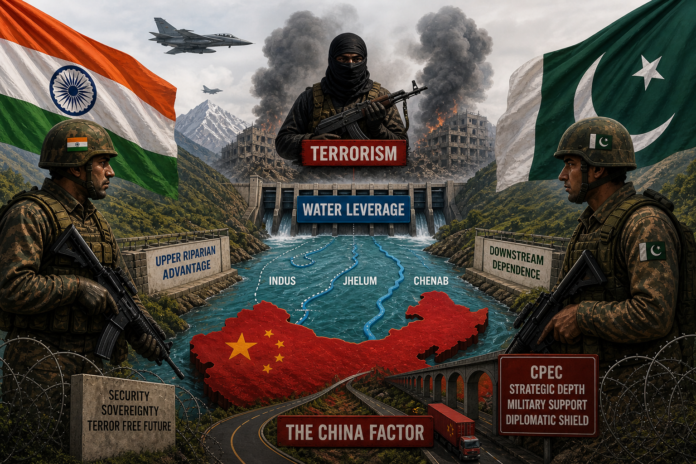
The suspension of the Indus Waters Treaty marked a significant escalation in India’s toolkit against Pakistan. Under the 1960 treaty, India has rights over the three eastern rivers (Ravi, Beas, Sutlej), while Pakistan enjoys primary use of the three western rivers (Indus, Jhelum, Chenab), with India allowed limited non-consumptive uses such as hydropower generation. Pakistan relies heavily on this system, with roughly 80 per cent of its agricultural land and over 90 per cent of its total water supply dependent on the Indus basin.

By placing the treaty in abeyance, India halted regular commissioner-level meetings, data sharing, and cooperative mechanisms, effectively rendering the treaty’s implementation defunct for the time being. New Delhi accelerated hydropower and infrastructure projects on the western rivers in Jammu and Kashmir, including works on the Chenab and others. Short-term actions, such as restricted water flows through dams like Baglihar, were reported in the immediate aftermath. Indian leaders, including Home Minister Amit Shah, signalled that water previously flowing to Pakistan could be diverted for domestic use, such as through canals to Rajasthan.
The implications for Pakistan are severe. With limited reservoir storage capacity at key dams like Mangla and Tarbela, any sustained reduction in flows could lead to agricultural losses, food shortages, water rationing in urban centres, and power blackouts. Pakistan has repeatedly described water as a “vital national interest” and warned that any attempt to disrupt flows would be viewed as an “act of war.” President Asif Ali Zardari, on World Water Day in March 2026, strongly condemned India’s “unilateral suspension” and “weaponisation of shared water resources,” calling for immediate restoration in line with international obligations. Pakistani diplomats have raised the issue at the United Nations, urging the Security Council to address the “grave peace and security, and humanitarian consequences.”

India has held its ground. At the United Nations and in bilateral briefings, Indian representatives, including Permanent Representative P Harish, have reiterated that the treaty will remain in abeyance until Pakistan takes “credible and irreversible” steps to end support for terrorism. Prime Minister Modi and senior officials have made it clear that the old framework of unconditional water cooperation no longer applies in the face of persistent security threats. As of April 2026, the treaty remains suspended, with India showing no inclination to restore it without fundamental behavioural changes from Islamabad.
This move has introduced a new layer of complexity to the relationship. It transforms water from a domain of limited cooperation into a strategic pressure point, raising concerns about long-term regional stability, environmental impacts, and potential humanitarian fallout during dry seasons. Climate change adds further strain, as shrinking glacial flows and increasing water demand affect both nations, yet mutual distrust prevents joint management.
The Deepening China-Pakistan Axis
Pakistan’s response to Indian pressure has been bolstered by its “all-weather” strategic partnership with China. Beijing has provided consistent diplomatic, economic, and military backing to Islamabad, particularly evident during and after the 2025 crisis. The China-Pakistan Economic Corridor (CPEC), a flagship project under China’s Belt and Road Initiative, continues to expand despite security challenges, with investments running into tens of billions of dollars. Parts of CPEC pass through Pakistan-occupied Kashmir, a territory India claims as its own, prompting strong objections from New Delhi.
The suspension of the 1960 Indus Waters Treaty after the Pahalgam attack marked a significant escalation in India’s toolkit against Pakistan. Pakistan relies heavily on this river system, with roughly 80% of its agricultural land and over 90% of its total water supply dependent on the Indus basin
During Operation Sindoor, China’s support extended beyond rhetoric. Reports indicate that Beijing supplied Pakistan with real-time intelligence, including “live inputs” on Indian military positions, helping Pakistani forces calibrate their responses. Chinese-origin weaponry played a prominent role, including PL-15 air-to-air missiles, J-10 fighter jets, air defence systems, and drones. Indian military officials later highlighted how Pakistan benefited from Chinese satellite support and technical assistance in recalibrating defences. There were even indications of Chinese personnel and operational guidance on the ground.
China has also extended economic lifelines to Pakistan, including repeated loan rollovers and commitments to fast-track delivery of advanced systems such as stealth fighters and submarines. Diplomatically, Beijing has backed Pakistan’s narrative at international forums while projecting itself as a responsible actor calling for de-escalation. Some Chinese statements even claimed a mediating role in ending the May 2025 hostilities, though India maintained the ceasefire was managed directly.
This axis complicates India’s security calculus. It creates a two-front challenge, with Pakistan acting as a frontline proxy and China providing the technological and economic depth. The CPEC not only strengthens Pakistan’s infrastructure but also enhances Chinese strategic presence near India’s borders. For India, this reality reinforces the need for robust deterrence, accelerated defence modernisation, and deeper partnerships in the Indo-Pacific to balance Chinese influence.
Pakistani leaders frequently highlight the strength of ties with China, describing the relationship as “higher than the Himalayas and deeper than the oceans.” In contrast, Indian statements underscore that external support cannot shield Pakistan from the consequences of sponsoring terrorism.
Pakistan’s Concentric Internal Fault Lines
Pakistan’s ability to sustain external confrontation with India is increasingly complicated by serious internal fault lines that have grown more pronounced in recent years. In Baluchistan, the long-running ethno-nationalist insurgency led by groups such as the Baloch Liberation Army (BLA) and Baloch Liberation Front (BLF) has intensified, with coordinated attacks on security forces, infrastructure, and even maritime targets. The province, Pakistan’s largest but poorest, has witnessed a surge in violence throughout 2025 and into 2026, including high-profile strikes on military camps, banks, markets, and Chinese-linked projects. Baloch separatists accuse Islamabad of exploiting the region’s rich natural resources while denying the local population equitable political autonomy and economic benefits.
In Khyber Pakhtunkhwa (KP), the Tehrik-i-Taliban Pakistan (TTP) has expanded its operations, controlled pockets of territory and launched frequent attacks on security personnel, police stations, and bridges. The province has borne the brunt of militant violence, accounting for a significant share of terrorism-related fatalities in 2025. Political tensions between the provincial government and the federal centre have further undermined counterterrorism efforts, with disputes over operations, funding for displaced persons, and narratives around Afghan-based militancy creating deep civil-military and federal-provincial fractures.
Beijing has provided diplomatic, economic, and military backing to Islamabad, particularly evident during and after the 2025 crisis. The China-Pakistan Economic Corridor (CPEC), China’s Belt and Road Initiative, passes through Pakistan-occupied Kashmir, prompting strong objections from New Delhi
Even in Pakistan-occupied Kashmir (PoK) and Gilgit-Baltistan, unrest has simmered, with reports of growing resentment against Pakistani control, enforced demographic changes, and heavy military presence. Protests against economic neglect and political suppression have occasionally turned violent, while groups like the TTP have reportedly extended influence into parts of the region. These internal challenges, ranging from separatist insurgencies and Islamist militancy to governance failures and resource disputes, force Pakistan’s military to fight on multiple domestic fronts, stretching its resources and limiting its capacity to focus exclusively on external adventures. The persistence of these fault lines highlights the structural weaknesses within the Pakistani state and raises questions about its long-term stability.
Limited Gestures Amid a Frozen Relationship
Despite the tensions, a few symbolic interactions have taken place. On December 31, 2025, External Affairs Minister S Jaishankar and Pakistan’s National Assembly Speaker Ayaz Sadiq exchanged a brief handshake in Dhaka during a regional event. Pakistani accounts portrayed it positively, while Indian officials downplayed its importance as routine diplomatic courtesy without policy implications. Informal Track-2 dialogues, including one in Doha in early 2026, continue sporadically but have yielded no breakthroughs.
As of April 2026, official bilateral dialogue remains suspended. India insists on verifiable dismantling of terror infrastructure before any talks. Pakistan continues to call for unconditional dialogue on Kashmir while rejecting Indian allegations. Defence Minister Khawaja Asif has warned of a “swift, calibrated, and decisive” response to any future Indian action.
International Concerns and Future Outlook
The international community monitors the situation warily, primarily due to the nuclear dimension. Assessments from think tanks and intelligence agencies note a moderate risk of renewed conflict triggered by terrorism. Water disputes add another potential flashpoint, with fears that escalating scarcity could compound existing tensions.
India has successfully de-hyphenated its broader foreign policy from the Pakistan context, focusing on economic growth, defence self-reliance, and partnerships with the United States, Europe, Japan, and Gulf nations. Internally, efforts to integrate Jammu and Kashmir through development and governance aim to reduce the appeal of militancy.
For Pakistan, economic vulnerabilities and reliance on external patrons like China shape its options. While some voices in Islamabad recognise the costs of perpetual confrontation, the influence of the military establishment and entrenched proxy networks hinder substantive change.
The Way Forward
Any realistic way forward for India-Pakistan relations hinges on Pakistan demonstrating verifiable and irreversible action against terror infrastructure and cross-border support for militancy. India has made it clear that restoration of normal ties, including revival of the Indus Waters Treaty, trade, and high-level dialogue, will only follow credible steps that address its core security concerns. For Pakistan, addressing its multiple internal fault lines — through genuine political inclusion in Baluchistan and Khyber Pakhtunkhwa, reduced reliance on proxies, and improved governance in PoK — could create space for pragmatic engagement.
Economic incentives, such as the gradual reopening of trade routes and people-to-people contacts, might help build constituencies for peace on both sides, provided terrorism ceases to be an instrument of state policy. In the longer term, backchannel diplomacy, Track-2 efforts, and possible third-party facilitation on non-core issues could serve as confidence-building measures. However, without a fundamental shift in Pakistan’s strategic calculus away from the military-jihadi complex and towards regional stability, sustained improvement appears unlikely. India, for its part, will likely continue prioritising deterrence, internal consolidation in Jammu and Kashmir, and multi-alignment globally while keeping the door open for dialogue on its own terms.
India has successfully de-hyphenated its broader foreign policy from the Pakistan context, focusing on economic growth, defence self-reliance, and partnerships with the United States, Europe, Japan, and Gulf nations. Internally, efforts to integrate Jammu and Kashmir through development and governance aim to reduce the appeal of militancy
Ultimately, lasting peace in South Asia will require both nations to move beyond historical grievances and focus on shared challenges like climate change, water security, and economic development.
In conclusion, India-Pakistan relations as of April 2026 show no signs of a genuine thaw. The suspension of the Indus Waters Treaty has introduced water as a powerful lever of Indian policy, imposing high long-term costs on Pakistan’s agriculture and economy. Meanwhile, China’s multifaceted support — military, intelligence, economic, and diplomatic — enables Pakistan to withstand pressure but deepens the strategic imbalance from India’s perspective.
Leaders on both sides reflect entrenched positions. Prime Minister Modi and his ministers have consistently linked any normalisation, including restoration of the IWT, to the end of terrorism. Pakistani leaders like Shehbaz Sharif and Asif Ali Zardari mix calls for peace and dialogue with strong condemnations of Indian actions and reliance on their Chinese ally.
The fragile ceasefire persists through functional military hotlines and practical arrangements, yet root causes remain unresolved. Without credible action by Pakistan against terror networks and a fundamental shift in its strategic behaviour, the relationship is likely to continue oscillating between uneasy calm and periodic spikes of tension. India’s policy of strength, selective disengagement, and multi-domain deterrence appears set to endure, prioritising national security and long-term regional influence over premature reconciliation. The people of South Asia continue to bear the costs of this enduring rivalry, with water security, great-power involvement, and Pakistan’s internal fragilities adding new dimensions to an already complex challenge.

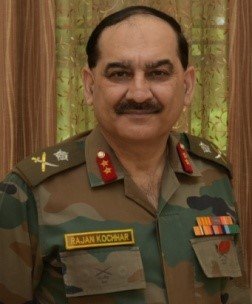
-The author retired as Major General, Army Ordnance Corps, Central Command, after 37 years of service. A management doctorate and expert on defence modernisation, he is the author of four books, including the Amazon bestseller “Breaking the Chinese Myth,” and a frequent media commentator. He is affiliated with several leading defence and strategic studies institutions in New Delhi. The views expressed are of the writer and do not necessarily reflect the views of Raksha Anirveda
