


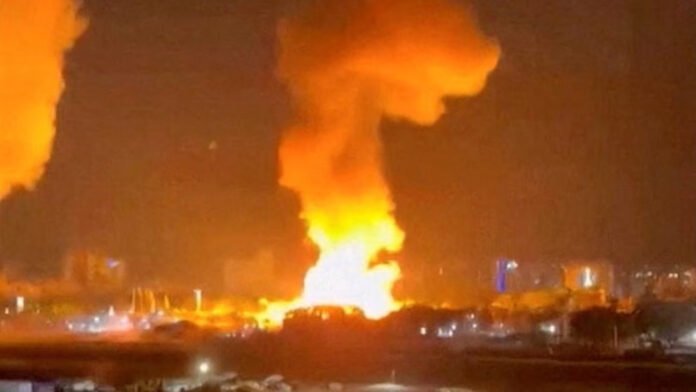
after almost six months of a US large-scale air-naval offensive against Iran’s underground nuclear reactors to reassert its security credibility in the Middle East, following Israel’s strikes in Qatar that crossed the region’s security red lines, the US, through an intensive joint and multi-domain operation codenamed “Operation Absolute Resolve,” captured Venezuela’s President Nicolás Maduro after a successful series of air strikes on 3^rd^ January 2026. This operation showcased that the US has again reasserted itself in Latin America to maintain the regional security balance and demonstrate its security dominance. The broader picture of this operation suggests a strong strategic message has been sent across the global order.
US Preventive Strike Strategy
In the US’s security and strategic community, the preventive strike strategy and war-like military actions are used to prevent a non-imminent threat from developing into a greater threat in the future, which differs from the pre-emptive strike notion where the threat is imminent. This strategy has three broad objectives:

First: Elimination of possible strategic threat, both political and non-political.
Second: Maximisation of strategic interests.
Third: The symbolic demonstration of its capability for security domination and restoring deterrence.
Impressions of these three objectives were evident in every US special military operation aimed at a preventive strike or war. The preventive-strike strategy became a means of enforcing the Monroe Doctrine, which advocated keeping the US hemisphere free of adversarial influence or action. President James Monroe articulated the policy in 1823. After decades, the doctrine opposing European colonialism and intervention in the Western Hemisphere. again came into focus when US President Trump released the National Security Strategy (NSS). The NSS was crystal clear not only in reaffirming the doctrine but also in effectively reasserting it. Perhaps the Monroe Doctrine was revived in Operation Absolute Resolve.
The Strategy
After decades, the US launched such a large-scale operation to topple a regime. The last time the US showcased its military might in its backyard was to topple the regime of Panama in the operation codenamed “Just Cause” in 1989. In the specific case of Venezuela, where the Trump Administration was using coercive diplomacy/gunboat diplomacy to deter and pressure the regime and even launched “Operation Southern Spear” in September 2025, a military and surveillance campaign with the goal of “detecting, disrupting, and degrading transnational criminal and illicit maritime networks”, especially focusing on Venezuela, the situation took a surprising turn and escalated into a full-fledged military operation. This is not the first time the US has made a quick transition from diplomacy to might. The notable case in 1991 was “Operation Desert Shield,” a massive buildup of troops and a naval blockade intended to coerce Iraq into withdrawing voluntarily, before launching “Operation Desert Storm” against Iraq.
The preventive-strike strategy became a means of enforcing the Monroe Doctrine… Perhaps the Monroe Doctrine was revived in Operation Absolute Resolve
Similarly, in its own backyard, the US used coercive diplomatic tactics against the military dictator of Panama, Manuel Noriega. After almost two years of coercive tactics, including economic strangulation, legal threats, and even military threats through “Sand Flea” exercises and aggressive convoys that drove straight through Panamanian territory to intimidate Noriega’s forces, the tipping point came before Operation Just Cause. The US launched “Operation Nimrod Dancer,” deploying nearly 2,000 combat troops to augment the forces already there and intimidate Noriega before the full invasion. In both cases, there was a three-stage execution—coercive diplomacy, gradual escalation, and military action—that demonstrated the US’s preventive-strike capabilities and its capacity for war.

Reasons for Going All Out
The strategic considerations for engaging in preventive strikes or war to topple regimes in both Iraq and Panama were the elimination of a strategic threat. Noriega was gradually tilting towards anti-American stances, engaging in drug trafficking, and endangering US influence and citizens in the region. Similarly, Saddam Hussein was seen as a major threat to the Middle East because of his links to terror-related activities and organisations such as Al-Qaeda. He also demonstrated consistent hostility toward the US, including an assassination plot against former President George H.W. Bush in 1993. Along with the strategic threat, the US also aimed at the maximisation of interests—US influence over the Panama Canal and its intention to remain a dominant power in the Western Hemisphere. Similarly, in Iraq, the intention of petro dominance and Gulf influence was one of the interests that went beyond the stated objectives of the operations.
In Operation Absolute Resolve against Venezuela, a similar pattern appears to have repeated. Nicolás Maduro’s involvement in narco-terrorism, including a drug cartel known as the “Cartel of the Suns,” was designated a Foreign Terrorist Organisation in late 2025, with claims that he used drug trade proceeds to destabilise the US. Two more notable reasons that made Maduro a strong and direct strategic threat to the US were border security, where migration from Venezuela was seen as a threat to the US southern border, and adversarial alliances, with Maduro’s close ties to China, Russia, and Iran, which posed a major strategic risk to the US’s long-term strategic interests and its long-dominant sphere of influence in the Caribbean, and even to US’s energy security, where Venezuela could divert oil to US’s adversaries.

Operation Absolute Resolve delivers a clear strategic message that the US still intends to dominate its strategic security space and underscores the seriousness of its capabilities to restore deterrence
Apart from strategic threat objectives, the U.S. may also have objectives for interest maximisation, such as petro-dominance, given that Venezuela holds the world’s largest oil reserves. A friendly regime there would help the US influence global energy calculations more effectively and aid in diversifying its oil market. The US still faces an “oil dilemma” and challenges to its energy security in a complex geopolitical environment and a volatile oil market, especially during external shocks.
The Strategic Message
US security assurances and their credibility have come under serious scrutiny in recent years, beginning with the Afghanistan withdrawal, the Ukraine situation, and, most recently, in the Middle East, where Israel carried out strikes in Qatar, prompting Middle East powers to scramble for security assurances. The US needed to deliver a strong strategic message to the global security order that it remains intent on and capable of dominating its sphere of influence, and that its security credibility holds—a tactic of restoring deterrence. The 2017 missile strike on Syria demonstrated Trump’s intent to restore deterrence. In 2013, the Obama administration drew a “Red Line” against chemical weapons use in Syria but failed to strike when that line was crossed, which cast serious doubt on US security credibility and assurances in the Middle East.
However, in 2017, when the Assad regime used chemical weapons again, the US President ordered a volley of around 59 Tomahawk missiles at the Shayrat Airbase in Syria. Similarly, Operation Absolute Resolve delivers a clear strategic message that the US still intends to dominate its strategic security space and underscores the seriousness of its strategic and operational capabilities to restore deterrence in a heightened security environment.

The writer is a national security analyst specialising in intelligence and strategic affairs. He has worked extensively with national security and foreign policy think tanks of repute, and has written for publications including The Telegraph, The Print, Organiser, and Fair Observer. He has also been a guest contributor to the School of International Studies at Jawaharlal Nehru University (JNU).





