

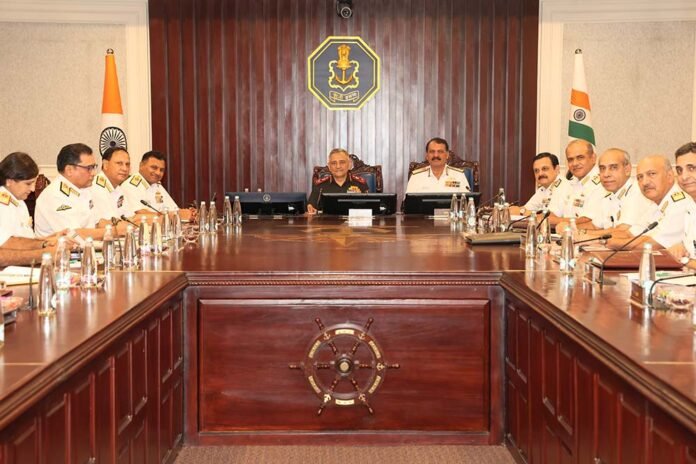
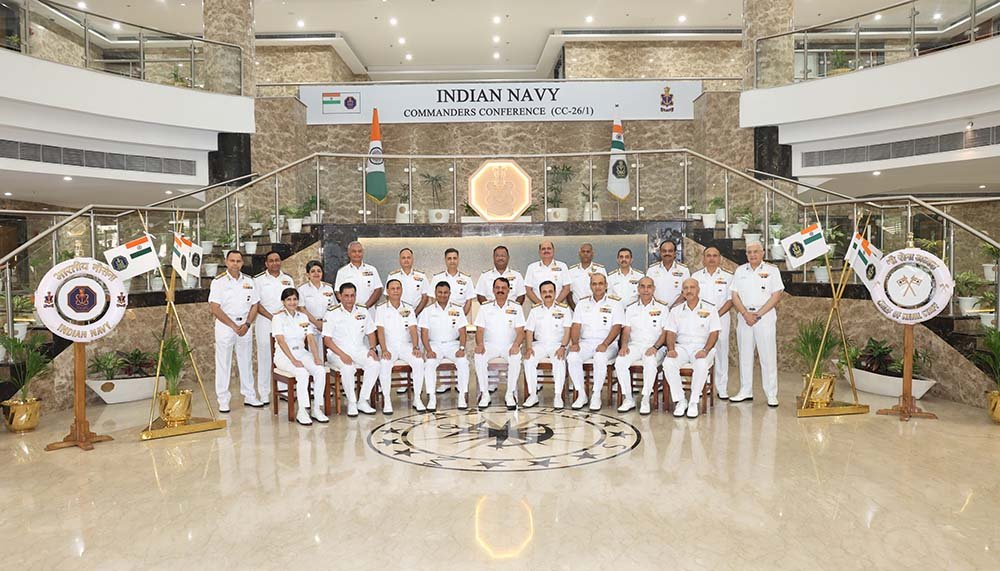
New Delhi: First day of Indian Navy’s Commanders Conference 2026 commenced at Nausena Bhawan on April 14, with an inaugural address by Adm Dinesh K Tripathi, Chief of the Naval Staff, to senior naval leadership, outstation Operational and Area Commanders and Command HQs and NHQ Staff.
CNS commended the achievements of the Navy towards safeguarding India’s maritime interests including Energy Security, amidst ongoing conflict in West Asia, increased tempo of operations and inter-services synergy. CNS laid emphasis on continued focus on combat readiness adapting emerging technologies to build a Future Ready force.
CNS reiterated the Indian Navy’s commitments in IOR and beyond in the emerging geo-strategic scenario and significance of Cohesive and Credible approach through proactive engagements with FFCs in multilateral and bilateral exercises.
Operational highlights including salient issues pertaining to jointness, capability enhancement (afloat/ ashore), maintenance/ refits, multi domain safety practices, training, foreign cooperation, HR issues and innovation/ indigenisation were discussed during the Conference.
The Chief of the Defence Staff, addressed and interacted with the Naval Commanders on matters pertaining to changing geo-political orders, and urged the Navy to plan for rapidly evolving character of war, including economic and technological factors.
In his address at the Commanders’ Conference, the CNS drew attention to the continued instability in West Asia and linked disruptions to maritime traffic, calling it “a reminder that security is interconnected, persistent, and unforgiving – where distance from conflict does not equate to distance from its consequences.”
The CNS spoke of the global power dynamic, noting that “in a span of five years, we have moved from a competition continuum to a conflict continuum.” He highlighted the salient impacts of the ongoing conflict, both economic and military, as well as the visible shaping of conflict perception through narrative warfare, and not just operational outcomes alone.
The CNS also stressed various aspects that have caused the maritime security environment to reach an inflection point – where concurrent conflicts, increasing adversary capabilities, erosion of institutions, and reduced acquisition costs for non-state actors are converging to create a highly contested space for the Indian Navy on a day-to-day basis.
The CNS highlighted the achievements of the Indian Navy in its journey towards becoming a Combat-Ready, Credible, Cohesive, and Future-Ready Force.
Along with the demonstration of absolute readiness for kinetic action, both offensive and defensive, the CNS highlighted that there has been a significant increase in the operational deployment of naval platforms over the past five to ten years. Continued upgradation and augmentation of warfighting capabilities in the surface, sub-surface, and air domains, supported by major infrastructural developments, robust maintenance practices, and in-house technical developments, were among the measures contributing to the Navy’s combat readiness.
The CNS brought out the credible capability augmentation that saw 100% utilisation of the total allotted budget ceiling, conclusion of 90-plus capital contracts, continued commissioning of indigenously designed and constructed platforms, and delivery of more than 15 platforms scheduled this year.
As a credible maritime stakeholder for the nation, the Indian Navy played a major role in the safe transit of merchant ships moving out of the Persian Gulf, while also being a source of confidence for Indian seafarers through the presence of Indian Navy warships in the region.
The maiden voyage of the stitched ship INSV Kaundinya, the conduct of several significant multilateral events including Maritime Mahakumbh, IFR, MILAN, and the IONS Conclave of Chiefs, and the deployment of IOS Sagar-2 with participation of 16 FFCs showcase India’s credibility as a regional and international partner, with the Indian Navy as a key stakeholder furthering India’s maritime heritage.
The CNS highlighted initiatives in recruitment, training, medical support, welfare, and sports, which have reinforced the cohesive spirit of the Indian Navy, strengthening the trust, resilience, and unity that define the force.
He also highlighted various technology-intensive capability developments that have taken place, along with those in various phases of development and induction, including incorporation of AI/ML in the operational framework, as measures towards the Navy’s future readiness.
The CNS outlined the priority areas that will ensure the Navy’s collective efforts remain coherent, continuous, and clearly directed. These include warfighting and sustaining peak combat efficiency as the foremost priority, force levels and capacity development, maintenance and logistics, innovation and integration of new technologies, workforce and HR, operational and organisational agility, and jointness and integration.

