

Background: The India-Israel MoU and Strategic Convergence: In the evolving grammar of India’s strategic partnerships, few relationships have matured with as much quiet purpose as that with Israel. What began as cooperation in agriculture and defence has steadily expanded into domains where survival and sustainability intersect — water, energy, and now the vast, underexplored potential of the oceans.
The India-Israel Memorandum of Understanding in marine and desalination technologies must be seen against this larger canvas. Israel, a nation that turned aridity into abundance through innovation, brings with it unmatched expertise in water management and compact, efficient technologies. India, by contrast, brings scale of geography, coastline, and ambition. Together, they form a partnership where necessity meets ingenuity.

It is within this convergence that Ocean Thermal Energy Conversion (OTEC) emerges not merely as a technological curiosity but as a strategic instrument. For India, surrounded by warm tropical waters and responsible for far-flung island territories, the ocean is no longer just a frontier — it is a reservoir of solutions.
The MoU thus signals a subtle but profound shift: from viewing the seas as routes of trade and theatres of security, to recognising them as sources of sustenance. In that transition lies the seed of a new maritime doctrine — one where energy, water, and sovereignty are drawn not from beneath the land, but from beneath the waves.
The India-Israel MoU in marine and desalination technologies must be seen against a larger canvas. Israel, a nation that turned aridity into abundance through innovation, brings with it unmatched expertise in water management and compact, efficient technologies. India, by contrast, brings scale of geography, coastline, and ambition. Together, they form a partnership where necessity meets ingenuity
Technical Foundations: How OTEC Fits India’s Maritime Reality
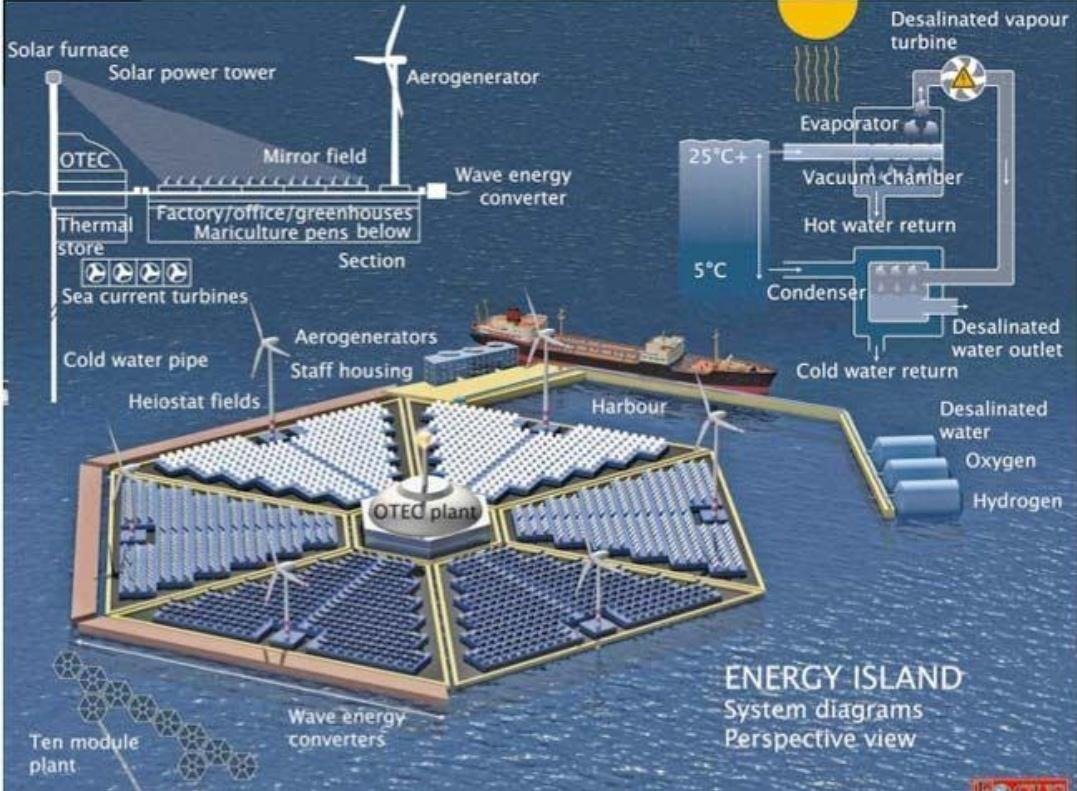
At its heart, OTEC is elegantly simple — an application of the Thermodynamic cycle played out on an oceanic scale. The tropical seas that lap India’s shores hold a natural temperature gradient: warm surface waters, heated by the sun, and cold, dense waters lying deep below. This difference — often exceeding 20°C — is the invisible engine.
In a typical closed-cycle system, warm seawater passes through a heat exchanger, vaporising a working fluid such as ammonia. The resulting vapour spins a turbine, generating electricity. Cold water, drawn from depths of nearly a kilometre, then condenses the vapour back into liquid, completing the cycle. The ocean, in effect, becomes a perpetual heat engine — quiet, continuous, and inexhaustible.

What makes this particularly suited to India is geography. Unlike many temperate nations, India’s island territories — especially Lakshadweep and the Andaman & Nicobar chain — offer steep ocean gradients close to shore, reducing engineering complexity. The required deep cold water is accessible without venturing far into hostile seas.
Moreover, OTEC is not a single-output system. In open or hybrid configurations, it can simultaneously produce desalinated freshwater, making it uniquely valuable for water-stressed islands. Thus, the technology aligns seamlessly with India’s dual imperatives — energy security and water sustainability.

In a country where sunlight is abundant but intermittent, and wind is seasonal, OTEC offers something rare: continuous, base-load renewable energy, drawn from the steady rhythm of the seas.
Lakshadweep – Fresh Water from the Depths
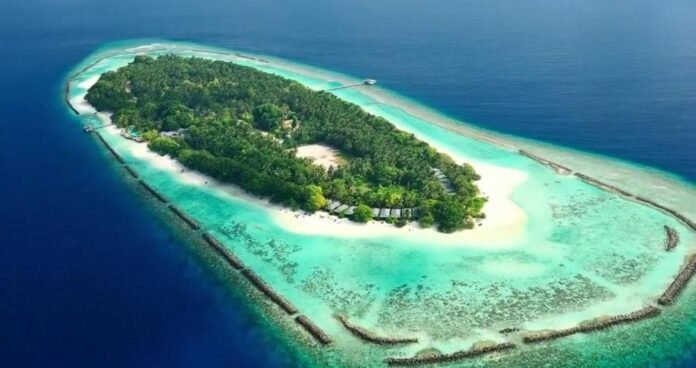
Scattered like emeralds across the Arabian Sea, Lakshadweep’s beauty conceals a quiet fragility — the scarcity of freshwater. With no rivers and limited groundwater, the islands depend heavily on rainfall and small-scale desalination plants. Every drop of water is precious, and every disruption — be it climate variability or logistical delay — carries immediate consequences.
At its heart, OTEC is elegantly simple — an application of the Thermodynamic cycle played out on an oceanic scale. The tropical seas that lap India’s shores hold a natural temperature gradient: warm surface waters, heated by the sun, and cold, dense waters lying deep below. This difference — often exceeding 20°C — is the invisible engine
Here, OTEC offers a transformation that is both technological and civilisational.
In its open-cycle form, OTEC does more than generate power. It creates freshwater as a natural by-product. Warm surface seawater is flash-evaporated under low pressure, producing steam that, when condensed using cold deep seawater, yields pure, desalinated water. Unlike conventional desalination, which is energy-intensive and often dependent on fossil fuels, OTEC-driven desalination is inherently sustainable.
For Lakshadweep, this means a shift from dependence to self-reliance. The surrounding ocean, once a barrier isolating the islands, becomes a life-giving resource. Water security would stabilise local communities, support tourism without ecological strain, and reduce the need for costly and carbon-intensive supply chains from the mainland.
India’s National Institute of Ocean Technology has already taken early steps in this direction, experimenting with OTEC-linked desalination systems. While still at pilot stages, these efforts point to a future where technology and geography align seamlessly.
In Lakshadweep, therefore, OTEC is not merely about innovation — it is about dignity. The dignity of an island that no longer waits for water to arrive, but draws it endlessly from the depths that surround it.
Lakshadweep – Reliable Electricity for Island Resilience
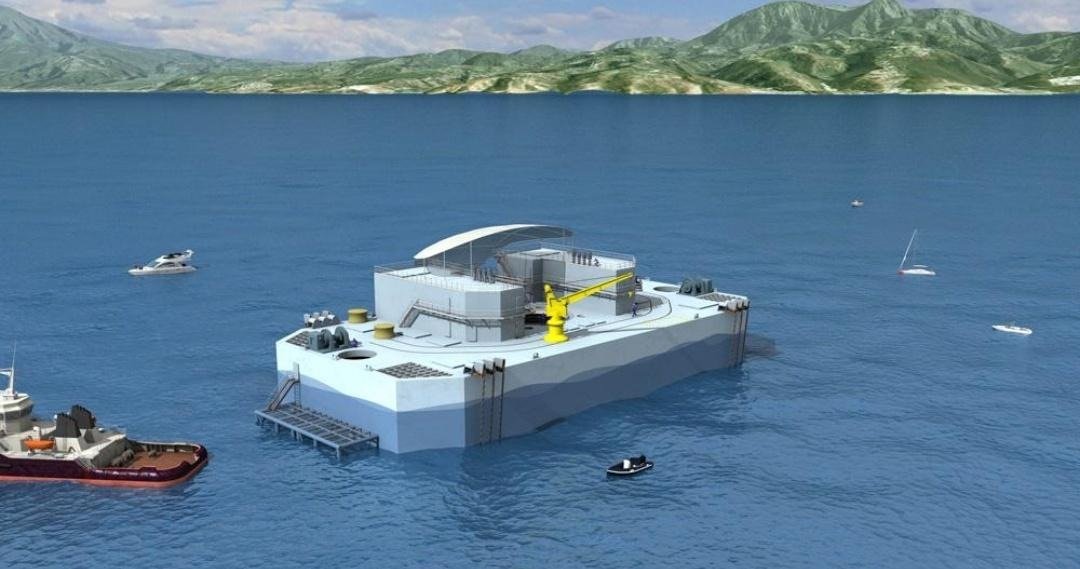
If water defines survival, energy defines possibility. In Lakshadweep today, electricity is largely sustained by diesel generators — costly, logistically demanding, and environmentally burdensome. Every litre of fuel must travel across the sea, tying the rhythm of island life to uncertain supply chains.
OTEC offers a decisive break from this cycle.
In its open-cycle form, OTEC does more than generate power. It creates freshwater as a natural by-product. Warm surface seawater is flash-evaporated under low pressure, producing steam that, when condensed using cold deep seawater, yields pure, desalinated water. Unlike conventional desalination, which is energy-intensive and often dependent on fossil fuels, OTEC-driven desalination is inherently sustainable
Unlike solar or wind, which ebb and flow with time and season, OTEC operates continuously, drawing power from the stable thermal gradient of the ocean. It provides what energy planners value most — base-load power. For an island ecosystem, this is transformative. Hospitals, communication systems, desalination plants, and tourism infrastructure can all function without interruption.
The shift is not merely technical — it is structural. Energy independence reduces vulnerability. It lowers long-term costs, stabilises development, and aligns with India’s broader climate commitments. Small, modular OTEC plants can be tailored to island needs, creating decentralised energy systems that are resilient by design.
In such a future, Lakshadweep ceases to be an energy outpost dependent on the mainland. It becomes a self-sustaining node, where the sea itself powers life ashore.
Future Horizons: Andamans, Coastline & Security Imperatives
Beyond Lakshadweep, the promise of OTEC expands eastward to the strategically vital Andaman and Nicobar Islands — India’s forward presence in the Indo-Pacific. Here, geography and strategy converge. These islands sit astride critical sea lanes, making them central not only to commerce but to national security.
In such a setting, OTEC acquires a dual identity. On one hand, it can power civilian life — supporting settlements, tourism, and infrastructure in remote locations. On the other hand, it can sustain defence installations, enabling greater operational endurance without reliance on vulnerable fuel supply chains. Energy, in this context, becomes an element of strategic autonomy.
Along India’s mainland coast — particularly in regions of Tamil Nadu and Kerala where deep waters lie close to shore — OTEC may find selective application. Though not universally viable, these pockets offer opportunities for hybrid energy systems, combining ocean-based and terrestrial renewables.
Yet, with opportunity comes responsibility. Offshore OTEC installations will require robust security frameworks. These structures, both on and below the water, could be vulnerable to sabotage, accidents, or natural disruptions. Protecting them will demand integration with naval surveillance, coastal radar chains, and emerging maritime domain awareness systems.
OTEC represents more than an energy technology. It is a convergence of science and geography, of partnership and policy, of sustainability and strategy. The India-Israel collaboration provides a catalyst, but the momentum must be India’s own. It calls for mission-mode execution, sustained investment, and the confidence to scale what is still emerging
Over time, OTEC platforms themselves could evolve into multi-functional maritime assets — nodes that generate power, support desalination, and enhance surveillance presence.
In alignment with India’s SAGAR vision (Security and Growth for All in the Region), they would represent not just infrastructure, but intent — a visible assertion of capability in the maritime domain.
India’s Blue Energy Moment
Nations are often shaped by the resources they harness. For centuries, power has risen from beneath the earth — coal, oil, gas — fuelling growth but also binding economies to finite reserves and fragile geopolitics. India now stands at the threshold of a different possibility — one that rises not from the depths of the land, but from the quiet gradients of the sea.
OTEC represents more than an energy technology. It is a convergence of science and geography, of partnership and policy, of sustainability and strategy. The India-Israel collaboration provides a catalyst, but the momentum must be India’s own. It calls for mission-mode execution, sustained investment, and the confidence to scale what is still emerging.
For island territories, it promises dignity through self-reliance. For coastal regions, it offers resilience. For the nation, it opens a pathway in which energy security, water security, and maritime security are no longer separate pursuits but parts of a unified vision.
The oceans that surround India have always shaped its destiny — as routes of trade, as theatres of history, as guardians of its shores. In the decades to come, they may well become something more profound: the engines of its sustainable future.
If the last century was defined by what lay beneath the soil, the next may well be defined by what flows silently above it — the endless, patient energy of the seas.

Lt Gen Rajeev Chaudhry (Retd) writes on contemporary national and international issues, strategic implications of infrastructure development towards national power, geo-moral dimension of international relations, and leadership nuances in a changing social construct. The views expressed are of the author and do not necessarily reflect the views of Raksha Anirveda
