


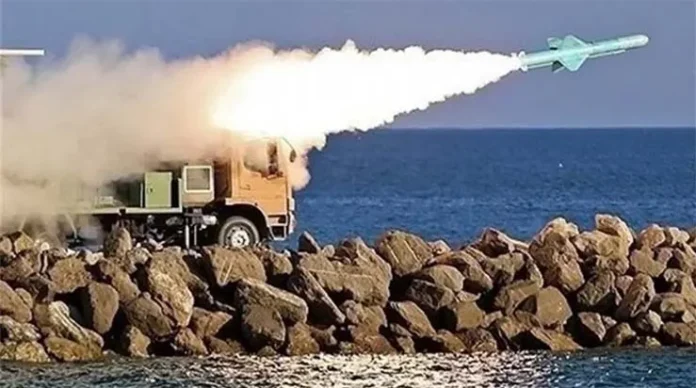
Tel Aviv: Iran is using its proxy in Yemen, the Houthi rebels, to test the efficiency of ballistic missiles against ships. The Houthis in Yemen take advantage of their strategic location and attack vessels in the Red Sea and in the Indian Ocean. By mid-January 2024 (January 18, 2024), they managed to launch a considerable number of missiles – all Iranian made.
In the past, almost all of the world’s precise armaments against ships, were based on cruise missiles; some of them rockets moving horizontally above the surface of the water, usually: subsonic. In the seventies of the last century, Russia (then Soviet Union) used ballistic missiles with several guidance methods to hit ships. These Russian efforts were not continued, but at the same time China chose to focus on them and developed, a number of coastal ballistic missiles with ranges of hundreds to thousands of kilometres. Iran and North Korea followed.

According to recent assessments, it seems that the Iranians chose to use anti-ship ballistic missiles based on three considerations – (i) Diversifying the attack array so that it threatens ships from the zenith – a less protected area. Modern battleship is very limited in its capabilities to deal with the threat of ballistic missile (ii) Penetrating the “hard” and “soft” defences of most battleships is more convenient when flying from above and (iii) the warhead which is more deadly.
The homing method chosen by the Iranians is electro-optical. Initially, based on sensors in the fighting area. In this approach, the ballistic missile is launched towards a point where the naval target is expected to be in the amount of time it will take the missile to get there (3 to 6 minutes). In this part of the trajectory, the missile will move Based on inertial navigation, often also with the help of GNSS updates (GPS and GLONASS).
At an appropriate range from the target, “the attacking missile opens its eye” and from there it is supposed to home in on it using Passive optical (no transmission). Some experts believe that the Iranian choice to use this homing system is due to the lack of mature radar homing technologies. A radar homing head will require certain manoeuvres of the missile.

-The writer is an Israel-based freelance journalist. The views expressed are of the writer and do not necessarily reflect the views of Raksha Anirveda






