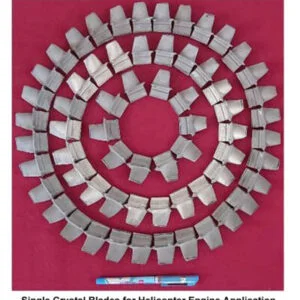
New Delhi. In another boost to government’s indigenous defence production push, Defence Research and Development Organisation (DRDO) has developed single crystal blades technology and supplied 60 of these blades to Hindustan Aeronautics Limited (HAL) as part of their indigenous helicopter development programme for helicopter engine application.

It is part of a program taken up by Defence Metallurgical Research Laboratory (DMRL), a premium laboratory of DRDO, to develop five sets (300 in number) of single crystal high pressure turbine (HPT) blades using a nickel-based super alloy. The supply of remaining four sets (240 in number) will be completed in due course.
Helicopters used in strategic and defence applications need compact and powerful aero-engines for their reliable operation at extreme conditions. To achieve this, state-of-the-art Single Crystal Blades having complex shape and geometry, manufactured out of Nickel based superalloys capable of withstanding high temperatures of operation are used. With this unique development of blades by DRDO, India joins the club of select nations in the world such as USA, UK, France and Russia. Before this, only these countries had the capability to design and manufacture such Single Crystal (SX) components.
The DMRL undertook this task based on its expertise gained during the development of such a technology for an aero-engine project earlier. Complete vacuum investment casting process to realise the blades, including die design, wax pattering, ceramic moulding, actual casting of components non-destructive evaluation (NDE), heat treatment and dimensional measurement, has been established at DMRL.
Special ceramic composition had to be formulated for making strong ceramic moulds which can withstand metallostatic pressure of liquid CMSX-4 alloy at 1500°C and above during casting operation. The challenge of maintaining the required temperature gradient has also been overcome by optimising the casting parameters.

A multi-step vacuum solutionising heat treatment schedule for complex CMSX-4 superalloy to achieve the required microstructure and mechanical properties has also been established. Further to it, a stringent non-destructive evaluation (NDE) methodology for the blades along with the technique for determining their crystallographic orientations has been developed.
Defence Minister Rajnath Singh has congratulated DRDO, HAL and the industry involved in the development of this critical technology.

Secretary Department of Defence R&D and Chairman DRDO Dr G Satheesh Reddy congratulated and appreciated the efforts involved in the indigenous development of this vital technology.