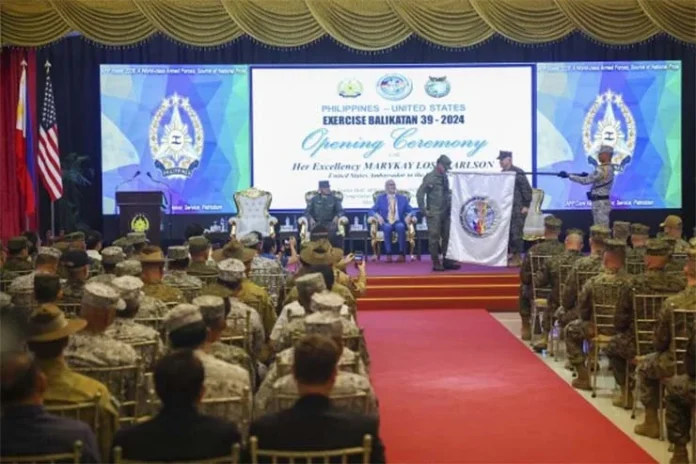
Manila: American and Filipino forces launched their largest combat exercises in years on April 22 in a show of allied firepower near the disputed South China Sea that has alarmed Beijing. The annual exercises by the long-time treaty allies will run until May 10 and involve more than 16,000 of their military personnel, along with more than 250 French and Australian forces.
While the Philippine military maintains that the Balikatan — Tagalog for “shoulder-to-shoulder” — trainings are not directed at a particular country, some of their main conflict scenarios are set in or near the disputed South China Sea, where Chinese and Philippine coast guard and accompanying ships have figured in a series of increasingly tense territorial face-offs since last year.

In encounters in disputed areas, Chinese coast guard vessels have resorted to water cannons, blocking and other dangerous manoeuvres that have caused injuries to Philippine navy personnel and damaged supply boats.
The Philippine military said a key focus of this year’s drills is territorial defence. “We’re dead serious about protecting our territory — that’s why we do these Balikatan exercises,” Col Michael Logico, who speaks for the Philippine military on the combat drills, said.
As the disputes between China and the Philippines have escalated, President Joe Biden and his administration have repeatedly warned that the United States is obligated to defend the Philippines, its oldest treaty ally in Asia, if it is attacked.
US Marine Lt Gen William Jurney said in the ceremony that the large-scale military exercises will demonstrate that the 1951 Mutual Defence Treaty between the US and the Philippines “is no mere piece of paper.”

Washington lays no claim to the contested waters but has declared that freedom of navigation and overflight and the peaceful resolution of the disputes are in its national interest.
Philippine military chief of staff Gen Romeo Brawner, who opened the exercises in a ceremony, said that as Pacific coastal nations, the United States and the Philippines “understand the importance of maritime cooperation in addressing the complex challenges that threaten peace and security in our region.”

China strongly criticised the exercises, saying the Philippines was “ganging up” with countries from outside Asia in an obvious reference to the United States and its security partners, and warned that the drills could instigate confrontation and undermine regional stability.
The combat drills will include a joint sail by the US, Philippine and French navies in and near disputed waters off the western Philippine province of Palawan, the sinking of a mock enemy ship by combined US and Philippine firepower, and the retaking of an occupied island off the north-western Philippines, according to the Philippine military.
China specifically opposed the transport of a US ground-launched missile system to the northern Philippines ahead of the exercises. No missile would be fired but the aim was to build familiarity among military participants with the high-tech weaponry in a tropical setting.
Chinese Foreign Ministry spokesperson Lin Jian expressed China’s grave concern over the deployment of the missile system “at China’s doorstep.” “The US move exacerbates tensions in the region and increases the risk of misjudgement and miscalculation,” he said in response to a question in a news briefing in Beijing last week. “The Philippines needs to think twice about being a cat’s paw for the US at the expense of its security interests and stop sliding down the wrong path.”
The Biden administration has been strengthening an arc of alliances to better counter China, including in a possible confrontation over Taiwan, an island democracy that Beijing claims as its own. That dovetails with efforts by the Philippines under President Ferdinand Marcos Jr. to defend its territorial interests by boosting joint military exercises with the US. He has also allowed rotating batches of American forces to stay in additional Philippine military camps under a 2014 defence pact, including in his country’s north, which lies just a sea border away from Taiwan and southern China.