


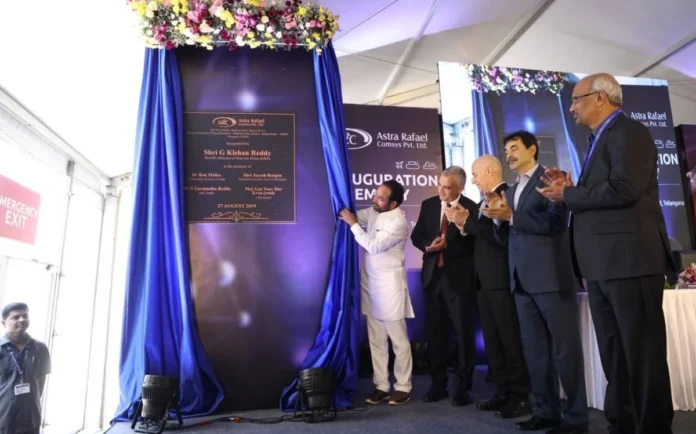
Tel Aviv. The local production, of the Rafael BNET software defined radio selected by Indian Air Force (IAF), in India will begin in October.

The systems will be manufactured by Astra Rafael Communication System (ARC),a joint venture of Israeli company Rafael and an Indian company Astra Microwave.
The facility operates at Hardware Technology Park close to Hyderabad international airport.
The Israeli company will supply 1,000 systems that will be integrated into all the IAF combat aircraft.
The BNET is the main communication system of the Israeli Air Force’s existing and future platforms.
It replaces existing radio systems installed in aircraft and according to the Israeli company while half in size and weight, it offers a very wide communications channel for data.
According to Gideon Weiss, Director of marketing and business development , air and C4I division, the SDR system optimises the spectrum utilisation, while the use of advanced waveforms deliver high speed networking, supporting live video, image transfer, voice and data.

According to Rafael, the BNET communication systems have been selected by the air forces of Brazil and Colombia, and is now competing in other countries.
The senior Rafael official added that the BNET allows the aircraft to achieve a fully networked communication system between airborne platforms and ground naval forces. The system is seamless and it allows the transfer of data including video images in unprecedented rates.

The Israeli system has been selected after a competition with Israel Aerospace Industries (IAI), US company Rockwell Collins and Rhode & Schwartz of Germany.
Rafael says that the use of ad-hoc networking optimises the spectrum utilisation, while the use of advanced waveforms deliver high speed networking, supporting live video, image transfer, voice and data. Reliance on SDR also ensures ‘future-proof’ upgradability and interfacing with legacy systems.
As per Rafael, the system that has been selected is based on a new family of SDR systems developed by the company in recent years.
Rafael began the development of BNET as a ground based network, and later adapted the system for airborne and air-ground applications. The company has transferred considerable elements of the system development and production to India, enabling local partners to share a major part of the programme in the current phase and also benefit from its future spinoffs.
According to Rafael, the efficiency of BNET as an adaptable network means that the airborne communications could provide in the future the basis for advanced terrestrial communications, supporting land-based applications as well.
The writer is an Israel-based freelance journalist

-The writer is an Israel-based freelance journalist. The views expressed are of the writer and do not necessarily reflect the views of Raksha Anirveda





