

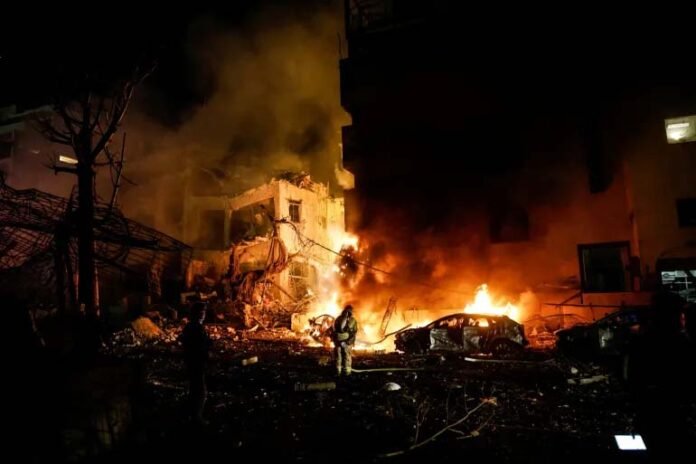
Evolving situation in the Middle East is seriously grim and there is a possibility that the US-Israel versus Iran war, which has intensified, will drag on for days or weeks, taking a huge toll on the region and the world, especially on energy and security fronts. While Iran, after the killing of its supreme leader Ayatollah Ali Khamenei and several other top defence and intelligence officials in a joint US-Israeli air strikes, has retaliated with missiles and drones targeting Saudi Arabia, UAE, Qatar, Bahrain, Oman and Kuwait as they have long-standing security partnership with the US.
From the Israel-American side, planning attacks on Iran for months, it does not appear the duo will take it to the negotiating table to resolve tension with Tehran so soon. Unless Iran accepts demands like complete cessation of its uranium enrichment programme, curbing the number and range of its ballistic missiles and ending its support and links with Hamas, Hezbollah, Houthis and other armed resistance groups in the Middle East region, it does not appear there would be any truce between the two sides.

India’s Challenging Moment
However, the ongoing war has not only brought turbulence in the Middle East, but it has also impacted India hugely on diplomatic, strategic and energy fronts. First, it took place just two-day after Prime Minister Narendra Modi’s visit to Israel, thereby bringing disrepute to New Delhi’s carefully calibrated and consistently maintained policy of diplomatic neutrality in the region.
Second, India has not condemned the killing of Iran’s supreme leader Ayatollah Ali Khamenei; it condoled his death five-day after his killing in a joint US-Israel attack in Iran on February 28. Foreign Secretary Vikram Misri on behalf of Government of India signed the condolence book at the Embassy of Iran in New Delhi.
Third, New Delhi has not spoken against the US or issued any condemnation in the aftermath of unprovoked torpedoing of Iranian warship IRIS Dena, a frigate-class warship, by an American submarine in the Indian Ocean. The Iranian warship with more than 100 naval personnel on board, was returning from Visakhapatnam after participating in International Fleet Review and MILAN 2026, hosted by India in the Bay of Bengal from February 18 to 25.
After killing Ayatollah Ali Khamenei, the US, in particular, thought that regime change could be possible. This objective apparently shifted following the realisation that it would not be an easy task to completely end clerics-Iranian Revolutionary Guards’ grip across all levers of the country
The incident has caused deep resentment in India’s strategic community, yet the country has not officially commented on it. Rather measured statement was issued by Prime Minister Modi who maintained that “Military conflict alone cannot resolve any issue. Whether in Ukraine or West Asia.” The Ministry of External Affairs on the Iranian crisis said, “We have urged all sides to exercise restraint, avoid escalation, and prioritise the safety of civilians.”

Iran War May Prolong
On February 28, the US and Israel launched joint strikes on Iran with an aim to bring a regime change in the country. After killing Ayatollah Ali Khamenei, the US, in particular, thought that regime change could be possible. This objective apparently shifted following the realisation that it would not be an easy task to completely end clerics-Iranian Revolutionary Guards’ grip across all levers of the country. Then Iran has reportedly elected Mojtaba Khamenei, the son of Iran’s deceased leader Ayatollah Ali Khamenei as the new supreme leader, signalling categorically that Tehran can be destroyed but cannot be easily defeated.
This truth has been realised as General Dan Caine, Chair of the US Joint Chiefs of Staff said the US’s military goals in Iran “will be difficult to achieve, and in some cases, will be difficult and gritty work.” He warned that America could see more casualties as the war drags on. So far, the US has lost six military personnel and several F-15 jets in retaliatory attacks by Iran, which have targeted Kuwait, the UAE, Saudi Arabia, Bahrain and Oman—all American allies in the Middle East region.

Despite losing its supreme leaders and top military commanders in war with Israel and the US, Iran has made it clear that it alone will determine when and how the confrontation ends. This signals Tehran’s readiness for a prolonged military campaign without showing visible signs of attenuation
Despite losing its supreme leaders and top military commanders in war with Israel and the US, Iran has made it clear that it alone will determine when and how the confrontation ends. This signals Tehran’s readiness for a prolonged military campaign without showing visible signs of attenuation.
Maintaining one of the largest standing militaries in the Middle East, Iran has around 610,000 active military personnel and over 350,000 reservists, supported by additional paramilitary units. Additionally, Iran possesses between 1,700 and 2,000 tanks, tens of thousands of armoured vehicles and more than 1,500 mobile rocket launchers.
In terms of fighter jets, Iran operates only a few aircraft and fewer specialised platforms. But it has a huge stockpile of drones and missiles, including cruise, ballistic and hypersonic missiles. The longest-range Iranian ballistic missiles such as Ghadr, Sejjil and Soumar can travel between 2,000 km and 2,500 km.
This means they can strike Israel and US-linked interests located in the Gulf countries and far beyond the region. Taken together, these stockpiles of missiles and drones, backed by huge military manpower, strengthen Tehran’s ability to withstand the combined military might of the US and Israel rather than surrender easily. This resolve is reflected in the launch of multiple strikes targeting Israel, Iraq and the Gulf countries.
Disruptions in Energy Supplies
Iran’s wide-spread retaliation has resulted in chaos with Qatar halting production of liquified natural gas and Saudi Arabia shutting Ras Tanura refinery, Oslo-listed DNO and Dubai listed Dana Gas bringing shutter down on oil and gas production at their fields in the Kurdistan region of Iraq. Yet what has triggered concern in oil dependent countries like India is Iran’s decision to choke the Strait of Hormuz, a strategic route for global oil shipping.
Rattled by the development in the Middle East, Prime Minister Narendra Modi chaired a meeting of the Cabinet Committee on Security at his official residence and reviewed the security situation in the region, including military escalation, airspace closures, and potential strategic and economic impacts on India
It accounts for passage of 20% fuel from the region to the international market. Tehran has threatened to burn any ship trying to pass through this 32-km wide seaway between Iran and Oman. Around 50% of India’s oil imports and 60% of its LNG purchases come through the Strait of Hormuz.
Rattled by the development in the Middle East, Prime Minister Narendra Modi chaired a meeting of the Cabinet Committee on Security at his official residence and reviewed the security situation in the region, including military escalation, airspace closures, and potential strategic and economic impacts on India.
As per reports, at the CCS meeting, risks from Iran’s closure of the Strait of Hormuz were also discussed. India has a stock of 50 days of crude oil. “The country is well stocked with crude oil and inventories of key petroleum products, including petrol, diesel and ATF (Automatic Transmission Fluid), to deal with short-term disruptions arising from the Middle East,” Minister of Petroleum and Natural Gas Hardeep Singh Puri said.
However, given that the ongoing war in the Middle East is not going to end very soon, India will be exposed to disruptions in crude oil supplies and as a result, its economy could suffer significant consequences. Already, Brent crude oil prices in the international market have started jumping and there is a fear that they may go beyond $100 a barrel. If it happens, India’s drive to become a third economic power by 2028 will lose its steam, if not completely shattered.
Yet what is particularly worrying for India is the prospect of evacuating its 9.5 million nationals from the Gulf region if the US-Israel war against Iran spirals out of control. This possibility is very much high as both sides are in no mood to relax and give dialogue a chance to resolve their concerns and disputes
But then, there are options for sourcing energy from other international spots, including Russia. Media has already started speculating that India may turn towards Russia to offset supply volatility. Yet it should not be forgotten that India’s reduced dependence on Russia for oil was the key condition to the trade deal with the US under President Trump.
This year in January, Russia’s share in India’s oil imports fell to less than 20% – first time since May 2022. Any effort to increase oil purchases from Russia would lead to diplomatic strain with the US. However, if the Iran-led blockade of the Strait of Hormuz is not removed and supplies of oil and gas from the Gulf region remain disrupted for weeks and months, India will have to increase oil imports from Russia and other alternative suppliers like West Africa, Latin America and the US. That means India has options.
Summing Up
Yet what is particularly worrying for India is the prospect of evacuating its 9.5 million nationals from the Gulf region if the US-Israel war against Iran spirals out of control. This possibility is very much high as both sides are in no mood to relax and give dialogue a chance to resolve their concerns and disputes. Instead, the war is intensifying with each passing day, triggering cascading consequences not only for the region but also beyond it.

–The writer is a senior journalist with wide experience in covering international affairs. The views expressed are of the writer and do not necessarily reflect the views of Raksha Anirveda
