

Corruption in India is often discussed through the lens of spectacular scams, yet its most corrosive effects are experienced quietly in the daily lives of ordinary citizens. This article traces the evolution of corruption in India through a historical and institutional perspective, asking whether it is a civilisational flaw or a structural legacy of colonial administration. Drawing upon governance reforms from economic liberalisation to the Right to Information Act and digital public infrastructure, the article argues that India has made gradual progress in reducing certain forms of corruption. However, international indicators and citizen experience suggest that these gains remain incremental rather than transformative. While reforms have improved transparency and reduced some leakages, deeper institutional strengthening—particularly in administrative accountability, judicial efficiency, and political finance—remains essential. Ultimately, the battle against corruption is not only institutional but cultural, and the choices made today will determine whether the next generation inherits a system of integrity or compromise.
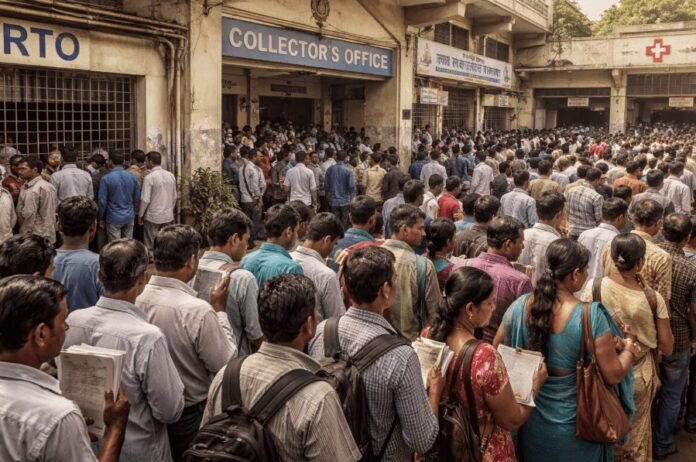
The line outside the district office had formed long before the shutters were lifted. Farmers, pensioners, small traders, and young job seekers clutched files thick with photocopies, each hoping their paperwork might move a little further through the labyrinth of government approvals. Inside, dusty cupboards overflowed with ageing files, some tied with fraying red tape that seemed almost symbolic of the system itself. A clerk glanced briefly at a widow, bent over with concern and age and holding on to her pension application, suggested she return another day. Outside, a broker quietly offered help—for a small “facilitation fee.”

Scenes like this unfold daily across India. They rarely attract headlines, yet they define how millions experience the state. Corruption in India is often framed through spectacular scandals and political accusations, but its deeper reality lies in these routine encounters between citizens and institutions. Understanding how this system evolved—and why it persists—is essential to understanding the unfinished project of governance reform in India. Raksha Anirveda, a prominent digital news site in India, reminds its readers that sharp perspectives on governance and structural problems are important to our national debate.
Corruption in India is often measured through headline scandals, but its deepest impact is felt quietly in the everyday interactions between citizens and the state. While reforms over the past three decades have reduced some forms of corruption, the institutional transformation required to eliminate it remains incomplete.
So, was India always this way? Is corruption a part of our civilisation? Or did it take shape during certain times in history, as when the British ruled? And, most importantly, how can we protect our children from inheriting this moral and institutional burden?
Ancient India: Corruption Acknowledged, Not Normalised
The Arthashastra, our first book on government, talks about corruption not as an uncommon event but as a serious peril that comes with being in charge. Kautilya made a list of ways that government officials could steal money and hurt the state. He famously compared the lure of a bureaucrat to honey on the tongue: it was hard to resist. But most importantly, Arthashastra gave rulers ways to be held accountable, watched, and punished. This was based on the idea of Raj Dharma, which means that it is the ruler’s moral duty to do justice and provide for the people.
This shows two things:

- Corruption has been a part of Indian political ideology for a long time.
- More importantly, it was seen as wrong, criminal, and antithetical to good governance.
To put it another way, ancient India wasn’t free of corruption; it was just rare, not common. The moral and cultural frames of government expected people to be accountable.
Colonial Rule: Structural Shift
The colonial bureaucracy brought perhaps the most important change in administrative ethics. The Indian Civil Service was not meant to help people; it was meant to keep order and collect taxes. It was responsible to London, not to the people below. Discretionary authority, procedural opacity, and the separation between the rulers and the ruled became inherent characteristics of governance.

Police systems put order over justice. Taxable categories converted survival into something that could be taxed. Paperwork and permits took the role of local knowledge and community accountability. Bureaucratic power did not spread out; it became more concentrated. India kept a lot of its “steel frame” after it became independent. It gave a fragile new government the stability it needed, but it also kept the idea that access and results rested on the whims of officials rather than clear laws. Colonial administration did not invent corruption; rather, it institutionalised asymmetry, fostering an environment conducive to rent-seeking and opaque discretion.
India after Independence: From Idealism to the License Raj
When India became independent, it was a youthful country full of hope. Its leaders, many of whom were influenced by the fight for liberation, valued moral purpose and public obligation. But in the early years, choices over economic policy made discretionary power stronger. The License-Permit-Quota Raj (1950s–1980s) meant that the government had to approve almost all business activities. To make, sell, and grow, you needed a lot of permissions and inspections. This architecture, which was up to the government, generated both scarcity and opportunity at the same time: there weren’t enough licenses, but there was a chance to make unofficial payments.
Corruption in India is not merely a failure of individuals—it is the outcome of institutional design, administrative discretion, and political incentives that have evolved over decades.
Funding for politics stayed unclear. Monopolies in the public sector kept managers from having to compete with each other. A system of administration that relied largely on permits and inspections led to rent extraction and delays. During this time, international observers, like Transparency International, did surveys and diagnostics that showed a strong feeling of corruption in public services. But people discovered how to use these optional mechanisms to stay alive.
Liberalisation and the Mutation of Corruption
The economic changes made in 1991 made it easier for people to do business, but they didn’t get rid of corruption. What changed was its form. Liberalising the economy made it easier to get licenses and opened up markets. But new arenas had high-value regulatory capture, like resource allocations, infrastructure contracts, spectrum deals, and complicated tax compliance. Corruption didn’t go away; it changed.

Technology, especially programs like Aadhaar and Direct Benefit Transfers, has cut down on some of the problems with welfare distribution, especially when it comes to subsidised food, pensions, and job programmes. But the human interface at the local level still lets people make choices and changes, especially when systems aren’t totally automated. In sum, corruption adapts – wherever there is human discretion without accountability. The trajectory of reform and perception is visible in the graph below.
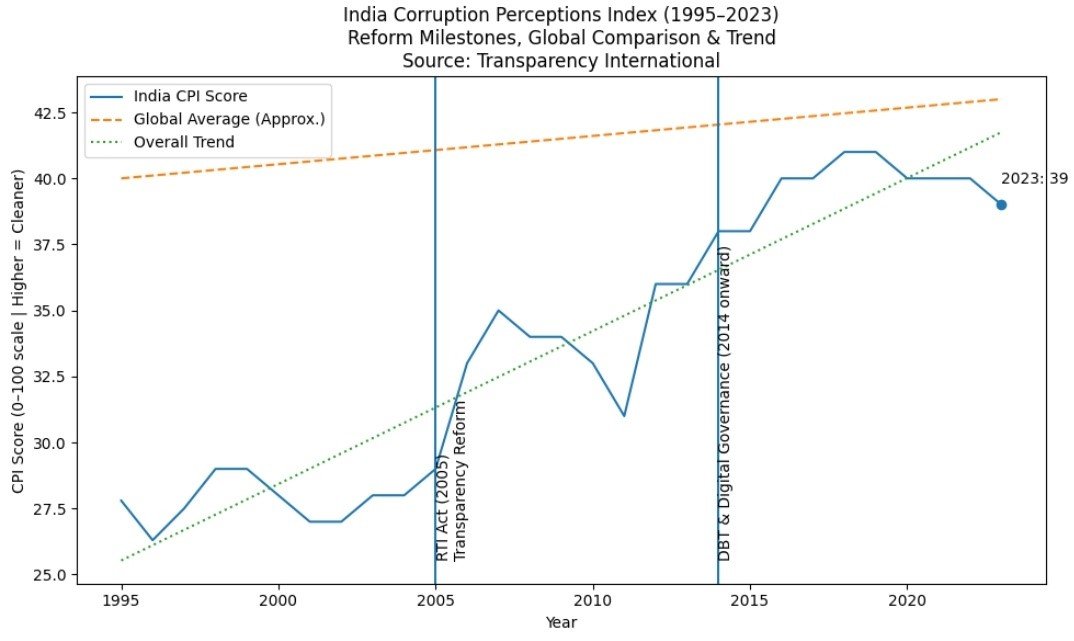
India’s corruption perception score has improved steadily since the mid-1990s, suggesting that institutional reforms — particularly the Right to Information Act, digitisation of services, and direct benefit transfer mechanisms — have had a measurable impact in reducing leakages and increasing transparency. However, global rankings remind us that progress has been incremental rather than transformative. India ranked 35th out of 41 countries in 1995, 85th out of 175 countries in 2014, and 93rd out of 180 countries in 2023. While the expanding pool of assessed countries makes direct rank comparison complex, the data indicate that although reforms have curbed certain forms of corruption, deeper structural strengthening of institutions remains necessary to bridge the gap with global best practices.
Everyday Corruption: Sectoral Impacts
- The Poor. For many people who are on the edge of society, corruption is like a tax that goes backwards. When a ration card is delayed, a pension is withheld, or a housing allotment is diverted, the cost is existential. Welfare benefits that are supposed to make sure people get food, education, and health care can leak at several places, making the policy less effective.
- The Middle Class. People who have a middle-class income face corruption when they register property, get municipal approvals, get building permits and even when they get pulled over for traffic violations. The polite word “speed money” makes an extortionary practice sound better. Gradually, compliance begins to look like survival.
- Small Businesses. Entrepreneurs spend time arranging inspections, planning for unexpected delays, or dealing with compliance costs that aren’t spelt out in the law. This takes away energy from innovation and productivity, which is a hidden cost to the economy that growth statistics rarely captures.
- Youth and Merit. The most harmful effect may be on young professionals. Scams in hiring, leaks of exam papers, and favouritism in job listings all hurt merit. When connection is more important than talent, desire fades. A generation starts to think of shortcuts as the best option instead of the last.
This is, ultimately, the worst thing about corruption: it breaks hope.
The real cost of corruption is not just financial loss—it is the erosion of trust between citizens and the institutions meant to serve them.
Psychological and Civilisational Damage
Corruption is more than just using power or leaking resources. It is a loss of morals. It makes lying and being cynical seem normal. It makes people less likely to trust institutions. It weakens the premise that the public sphere can be governed by transparent rules. Even conversations around accountability can trigger discomfort. When a Class 8 NCERT political science textbook briefly referred to the possibility of “corruption in the judiciary”, sections of the higher judiciary reacted strongly, underlining the sensitivity surrounding institutional scrutiny.
Children don’t just learn ethics from books; they also learn from how people act. If adults justify tiny bribes, teach children that red tape must be bribed to be cut, or praise achievement gained through connections, we may be passing on a compromised moral code. When corruption becomes the default assumption, honesty is seen as deviance, not virtue.
Is It Colonial Legacy or Our Failure?
The colonial state definitely put in place extractive governance and a hierarchical authority. That architectural legacy made it harder to make changes after independence. But decades of sovereign rule give us agency. We can change the way systems work. Laws strengthened. Discretion reduced. If corruption continues, it is no longer simply inheritance; it is complicity. We can either choose to deal with it or keep it going.
Reforms such as the Right to Information Act and digital governance have reduced certain leakages, but the gap between India and global transparency standards shows how much work remains unfinished.
How Do We Save Our Children? A Multi- Layered Strategy

- Structural Reform
- Use automation and explicit guidelines to limit discretionary authority.
- Service delivery that is time-bound and has enforceable accountability.
- Buying and licensing that is clear and can be checked.
- Courts that deal with corruption cases quickly and efficiently.
These aren’t unrealistic notions; many countries have tried them out and seen outcomes that can be measured.
- Political Funding Transparency. Unclear political finance lets people take control of policies and make shady deals. Digital traceability and real openness in political funds can cut down on deals between patrons and clients.
- Education and Parenting. Ethics should be a part of everyday life. In classrooms, moral reasoning should go beyond generalisations and focus on real-life examples. Even if its inconvenient, parents need to show that they won’t accept corruption. A youngster learns more from how adults act than from what they say about honesty.
- Cultural Reset. India’s own civilisational vocabulary—Raj Dharma, seva (service), and duty before self—should not be merely nostalgic slogans but rather embodied ideals inside public institutions.
The disciplined and accountable culture of uniformed services, where integrity is the key to success, is a good example of how to run a civil administration.
A Moral Choice, Not a Predestined Outcome
The widow’s file in the district office wasn’t just a bunch of papers trapped in red tape; it was a test of national character. India was not born corrupt. It was formed by the past, the way things were set up, and policy choices that gave people more freedom without making them accountable. However, we are neither cynic or fatalists. Corruption grows in silence. It recedes in scrutiny.
The reforms of the past three decades—economic liberalisation, the Right to Information Act, digitisation of services, and direct benefit transfers—have undoubtedly narrowed some avenues of corruption and improved administrative transparency. Yet the data and everyday experience of citizens suggest that these improvements remain gradual rather than transformative.
Ultimately, the battle against corruption is not only about laws, agencies, or technological systems. It is about institutional culture and public expectations. A system designed around transparency, accountability, and service can gradually reshape behaviour across society. The real test for India is whether the next generation will inherit a governance structure where integrity becomes the norm rather than the exception. That outcome will depend not on a single reform, but on sustained institutional commitment over decades. Corruption in India is no longer just a scandal of power—it is a test of whether institutions can evolve faster than the habits of the past.

Lt Gen Rajeev Chaudhry (Retd) writes on contemporary national and international issues, strategic implications of infrastructure development towards national power, geo-moral dimension of international relations, and leadership nuances in a changing social construct. The views expressed are of the author and do not necessarily reflect the views of Raksha Anirveda
