

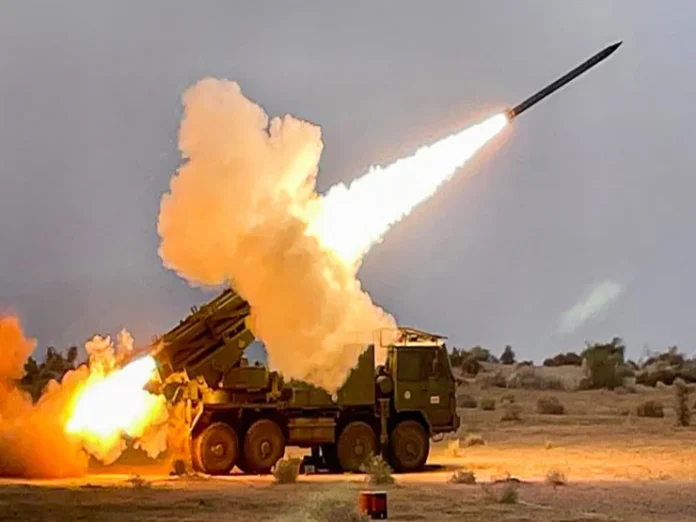
As part of efforts to further strengthen its long-range artillery capabilities post Operation Sindoor, the Indian Army is looking to induct 120 km strike range Pinaka rockets in a proposal worth around Rs 2500 crore
The Pinaka rockets with the capability to strike targets at 120 kilometres would be developed by the Defence Research and Development Organisation (DRDO), and the first trials are planned to be carried out in the near future, and then it would be developed with the Development-cum-Production Partners who would be chosen after a bidding process, defence officials told ANI.

The Army’s proposal for approval for the project is set to be taken up for clearance by the Defence Acquisition Council (DAC) very soon, sources said. The proposal will mark a major leap in indigenous battlefield strike capability.
The proposal, estimated to be worth over ₹2,500 crore, aims to enhance the Army’s deep-strike precision and long-range deterrence as part of the ongoing post-Operation Sindoor capability enhancement drive.
The proposed advanced rockets are expected to significantly upgrade the operational envelope of the Pinaka multi-barrel rocket launcher system, reinforcing India’s focus on self-reliance in defence manufacturing under the Aatmanirbhar Bharat initiative.
The Pinaka Multi-Barrel Rocket Launcher System (MBRL) is one of India’s most successful indigenous artillery platforms, developed as a result of the first public-private partnership in Defence systems, between DRDO and TATA Advanced systems Ltd (TASL), which developed the precision digital Pinaka Rocket Launcher over a period of 20 years (conceptualisation to deployment by user).

So far TASL has already supplied 40 Pinaka Launchers and 8 Command Posts & supply of another Pinaka 36 Launchers are in the pipeline. These indigenous Rocket Launchers have been designed around critical subsystems which themselves have been designed and developed in the country (such as Servo System and Fire Control system).
Pinaka Multi Barrel Rocket Launcher (MBRL) is battle-proven all-weather, indirect area fire artillery weapon system designed by TASL. Its mission is to deliver a large volume of fire within a very short time against critical and sensitive area targets. The quick response and relatively high pointing accuracy of the Launcher enables it to deliver a large volume of fire against critical and time-sensitive enemy targets, within a very short time.

The Launcher System is supported on four hydraulically actuated outriggers at the time of firing. The cradle, a platform for clamping the pods, is pivoted to the revolving base and has two pods mounted side by side. Each pod contains six launcher tubes, for loading the rockets, stacked in a 2X3 matrix.
The Man Machine Interface is housed inside vehicle cabin. It is possible to operate the Launcher by linking it with a Fire Control Computer (FCC) or by Launcher Computer (LC) or Manually. The initialisation of the Launcher is done by an Automatic Gun Alignment and Pointing System (AGAPS) or by a Dial Sight.
Originally designed to deliver rapid, high-volume firepower, the system has evolved steadily over the years with increasing range, accuracy, and lethality.
Currently, Pinaka systems in service are capable of firing rockets with ranges of 40 km and 75 km, both of which have been extensively tested and inducted into the Indian Army. The move toward a 120-km guided version represents the next logical step in extending India’s standoff strike capabilities while maintaining high precision.
The DRDO is currently in advanced stages of development of the 120-km strike version of the Pinaka rocket. Defence officials have indicated that the first test trials are expected to be conducted in the next financial year, after which the system will move toward validation and production.
The extended-range version will incorporate: Improved rocket motor technology, Advanced navigation and guidance systems, and Enhanced accuracy and reduced circular error probable (CEP).
These upgrades are aimed at ensuring high-precision strikes against enemy targets located deep inside hostile territory.
With the ability to engage targets far beyond traditional frontlines, the system will enable deep precision strikes, reduce reliance on air power for certain target sets, enhance deterrence along sensitive borders, and provide rapid response options during high-intensity conflicts
The new rockets can be launched from the same Pinaka launcher platforms already deployed, ensuring cost-effectiveness and logistical simplicity. The Indian Army has already taken multiple steps to strengthen its existing Pinaka regiments.
Recently, the Ministry of Defence signed contracts with Economic Explosive Limited (EEL) and Munitions India Limited (MIL) for the procurement of: Area Denial Munition (ADM) Type and High Explosive Pre-Fragmented (HEPF) Mk-I (Enhanced) rockets
These contracts, collectively valued at ₹10,147 crore, support the operational readiness of Pinaka units and underline the system’s importance in India’s artillery arsenal.
In addition to ammunition procurement, a separate contract has been signed with Bharat Electronics Limited (BEL) for software and system upgrades to the SHAKTI fire control software, which enhances accuracy, responsiveness, and network-centric operations of the Pinaka system.

