
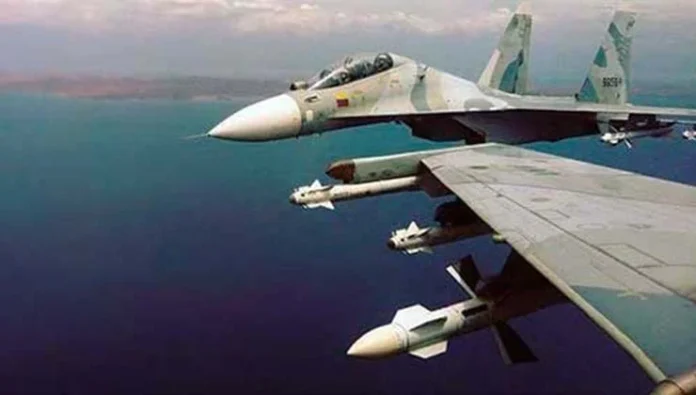
New Delhi: With the Indian Air Force operating an impressive assembly of aircraft, which serve as vital components in the augmentation of the country’s aerial defence system and integral to these is the R-73E missile, a short-range air-to-air missile of substantial strategic importance. Considering India’s increasing focus on the Aatmanirbhar (self-reliance) policy, the need for domestic manufacturing of these missiles is being recognised.
The approach under consideration to realise this objective involves the production of the R-73E missiles under the “Make III” methodology, as stated in Chapter III of the Defence Acquisition Procedure 2020 (DAP 2020).

Widely hailed for its superior performance, the R-73E missile constitutes a critical element of India’s air defence blueprint. Conceived and produced by the Russian Tactical Missiles Corporation, this compact air-to-air missile boasts a range of 30 kilometres, with its most recent variant – the RVV-MD – extending this radius to 40 kilometres.
R-73E is a versatile missile that finds application in an array of unique aircraft, ranging from fighter jets, and bombers to attack aircraft. It is noted for exceptional agility, courtesy of an innovative gas/aerodynamic control system enabling thrust vectoring. Such advancements empower the missile to engage targets within off-boresight angles of ± 45 at line-of-sight rates reaching up to 60 degrees.
Not to be understated are the remarkable operational capabilities of the R-73E missile, possessing the capacity to intercept targets moving at blistering speeds reaching 2,500 kilometres per hour and at varying altitudes between 0.02 to 20 kilometres. The missile’s maximum flight range extends to 30 kilometres, adding to its adaptability in air combat.
Inspecting real-world scenarios, the R-73 missile’s worth was well-proved during the tumultuous episodes of 2019. Then Wing Commander Abhinandan Varthamanam, after enduring nearly 60 hours of Pakistan’s captive state, reached Indian soil.

Commanding a MiG-21 ‘Bison’, Wing Commander Varthamanam brought down a Pakistani F-16 combat aircraft using a short-range R-73 missile amidst an intense aerial duel. He ventured past the Line of Control (LoC) to deter Pakistani jets attempting to encroach upon Indian airspace. In the ensuing skirmish, his MiG-21 was hit and he was subsequently captured by the Pakistani military. The successful engagement with an adversary aircraft using the R-73 missile highlighted both the missile’s robust capacity and the valour and finesse of the Indian Air Force pilots.
The proposal to internally produce R-73E missiles aligning with the Aatmanirbhar policy lights the path towards self-dependency in missile construction. This initiative not only fortifies India’s air defence arsenal but also resonates with the Aatmanirbhar Bharat’s ethos of reduction in foreign dependence.