


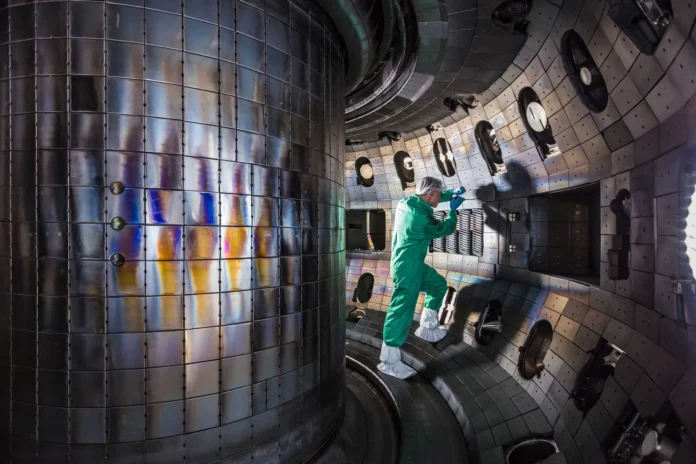
San Diego, May 18, 2018 – One of the most flexible and highly instrumented fusion research reactors in the world is undergoing major enhancements that will pave the way to future fusion power plants.

The DIII-D National Fusion Facility, operated by General Atomics for the Department of Energy, is the largest magnetic fusion experiment in the U.S. This week marks the start of a series of enhancements to DIII-D that will make it possible to commence new studies of the physics of future fusion reactors. That will help scientists understand how to achieve high fusion power in the ITER device now under construction in France, and how to sustain such regimes indefinitely in the fusion power plants that will follow ITER.
The planned year-long activity will enhance DIII-D systems by adding increased and redirected particle beams and radio frequency systems to drive current and sustain the plasma in a so-called “steady state.” The improvements will also expand capabilities with the installation of new microwave systems to explore burning-plasma-like conditions with high electron temperatures. This will allow researchers to explore how to achieve higher pressure and temperatures while increasing control of the plasma, conditions critical to sustained fusion operation.
“In our recent campaigns, DIII-D has pioneered many of the key techniques for ITER, controlling plasma instabilities and developing startup and quenching of fusion plasmas,” said Richard Buttery, DIII-D experimental science director. “These new capabilities will give us the flexibility to optimize performance for the reactor scale, and develop the basis for sustained fusion for commercial power.”
-Richard Buttery, DIII-D Experimental Science Director.
ITER is one of the most ambitious energy projects in the world, and will demonstrate the feasibility of fusion power at a reactor scale. The facility will create a self-heated burning plasma that produces ten times the energy required to heat it, and hold it for 400 seconds. Like DIII-D, it is a “tokamak” – a donut-shaped magnetic field that holds the hot plasma at over 100 million degrees, causing the atoms to fuse and release energy. The new capabilities at DIII-D will help the U.S. play a leading role in ITER and map the path to future fusion power plants to establish fusion as a viable and plentiful form of energy.

In this first extended opening of DIII-D in more than five years, technicians will open the vacuum chamber to install three major systems. An off-axis neutral particle beam will allow researchers to control the location and direction of high-energy atoms injected into the plasma. New microwave systems will significantly increase electron heating power. And a new ultra-high frequency “helicon” radio wave antenna will provide high-power tests of a promising reactor technology for efficient sustained current.
Together, these developments will deliver unprecedented flexibility to discover and explore solutions for future fusion reactors. The facility enhancements are expected to enable very high-pressure plasmas, in which the plasma current needed to sustain fusion performance becomes driven by the plasma itself – known as the “bootstrap” effect – which has the potential to help sustain the plasma indefinitely. DIII-D will resolve how to achieve such self-sustaining configurations.

-David Hill, DIII-D director.
“The knowledge gained during the next phase of operations will be critical for developing the next step for the U.S. fusion programme, and for our international collaborators,” said David Hill, DIII-D director. “The path toward commercial fusion will require construction of a device that can take advantage of the sustained plasmas that we will be investigating at DIII-D.”
While the facility enhancements are being implemented, researchers at DIII-D – which draws hundreds of collaborators from more than 100 institutions worldwide – will be busy analyzing data from recent operations, looking for new breakthroughs that have applicability for ITER and other advanced fusion concepts.