
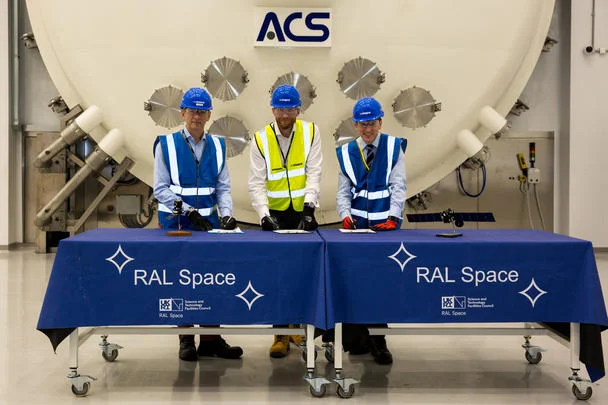
Stevenage. Airbus has selected the National Satellite Test Facility (NSTF) at Harwell in Oxfordshire to carry out the comprehensive test campaign on the UK Ministry of Defence’s next generation secure communications satellite SKYNET 6A.

The £116 million government-funded NSTF, operated by experts from the STFC RAL Space (Science and Technology Facilities Council), will carry out the SKYNET 6A test campaign, including electromagnetic compatibility, as well as acoustic and thermal vacuum testing, to replicate the harsh conditions of space.
Richard Franklin, Managing Director of Airbus Defence and Space UK, said: “SKYNET 6A is designed and manufactured at our Stevenage and Portsmouth sites and will undergo its entire testing campaign at the new National Satellite Test Facility. It is fitting that the facility’s first testing contract is for Britain’s’ next generation SKYNET 6A, which will provide critical, secure-communications capability for our armed forces and will help further extend the UK’s space ecosystem and capability.”
Ian Annett, Deputy CEO at the UK Space Agency, said: “The National Satellite Test Facility is a significant addition to the UK’s growing space infrastructure that will improve the support available for companies across the breadth of the UK space industry, which employ thousands of people across the country. The brand new facility, the first customer of which will be Airbus Defence and Space, will also help attract new businesses of all shapes and sizes to Harwell and the UK. This will catalyse investment and accelerate the development of new technologies for decades to come – from advanced satellite manufacturing to secure communications, navigation and Earth observation.”
SKYNET 6A will be the first SKYNET milsatcom satellite to be entirely designed, built and tested in the UK. The programme involves a 500-strong team at Airbus and is being supported by more than 45 SMEs across the UK. This geostationary telecommunications satellite will provide secure communications services for the UK’s armed forces around the world following its launch in 2025.