

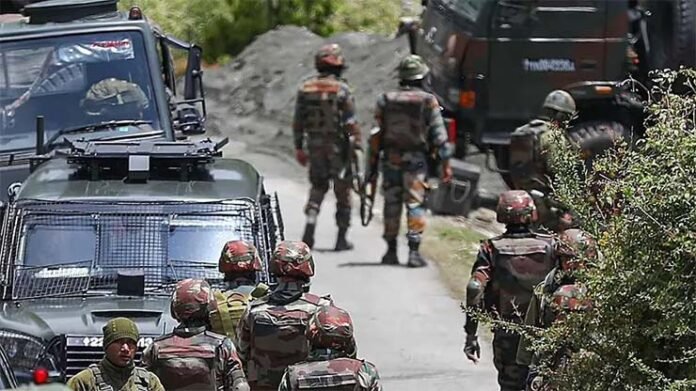
New Delhi: During the “Eastern Prahar” tri-service exercise (November 10 to 18, 2024), India’s strategic readiness along its northeastern border will be on full display. The exercise which commenced on November 10, led by the Indian Army, aims to strengthen the interoperability and synergy between the three branches of the military.
Focusing on executing integrated operations against a fictional enemy, requiring real-time coordination between land, air, and sea assets – the tri-service exercise will see integrated operations across the Army, Navy, and Air Force, honing their coordination in the challenging mountainous terrain of the region. The purpose of the exercise is to ensure that India’s armed forces remain operationally prepared for any eventualities in the eastern sector, a region that has been a focal point of border tensions, particularly with China. Troops will simulate joint operations, refining tactics and communication systems to enable seamless cooperation in high-altitude, difficult terrains.

A wide array of modern military platforms will be involved, showcasing India’s advanced capabilities, according to sources in the defence and security establishment. The Indian Army will bring its Special Forces, Infantry, M777 Ultra-Light Howitzer artillery systems, UAVs, and helicopters from Army Aviation, including advanced platforms like the Chinook heavy-lift helicopter and Dhruv Advanced Light Helicopters. These forces will coordinate with the Indian Air Force’s fighter jets, including Sukhoi and Rafale, as well as reconnaissance aircraft, helicopters, and transport planes. The Indian Navy will also contribute by deploying its long-range reconnaissance aircraft, the P8i.
The integration of modern warfare technologies is one of the defining features of this exercise. Swarm drones, First-Person View (FPV) drones, and loitering munitions will be utilised to enhance situational awareness, precision targeting, and speed of operations. These technological advancements have transformed modern military strategy by improving operational efficiency and effectiveness. AI-driven analytics and satellite communication systems will further enhance the coordination between the three services, creating a more accurate and shared operational picture.
As India looks to maintain an edge in modern warfare, the exercise will also focus on refining joint control structures – a critical approach, which will allow for better communication and quicker decision-making in the heat of battle. One of the key highlights of Eastern Prahar is the emphasis on rapid troop deployment and mobility, a crucial factor in high-altitude operations. The exercise will simulate real-world combat scenarios, where Indian special forces and commandos are deployed swiftly via air from northeastern airbases to forward positions near the LAC. Using helicopters, forces will execute trans-valley troop movements, which will be followed by a simulated final assault.
During the exercise, Indian Air Force’s ability to respond quickly to dynamic situations, such as transporting injured personnel and landing troops in combat zones with minimal delay will be tested. By deploying both tactical transport aircraft like the C-130J Super Hercules and heavy-lift helicopters, the exercise will demonstrate India’s capability to rapidly mobilise forces in the event of an emergency.

Currently, tensions remain high along India’s northeastern border, particularly in regions like Arunachal Pradesh, where China has laid territorial claims. As the Indian military remains vigilant and prepared for any escalation, the timing of Eastern Prahar is significant as it serves as a clear signal of India’s commitment to maintaining a strong defence posture in the eastern sector. The exercise not only enhances Indian Armed Forces operational readiness but also strengthens the deterrent effect, reassuring that India is prepared for any contingencies along the LAC.

Raksha Anirveda's editorial desk team brings in the collective experience of creative professionals - a fine mix of senior copy editors, writers, proofreaders and designers. Working as a team, they continuously create, manage, and curate content to sustain the magazine's profile and reputation in line with market trends and achieve magazine's goal.

