

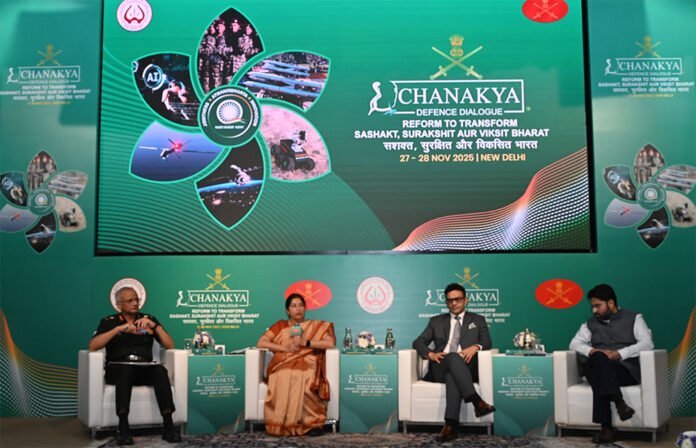
The Indian Army, in partnership with the Centre for Land Warfare Studies (CLAWS), on Monday 17 November, held the Curtain Raiser for the Chanakya Defence Dialogue 2025 (CDD-2025) at the Manekshaw Centre in New Delhi.
Based on the theme ‘Reform to Transform: Sashakt, Surakshit aur Viksit Bharat’, the dialogue is being organised by the Indian Army, in collaboration with the Centre for Land Warfare Studies (CLAWS), on November 27-28 in the national capital.

During the ‘Fireside Chat’ at the event, Chief of the Army Staff (COAS), General Upendra Dwivedi, highlighted the linkage between national development and national security, noting that the aspirations of Viksit Bharat @2047 require sustained stability and a secure environment.
COAS also referred to the Ministry of Defence’s declaration of 2025 as the Year of Reforms, adding that security and development “must move in tandem.”
Referring to the recent Operation Sindoor, General Dwivedi reiterated India’s uncompromising stance against terrorism. “Blood and water cannot flow together,” he said, stressing that accountability was essential for those aiding terrorist activities. He noted that the operation underscored India’s firm and proactive approach to safeguarding national interests and contributing to regional stability.
Addressing the gathering, Rajiv Chandrasekhar, Former Minister of State for Electronics and Information Technology and Skill Development and Entrepreneurship, emphasised the strategic link between technological capability and national security, highlighting the importance of trusted, indigenous digital and emerging-technology ecosystems in strengthening India’s long-term self-reliance.

Later, a panel discussion chaired by Lieutenant General Rahul R Singh, Deputy Chief of the Army Staff (Capability Development & Sustenance), brought together experts from DRDO, the defence industry and academia.
Deliberations focused on Aatmanirbharta as a pathway to strategic autonomy, emphasising indigenous design, development, and innovation; strengthening dual-use technologies; ecosystem integration between DRDO, private sector and academia; reforms in procurement processes; and the role of MSMEs and Defence Industrial Corridors in building competitive and export-capable clusters.

Discussions also highlighted the need for resilient supply chains, reduced external dependencies and accelerated development of India’s deep-tech ecosystem to address future operational requirements.
CDD-2025 will bring together national and international experts to deliberate on defence reforms, technological transformation, civil-military integration, and India’s emerging security priorities in the run-up to Viksit Bharat @2047.

