

How important is the Strait of Hormuz for India?
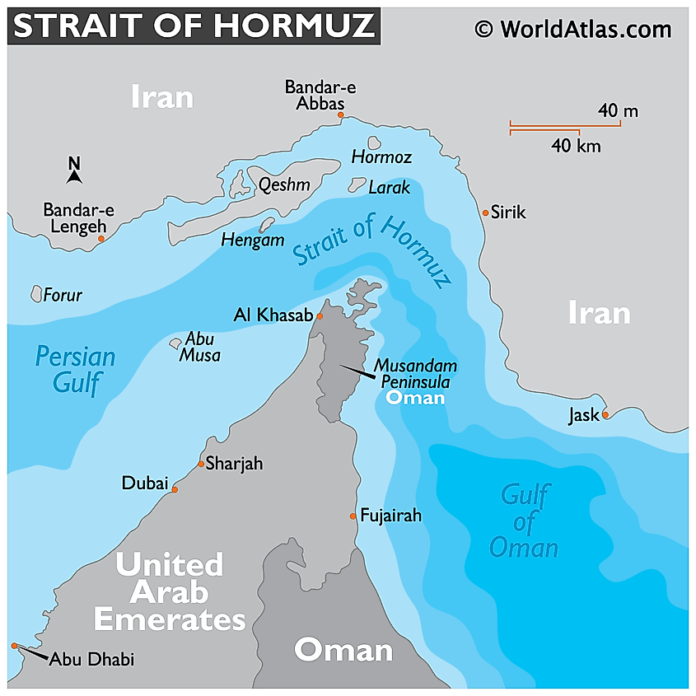
The Strait of Hormuz handles roughly one-fifth of the world’s seaborne oil flows. For India, the dependence is greater: recent reporting and government briefings estimate that around half of India’s monthly crude imports transit the strait (moving from Persian Gulf loading ports through the Gulf of Oman into the Arabian Sea). That exposure goes beyond crude: substantial volumes of LPG and a meaningful slice of India’s non-oil exports also transit these sea lanes. A closure or effective disruption, therefore, immediately tightens global and Indian supplies, driving price spikes and insurance/warrants that escalate shipping costs.
Can India ‘afford’ to lose access?
Short answer: India can survive a short disruption through a mix of stock, market options and alternative sourcing — but it cannot afford a protracted closure without substantial economic pain.

Nearly half of India’s monthly crude imports pass through the Strait of Hormuz. Substantial volumes of LPG and a meaningful slice of India’s non-oil exports also transit these sea lanes. A closure or effective disruption, therefore, immediately tightens global and Indian supplies, driving price spikes and insurance/ warrants that escalate shipping costs
Why that distinction matters:
- Time horizon: India’s Strategic Petroleum Reserves (SPR) and commercial inventories create a buffer for weeks to months, depending on drawdown discipline. But SPR levels are not limitless; replenishment depends on market access and shipping capacity. Recent government and industry reports show that New Delhi is actively expanding reserves and contingency planning — a recognition that buffers are finite.
- Price effect: Even if physical flows can be rerouted or replaced, prices can spike sharply. Global oil markets react quickly to chokepoint risk; analysts have warned prices could spike well above pre-crisis levels if Hormuz were closed, amplifying inflation and fiscal stress in India. That price shock alone — even without an absolute shortage — transfers wealth from Indian consumers and the exchequer to exporters and traders.
- Trade and logistics: Beyond hydrocarbons, a meaningful portion of India’s non-oil exports traverse sea lanes connected to Hormuz. Insurance premiums, war-risk surcharges and port diversions raise freight costs and delivery times, hurting competitiveness in time-sensitive sectors.
So: a brief disruption is manageable; a prolonged or recurrent blockade would be economically painful and politically destabilising.
What are India’s current government positions?
New Delhi’s public posture since the recent escalation in West Asia has been cautious and calibrated. The centrality of Indian interests — safety of nearly 10 million Indians in the region, energy supplies and trade — underpinned an official call for restraint and diplomacy by the External Affairs Ministry. Foreign Minister S Jaishankar has emphasised dialogue to de-escalate tensions, and the Indian government has been in active contact with regional partners.
At the highest level, Prime Minister Narendra Modi convened the Cabinet Committee on Security to take stock of the evolving crisis and to review contingency measures for stranded nationals and supply risks, signalling that the government treats any threat to Hormuz as a national security and economic priority.

The petroleum minister has also pointed to progress in diversification of suppliers as one reason India is better placed than in earlier decades to manage shocks — a point echoed in ministerial briefings that highlight alternative buying arrangements and inventory management.
India’s Strategic Petroleum Reserves and commercial inventories create a buffer for weeks to months, depending on drawdown discipline. But reserves are not limitless; replenishment depends on market access and shipping capacity. Recent reports show that New Delhi is actively expanding reserves and contingency planning — a recognition that buffers are finite
The Mathematics of Vulnerability
India is the world’s third-largest oil consumer, importing over 88% of its needs. The stakes are crystalline:

-
The Price of Conflict: Every $1 rise in the price of a barrel of crude adds approximately $2 billion to India’s annual import bill.
-
The Export Risk: Beyond energy, nearly 13% of India’s non-oil exports (valued at roughly $47 billion) pass through this corridor to reach Gulf markets.
Can India afford to ‘lose’ Hormuz? The short answer is: Briefly, yes; prolonged, no. India currently maintains Strategic Petroleum Reserves (SPRs) and refinery inventories that can sustain the nation for approximately 65 to 70 days. However, a total blockade would trigger a domestic inflationary spiral that could derail the current GDP growth projections of 7.5%
What analysts and strategists say
Strategic analysts and defence commentators underline two linked themes: the structural centrality of Hormuz to global energy flows and India’s need to think regionally and multidimensionally. Analysts such as C Raja Mohan and C Uday Bhaskar have long argued that India must treat maritime chokepoints as strategic vulnerabilities and integrate naval posture, diplomatic outreach (especially to Oman, the UAE and other Gulf states) and economic hedging. Recent commentary reiterates that while tactical responses (diversification, rerouting) help, durable resilience requires structural changes: larger reserves, alternative pipeline access, stronger regional logistics and faster energy transition.
Market analysts emphasise the immediate price reaction: even rumours of a closure can trigger sharp rallies in crude prices, and insurers rapidly withdraw war-risk coverage, multiplying transport costs. The practical upshot is that economic pain arrives within days for consumers and industry, and persists until markets are reassured.
At the highest level, Prime Minister Narendra Modi convened the Cabinet Committee on Security to take stock of the evolving crisis and to review contingency measures for stranded nationals and supply risks, signalling that the government treats any threat to Hormuz as a national security and economic priority
Practical steps India can (and should) take — three baskets of policy action
Immediate & near-term measures (weeks to a few months)
-
Activate and prudently draw on Strategic Petroleum Reserves while simultaneously hedging purchases in futures markets to lock prices where possible. SPR drawdown buys time but must be managed to avoid creating a scramble that further spikes prices.
-
Diplomatic outreach to Gulf partners (Oman, the UAE, Saudi Arabia, Kuwait) and consumer countries to coordinate shipments, safe-corridor arrangements and alternative port rotations. India’s missions and the MEA have already been engaged with counterparts in the region.
-
Orderly commercial responses — impose temporary customs and excise relief for exporters hit by route diversion, and consider targeted fuel subsidies or cash transfers to protect vulnerable households from immediate price shocks.
Operational and military steps (weeks to months)
Expand naval escort operations for India-bound tankers in international waters where permitted; coordinate with like-minded navies to keep shipping lanes open while avoiding steps that escalate confrontation. India’s naval presence and existing partnerships provide a credible, limited option for protecting convoys.
Strengthen port capacities on India’s western coast for rapid offloading and distribution; expand insurance-backstop arrangements (sovereign or multilateral) to stabilise shipping costs.
Structural resilience (months to years)
- Accelerate diversification of import sources: longer-term contracts with West African, Latin American and Russian suppliers, and investment in LNG and renewables to reduce crude-intensive demand. Analysts note that diversification already helped India reduce single-supplier risk; this must now be intensified.
- Build pipeline or trans-peninsula capacity where geopolitically feasible — the UAE and Saudi Arabia have pipelines to bypass Hormuz; India should pursue strategic partnerships that secure overland or alternative maritime routings.
- Speed up the energy transition: efficiency measures, electric mobility, biofuels and renewables shrink exposure to oil price volatility over the medium term.
A realistic assessment — can diplomacy, navy and markets together buy India’s safety?
No single lever will buy India complete safety. Diplomacy can reduce the odds of prolonged closure; naval escorts can keep some flows moving; markets and strategic reserves can blunt price spikes. But sustaining energy supplies in the face of a deliberate, long-term interdiction of Hormuz would require a combination of all three, plus international cooperation to re-route and replace lost barrels. The economic pain of a sustained closure — higher inflation, wider fiscal deficits, and pressure on industry — is therefore difficult to avoid.
India’s policy has been to balance urgent diplomacy (calls for restraint by the MEA and high-level contacts) with contingency planning (CCS reviews, reserve management) and incremental structural steps (supplier diversification, defence cooperation). That is the correct blend: buy time politically and operationally while accelerating durable energy resilience
India’s policy so far has been to balance urgent diplomacy (calls for restraint by the MEA and high-level contacts) with contingency planning (CCS reviews, reserve management) and incremental structural steps (supplier diversification, defence cooperation). That is the correct blend: buy time politically and operationally while accelerating durable energy resilience.
Final opinion
India cannot afford to treat the Strait of Hormuz as someone else’s problem. The chokepoint sits at the intersection of India’s energy security, trade competitiveness and the safety of its diaspora. A smart Indian response blends urgent diplomacy, coordinated naval and commercial measures, judicious use of strategic reserves, and accelerated structural reform of the energy mix. Over the short term, the government can and should mitigate shocks; over the medium term, it must reduce the strategic tether that links India’s prosperity so tightly to a narrow 33-kilometre waterway. That is not just prudence — it is a geopolitical imperative.

The writer serves as the BJP Karnataka Spokesperson and Head of the Research Team.
