

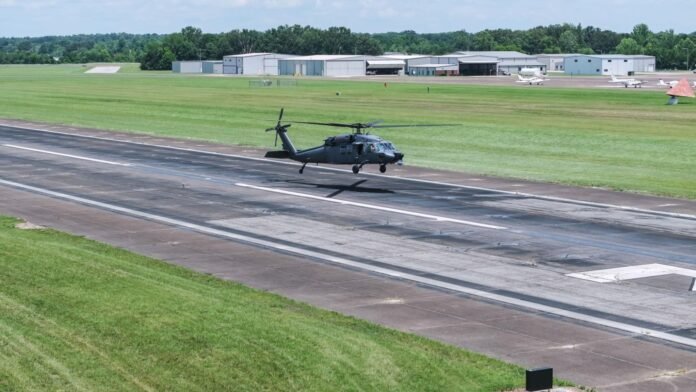
Pittsburgh, PA. Near Earth Autonomy (Near Earth), together with their collaborators Honeywell, Moog, and XP Services, wrapped up a year of integration progress and flights in preparation for this year’s mission flight testing of the RUC-60: Optionally Crewed Black Hawk designed for contested logistics. The RUC-60 is a fully integrated logistics aircraft, converted from the Army’s inventory of surplus UH-60L Black Hawks. RUC (Responsive Uncrewed Capability) helicopters are equipped with Near Earth’s Captain Architecture, a safety-critical autonomy system designed for accreditation under existing aerospace standards.
This past summer, the team showcased the first of their privately-owned Black Hawks completing a fully automated flight, from take-off to landing, and coordinated plans for designing and accrediting its safety-critical autonomy architecture. Recent integration demonstrations also highlighted advancements in flight computing, perception sensors, flight control systems, and the roadmap toward product maturity.

“Near Earth is leading the integration of autonomy into the next generation of military operations,” said Lyle Chamberlain, Chief Technology Officer at Near Earth. “Once you remove the pilot, you have to re-evaluate the entire operation, everything from how the aircraft gets out of the hangar to how it navigates and makes mission-critical decisions in flight. Autonomy isn’t just about flight control; it has to take on the full role of the crew, including responsibilities we often take for granted. That’s why we built the Captain autonomy architecture from the ground up to support end-to-end operations and meet the rigorous accreditation standards needed for real-world deployment.”
Military logistics is evolving to meet the demands of a new, contested battlefield. In a modern battlespace, the military must avoid force concentration or vulnerable logistics hubs. Autonomous aircraft will provide a key capability in future distributed operations. “Recognising that large-scale combat within the context of a contested logistics environment places a premium on the ability to robustly sustain forces over extended time and distance, modernising sustainment capabilities is non-negotiable,” stated Maj Gen Simerly, Col Callis, and Maj Legault in their February 2024 article. “Commanders will likely take much greater risks with machines than they otherwise would with Soldiers’ lives.”
This doctrinal shift demands a logistics chain that is both distributed and resilient. Traditional sustainment methods using crewed aircraft face limitations in operational tempo and are vulnerable to threats along their routes, hindering critical resupply missions. Most uncrewed alternatives either lack sufficient cargo capacity or are more than a decade from operational deployment.
In a series of meetings since the summer, Near Earth gathered with their team to finalise the configuration and functions that will be flown in logistics mission testing through 2026 and to define the functional requirements for the next phase of uncrewed vertical lift capabilities.

“We are working together to tightly define the exact capabilities needed for Near Earth’s Captain autonomy to take on the full responsibilities of a human pilot,” said Samuel Dinnar, Chief Strategy Officer at Near Earth. “This includes every operational procedure, from coming up cold on a flight line to finishing the mission and shutting down.”
“Autonomy at this scale demands avionics that are certifiable, modular, and resilient from day one, and that’s what Near Earth gets with Honeywell Anthem,” said Matt Milas, President of Defence & Space, Honeywell Aerospace Technologies. “In addition to avionics components, Honeywell will provide resilient navigation and systems engineering backbone that enables Near Earth’s autonomy to scale across aircraft, missions, and operational environments.”

Near Earth began working toward an uncrewed Black Hawk in 2021, building on its aerial autonomy track record, which today includes 10,000+ flights across 140+ airframes (including Airbus, Bell, Boeing, Kaman, and Leonardo helicopters). Near Earth has recently been leading efforts with the Marine Corps to understand future operations of the USMC Aerial Logistics Connector while flying a Leonardo AW139 which has been upgraded to include autonomy.
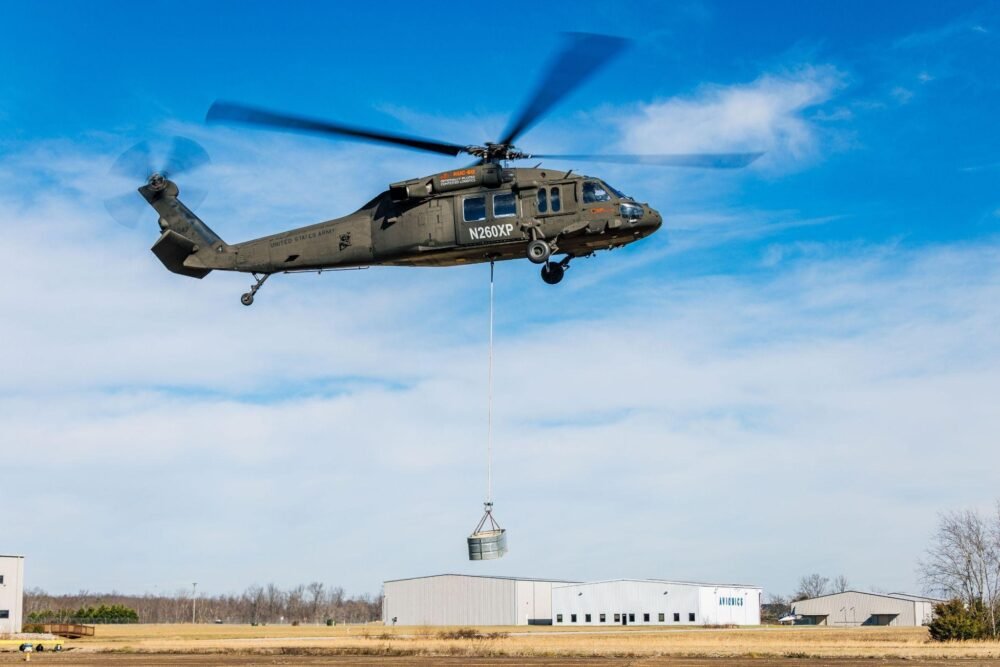
Near Earth is developing autonomy kits that convert the Army’s fleet of UH-60Ls into RUC-60s: High-tempo, uncrewed delivery workhorses capable of operating around the clock in contested airspace without onboard crew, remote pilots, or continuous data links. The solution delivers scalable logistics and sustainment while significantly reducing risk to Soldiers.
Last July at XP Services’ Tullahoma, TN facility, Near Earth and team demonstrated automated flight with a UH-60, using Moog’s Genesys GRC™ 4000 four-axis autopilot and flight control hardware enabling deterministic control without pilot stick input, including for automated take-off and landing.
“Our partnership with Moog began in 2022, leveraging their high-performance Genesys flight control system on Black Hawk platforms,” said Dinnar. “The prototype system we flew together in 2024 has now received FAA TSO civilian certification for operations in national airspace. This is just one of the many ways we are working together. Moog’s Genesys autopilot delivers exceptional control performance and integrates seamlessly with air traffic management systems, making it ideal for dual-use applications.”
“By combining our collaborator’s technology with Near Earth’s Captain autonomy architecture, we can accelerate the deployment of advanced uncrewed capabilities while meeting accreditation standards and achieving airworthiness for both defence and certified commercial use cases,” said Dinnar.
Near Earth’s RUC-60 In Flight 2026
“The UH-60L Black Hawk is a great place to start”, said Sanjiv Singh, CEO of Near Earth. “The Army has over 700 of them headed for retirement over the next few years, and each one can move up to 90,000 pounds of cargo a day. They are more available and cost-effective than larger aircraft, with the added benefit of existing maintenance infrastructure and spare parts. The Army’s been flying them since the late ’80s, but as they transition to the MV-75 and UH-60M, we see an opportunity to upgrade these trusted workhorses for uncrewed logistics. And once that’s in place, we can scale the same autonomy to bigger platforms, like the Chinook or Super Stallion, and also take on new missions like casualty evacuation and disaster relief.”
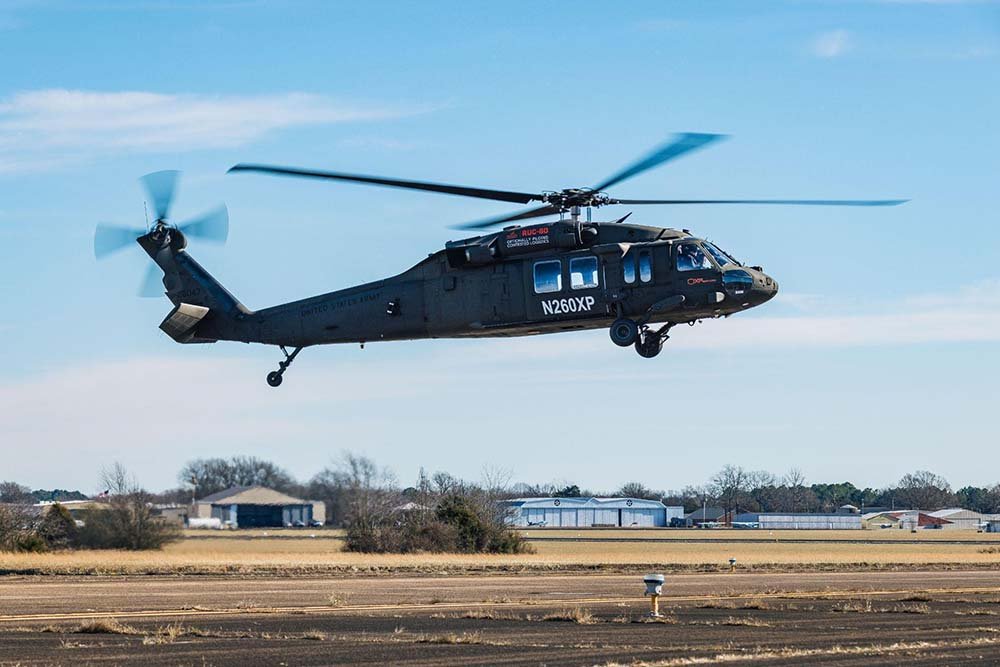
“Moog is proud to demonstrate our innovative design capabilities in autopilots, flight decks, and flight-control hardware to revolutionise how aircraft are flown now and into the future,” said Sharmila Durairaj, General Manager, Moog Avionics.
“Experiencing our autopilot flying the Black Hawk automatically from take-off, to hover, to landing confirms it’s a game-changing capability for the UH-60 rotorcraft platform,” said Nick Bogner, Business Development Director, Moog Avionics. “Moog is excited to collaborate with Near Earth on the RUC programme for optionally piloted helicopter technology applicable to any rotorcraft platform.”
Honeywell Aerospace Technologies is supporting the RUC programme by providing certified Honeywell Anthem avionics, alternative navigation and Satcom capabilities, along with system engineering and a variety of subject matter experts.
“Not only is this successful demonstration a major step in creating brand new possibilities for defence, but it also creates a potential pathway for use by other helicopter operators,” said Jason Wissink, Vice President and General Manager of Avionics at Honeywell Aerospace Technologies. “With Near Earth, we’re showing how existing aircraft can be adapted to support the next generation of defence logistics. Uncrewed aircraft will be vital in keeping service men and women as safe as possible in contested environments, and we are one step closer to realising that vision.”
Gearing up for significant flight testing in 2026, the Near Earth team recently flew their next surplus Black Hawk that is undergoing the RUC conversion. “Our collaboration and flights prove that we have the right team to provide an autonomous solution that meets the Army’s requirement to operate in a contested logistics environment,” said Ken Pfleger, Programme Manager of XP Services. “The XP Services team has performed hundreds of aircraft conversions since its beginning in 2008. We have the resources to support RUC-60 kit installations at the rate and standard that customers would demand.”
The conversion approach offers a rapid, cost-effective path to modernisation by breathing new life into surplus UH-60Ls. Uncrewed operations make it possible to deliver critical cargo in GPS or communications-denied, high-threat zones without exposing aircrews to unnecessary risk. Autonomy enables sustainment when and where it matters most.
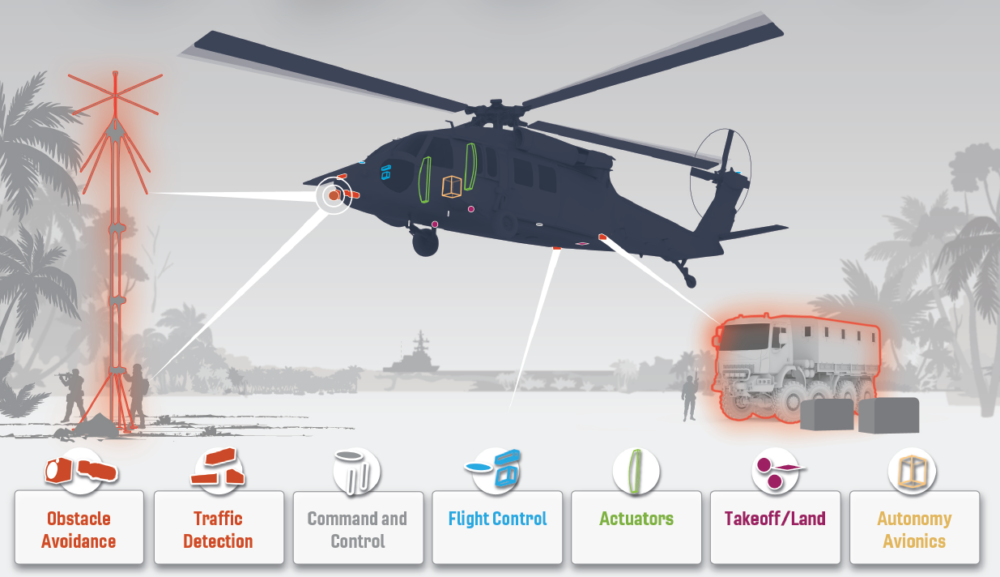
The solution uses Near Earth’s Captain, a deterministic architecture for safety-critical autonomy. A Modular Open Systems Approach (MOSA) enables rapid upgrades, flexible new capability insertion for new missions, fleet-wide scalability, and extension to additional aircraft models. The system provides a scalable roadmap for migrating autonomy across rotorcraft fleets and directly informs the development of Future Vertical Lift doctrine.
“The sooner we complete this contested logistics solution, the sooner it will be delivering needed supplies to Soldiers and keeping the crew safe,” said Sanjiv Singh, CEO of Near Earth.

