

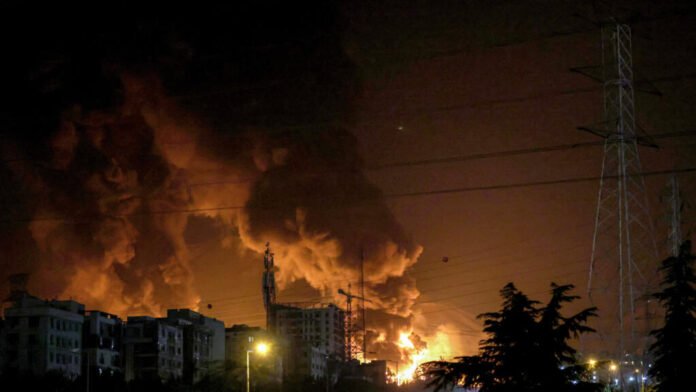
Within 24 hours, Iran suffered a severe blow, with its Supreme Leader, Ayatollah Khamenei, and the top leadership of the Islamic Revolutionary Guard Corps (IRGC) killed. This is perhaps the deadliest US-Israeli strike on Iran in recent years. While the immediate impression suggested that the joint action against Iran was guided by long-standing objectives regarding nuclear enrichment and cautious negotiations, there was a strategic shift in the escalatory dynamics this time. The massive scale of offensive operations at one end and massive retaliation from the other crossed red lines and significantly impacted regional stability, bringing it to the brink of collapse. A closer look at the scale and intent raises questions about whether certain strategic calculations have gone awry or whether dramatic and risky escalation is actually working to impose deterrence on both sides.
The Core Objectives

The immediate trigger was nuclear enrichment and tight negotiations, which cast the initial wave of strikes as a response akin to Operation Midnight Hammer, launched last year to deter and degrade Iran’s strategic nuclear capabilities. The objectives were clear and limited. However, the United States’ (US) Operation Epic Fury and Israel’s Operation Rising Lion may have been guided by hidden objectives under the guise of traditional nuclear and tactical deterrence. These objectives were to launch sustainable destabilisation operations using “shock-and-awe” and thunderbolt tactics to lead to the collapse of the regime, paving the way for a new administration.
While regime change was central to the objective, the secondary objective was psychological operations (psyops) to create a wave of anti-regime mobs to take to the streets—as in recent protests—to further fuel internal destabilization and disarray within the IRGC. This, by design, appears to be a full-fledged, phased operation to topple the regime through a pincer offensive, attacking every frontier of Iran ranging from the political to the military. The goal was to restrict and dismantle Iran’s politico-military strength to such an extent that Iran lost its internal political cohesiveness and became vulnerable to external influence.
Some reports indicate that Israel and Saudi Arabia pushed for this strike, and the US may have been blinded by the high reward associated with this high risk
The Miscalculations
The strategic calculation may have been based on a single variable: rapid escalation and a series of leadership-targeting strikes would lead to near-total dominance across Iran’s political and strategic space, creating a vacuum and instability. This would create an opportunity to wage a psyop on the ground and push for regime change. This single variable focused the design and launch of the operation against Iran and overlooked three other important variables needed for near-accurate operational calculations:
- First, gauging the Iranian response.
- Second, operational sustenance.
- Third, the requisite ground support to support Israel’s psyops.
This miscalculation and reliance on the shock-and-awe variable alone mirror Israel’s failure in the 2006 war against Hezbollah, when Israel launched a massive air campaign to degrade and decapitate Hezbollah’s operational capabilities and leadership. Israel also targeted civilian infrastructure to turn the Lebanese population against the outfit. However, only superficial damage was inflicted, and Hezbollah’s decentralised command continued to operate and strike Israel. Most notably, the population expected to turn against Hezbollah instead supported the outfit, as attacks generated sympathy and Islamic-Arab nationalism. This strengthened Hezbollah politically.

The US-Israel joint action didn’t read the ground correctly, underestimated the Iranian response, and is now struggling for operational continuity
Similarly, for the US, the failure of the Bay of Pigs invasion—which aimed to topple Fidel Castro—saw the US carry out air strikes alongside Central Intelligence Agency (CIA)-backed ground operations. They expected that swift and sustained air-ground operations targeting leadership and the Cuban military would collapse Castro’s regime and trigger an uprising against him. However, the result was the opposite; the invasion fuelled Cuban nationalism, strengthened Castro, and was decisively crushed by Castro’s forces within three days. In both cases, the use of massive force, with its shock value and failure patterns, was common because three variables were underestimated and overlooked: response, sustenance, and ground support.
Most importantly, ground support and response were key nationalist factors, and the decentralised design of the target was often ignored, leading to sudden turnarounds during operations, increased collateral damage, heightened instability, and a spillover impact.

A counter-argument regarding Venezuela’s regime change can be dismissed here, as Venezuela’s state affairs were completely different from those operating in the Middle East or from the situation in place with Castro’s regime. Venezuela’s regime was operating as a “Mafia State” with oil and political patronage rather than on ideological or nationalist identity, as in the case with Cuba and Iran. Despite the asymmetry of power against the US, the Iranian military remained operationally intact and ideologically loyal to the regime, unlike Venezuela’s weakened and fragmented military. Deep institutional, structural, and operational weaknesses in Venezuela made it vulnerable to foreign intervention, so only one variable was sufficient for regime change. As a result, the US was able to topple the Venezuelan regime with massive use of force and fewer complications.
In short, the joint action of Israel and the US triggered Iranian nationalism and consolidated the politico-social influence of the IRGC. This completely diminished the advantage of two critical variables—conducive ground support and Iran’s response—which are now diminishing the value and need of the third variable: operational sustenance
Web of Miscalculations
The US’ Operation Epic Fury, which degraded Iran’s military and operational capabilities, paved the way for Israel’s multi-phase operations that culminated in the assassination of the Supreme Leader and the leadership strike. It was primarily based on a blitzkrieg strategy, utilising speed and surprise while ignoring sustenance, response, and ground realities. The Iranian response was also massive and unexpected, contrary to what Americans and Israelis expected. Iran launched strikes across the Middle East, shut the Strait of Hormuz, and attempted to target US strategic bases beyond the Persian Gulf.
The massive response created complexity in maintaining operational sustainability with no clear objective, because the primary objective of regime change—which was expected to occur after the assassination of Ayatollah Khamenei and the top military and political leadership—didn’t happen. The operational miscalculation triggered a cycle of failures, beginning with the underestimation of Iranian nationalism and Islamic identity, which still strongly resonate with the Islamic revolution. History shows that it took almost one year to trigger the Islamic revolution in Iran, underscoring the complexity of Iran’s socio-political psychological landscape.
However, the high reward is tactical rather than strategic. The only major beneficiary of this operation, in tactical terms, is the Israel-Saudi Arabia partnership, as a severely weakened Iran helps Israel expand its influence in the region
This led to the view that the attack was an attack on sovereignty, and sympathy for the killing of its Supreme Leader inspired confidence and support— “street power”. The advantage of a power vacuum was also misjudged; instead of triggering a power struggle, the vacuum was swiftly filled with an interim arrangement without a tussle. In short, the joint action of Israel and the US triggered Iranian nationalism and consolidated the politico-social influence of the IRGC. This completely diminished the advantage of two critical variables—conducive ground support and Iran’s response—which are now diminishing the value and need of the third variable: operational sustenance.
This has put enormous pressure on the operation and raised serious questions about operational sustainability and the need for continuity, as its strategic objectives failed and the region is gradually experiencing severe strategic-economic pain. The failure in judgment and calculation may have stemmed from biased intelligence assessments and an impulsive risk approach. Some reports indicate that Israel and Saudi Arabia pushed for this strike, and the US may have been blinded by the high reward associated with this high risk, as the CIA director reportedly told US President Trump before striking Iran.
With the key strategic objective of regime change having failed, the US and Israel are now desperately attempting to hyper-escalate to force de-escalation. This is currently happening from both ends—US-Israel and Iran. It now appears that the operational compass has shifted to further degrade Iran’s strategic and operational capabilities, impose de-escalation, and counter Iran’s attempt to inflict maximum damage on the region
However, the high reward is tactical rather than strategic. The only major beneficiary of this operation, in tactical terms, is the Israel-Saudi Arabia partnership, as a severely weakened Iran helps Israel expand its influence in the region. Even this is only temporary, as Iran’s political will and institutional clarity may help it recover. In summation, the three-variable test necessary for regime change failed in the current scenario, as US-Israel joint action didn’t read the ground correctly, underestimated the Iranian response, and is now struggling for operational continuity. If the US and Israel are celebrating significant blows to Iran, they must read them as tactical victories and not strategic.
The Escalation Drama
With the key strategic objective of regime change having failed, the US and Israel are now desperately attempting to hyper-escalate to force de-escalation. This is currently happening from both ends—US-Israel and Iran. It now appears that the operational compass has shifted to further degrade Iran’s strategic and operational capabilities, impose de-escalation, and counter Iran’s attempt to inflict maximum damage on the region. This operation now appears to be a gamble that underscores the high costs of underestimating the fog of war for high rewards.

The writer is a national security analyst specialising in intelligence and strategic affairs. He has worked extensively with national security and foreign policy think tanks of repute, and has written for publications including The Telegraph, The Print, Organiser, and Fair Observer. He has also been a guest contributor to the School of International Studies at Jawaharlal Nehru University (JNU).
