
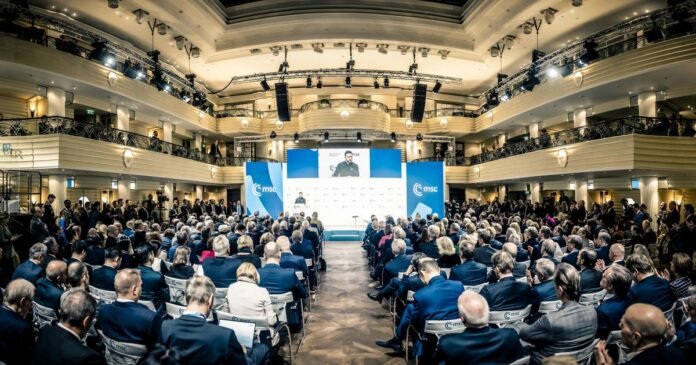
This year the Munich Security Conference (MSC) focused on themes like the erosion of global order, Europe’s strategic autonomy, and the future of deterrence. This year’s conference, themed “Under Destruction” in its flagship report, highlighted a world order in flux, with rising geopolitical tensions and uncertainty. The event further underscored Europe’s growing assertiveness in shaping its security future, with women leaders playing a central role in advancing democratic values and transatlantic cooperation
In a largely unpredicted outburst, Merz while inaugurating the MSC told other world leaders that “our freedom is not guaranteed” in an era of big power politics, and that Europeans must be ready to make “sacrifice”.

The rules-based world order “no longer exists”, the German Chancellor warned besides admitting that “a deep divide has opened between Europe and the United States”, the BBC reported.
MSC was hosted at a time when US commitments to the Nato military alliance have been called into question. Trump’s ambition to acquire Greenland has also been viewed by many European leaders as a watershed moment that has eroded trust with their biggest ally.
The MSC deliberations were also overshadowed by the ongoing Russia-Ukraine war, tensions between the West and China, as well as a potential Iran-US nuclear deal of war.
Merz told the conference: “I fear we must put it even more bluntly: this order (rules-based world order), however imperfect it was even at its best, no longer exists in that form.” He also identified “a rift, a deep divide, which has opened between Europe and the United States. And which was referred to by the American Vice-President JD Vance at the last year’s MSC.

Merz also said, “He was right. The culture war of the Maga (Make America Great Again) movement is not ours. Freedom of speech ends here with us when that speech goes against human dignity and the constitution. We do not believe in tariffs and protectionism, but in free trade.”
However, Merz appealed directly to the US by saying “let’s repair and revive transatlantic trust”, instead of writing off the decades-long partnership. The German leader also revealed that “confidential talks” were ongoing with French President Emmanuel Macron on creating a joint European nuclear deterrent. He gave no further details.

France and the UK are the only two nuclear powers in Europe – but Germany and many other European nations have traditionally relied on the US nuclear umbrella within the Nato alliance for deterrence.
Addressing the MSC, French President Macron reiterated his call for Europe to “learn to become a geopolitical power” in the new global context. He said Europe was already re-arming following Russia’s full-scale invasion of Ukraine in 2022 – but stressed that “we have to accelerate” and work collectively across the continent.
Describing the war in Ukraine’s as Europe’s “existential challenge”, the French leader urged others not to “cave in to Russian demands” – but rather to increase pressure on Moscow to achieve a just peace.
“We live in a new era in geopolitics, and it’s going to require all of us to sort of re-examine what that looks like and what our role is going to be,” he said.
Tensions have been heightened in recent months between Europe and the US, as Trump has repeatedly said that Greenland is vital to US national security, stating without evidence that it was “covered with Russian and Chinese ships all over the place”.
On the other hand, With Europeans desperate for a reassurance, the assembled leaders were also eager for any signs of transatlantic solidarity in US Secretary of State Marc Rubio’s speech. Nathalie Tocci writing for The Guardian says that the secretary of state offered warm words, celebrating the shared cultural heritage, history and specifically the Christianity of the west. He claimed that the US, a “child of Europe”, was not interested in managing western decline but instead determined to spearhead a western civilisational renaissance.
But beneath the surface, Rubio’s speech this year and Vance’s in 2025 were two sides of the same coin. Vance’s was crude and outrageous, even silly.
Rubio’s speech was more subtle and coherent, but he in essence repeated the same thoughts: the message from Washington remains that Europe and the US should be defined by ethno-political values of culture, tradition, and religion. The fact that such history has also bred nationalism, racism, fascism, and colonialism is apparently nothing to be ashamed of.
Merz, along with Emmanuel Macron, Keir Starmer, Pedro Sánchez and the European Commission chief, Ursula von der Leyen, all spoke of the need for European independence, for giving substance to the EU treaty’s article 42.7, a pledge of mutual assistance in the event of attack and for a Europeanised Nato.
As von der Leyen put it, the lines that have been crossed cannot be uncrossed. Russia’s war on Ukraine – which approaches its fourth anniversary – added a sense of urgency. So did the sober reminder from the Danish prime minister, Mette Frederiksen, that the US threat to Greenland has not gone away.
However, the currently evolving geopolitical tensions, primarily between Europe and the US, while European resolve and collective action will most likely continue, the real focus should be to work within existing transatlantic frameworks, especially Nato. This should indeed be a key strand of work.
In fact, UK and Italy both receive Nato commands from the US, signals an important step toward establishing a European “pillar” within the transatlantic defence alliance. The US will remain critical, providing command and control, specialised capabilities and, above all, the nuclear umbrella.
But overall Trump should realise that him going ballistic over Europe and Nato, will not serve the American interests at all and it might even reduce the American influence at the global level. Though this may lead unexpectedly to a Europe which is confident of managing its own affairs instead of the big daddy solving its continental problems and assuring them of his continued safety commitment. This may even lead to a new era of the European resurgence.

-The writer is a New Delhi-based senior commentator on international and strategic affairs, environmental issues, an interfaith practitioner, and a media consultant. The views expressed are personal and do not necessarily carry the views of Raksha Anirveda
