

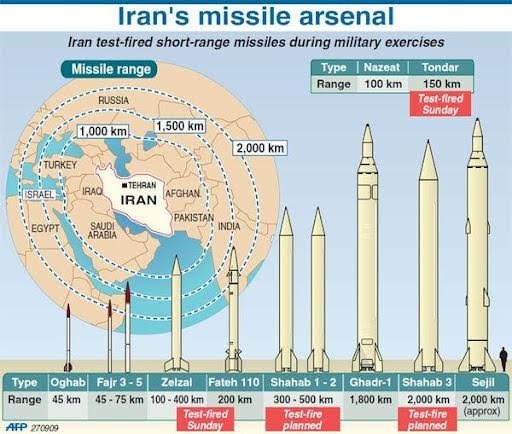
Missiles as the Core of Iran’s Deterrence Strategy: Iran’s missile arsenal represents one of the most extensive and operationally centralised strike capabilities in the Middle East. In the absence of a modern, survivable air force, Tehran has substituted airpower with ballistic and cruise missiles as its principal instrument of deterrence, coercion, and warfighting. This doctrinal choice, shaped by decades of sanctions and technological denial, has produced a force that prioritises volume, survivability, and layered employment over technological sophistication alone.
Current estimates indicate that Iran initially possessed between 2,500 and 4,000 ballistic missiles, supplemented by several hundred cruise missiles and a rapidly expanding fleet of long-range unmanned systems. Wartime attrition has likely reduced operational availability to roughly 1,000–1,500 missiles, yet this does not constitute strategic depletion. Iran’s indigenous production ecosystem ensures that its missile capability remains regenerative, not finite.

Force Composition and Inventory Depth
At a structural level, Iran’s missile force is diversified across ballistic, cruise, and UAV-integrated systems. Ballistic missiles form the backbone, providing long-range strike capability. Cruise missiles contribute low-altitude penetration and radar evasion, while drones serve both as strike assets and as force multipliers for saturation attacks.
This layered architecture is central to Iran’s operational philosophy. Rather than relying on a single class of weapons, Tehran employs a composite strike model designed to overwhelm even advanced air defence systems through simultaneity and redundancy.
Range Stratification: The Architecture of Reach
Iran’s missile arsenal is organised along a clear range-based hierarchy, each tier aligned with specific operational roles and geographic targets.
Short-Range Ballistic Missiles (0–300 km): The lowest tier includes systems such as Fateh-110 and Shahab-1. These missiles typically carry payloads between 500 and 1,000 kilograms and are capable of supersonic speeds, transitioning to hypersonic velocities during terminal descent. Their primary role is tactical, targeting nearby adversaries and regional bases. In the context of Israel, their relevance is indirect, becoming operationally significant only if deployed via forward proxies such as Hezbollah.

Current estimates indicate that Iran initially possessed between 2,500 and 4,000 ballistic missiles, supplemented by several hundred cruise missiles and a rapidly expanding fleet of long-range unmanned systems. Wartime attrition has likely reduced operational availability to roughly 1,000–1,500 missiles, yet this does not constitute strategic depletion
Short-to-Medium Range Systems (300–1,000 km): This category includes Fateh-313, Zolfaghar, and Qiam-1. These missiles represent a qualitative shift, particularly due to their solid-fuel propulsion, which allows rapid launch and reduces exposure to pre-emptive strikes. Payload capacities typically range from 500 to 750 kilograms. Notably, these systems demonstrate improved accuracy, with some variants achieving CEP values below 100 metres. They have been operationally tested in regional theatres such as Iraq and Syria, indicating a growing Iranian emphasis on precision.
Medium-Range Ballistic Missiles (1,000–2,000 km): This tier forms the core of Iran’s strategic strike capability against Israel. Systems such as Shahab-3, Ghadr, Emad, Sejjil, and the Khorramshahr series fall into this category. With payload capacities ranging from 700 to 1,800 kilograms, these missiles can cover the entirety of Israeli territory from within Iran. During re-entry, they achieve velocities between Mach 8 and Mach 12, placing them in the hypersonic regime in terms of speed. However, their trajectories are largely ballistic and therefore predictable. To address this vulnerability, newer variants incorporate manoeuvrable re-entry vehicles (MaRVs), enabling limited terminal manoeuvres that complicate interception.

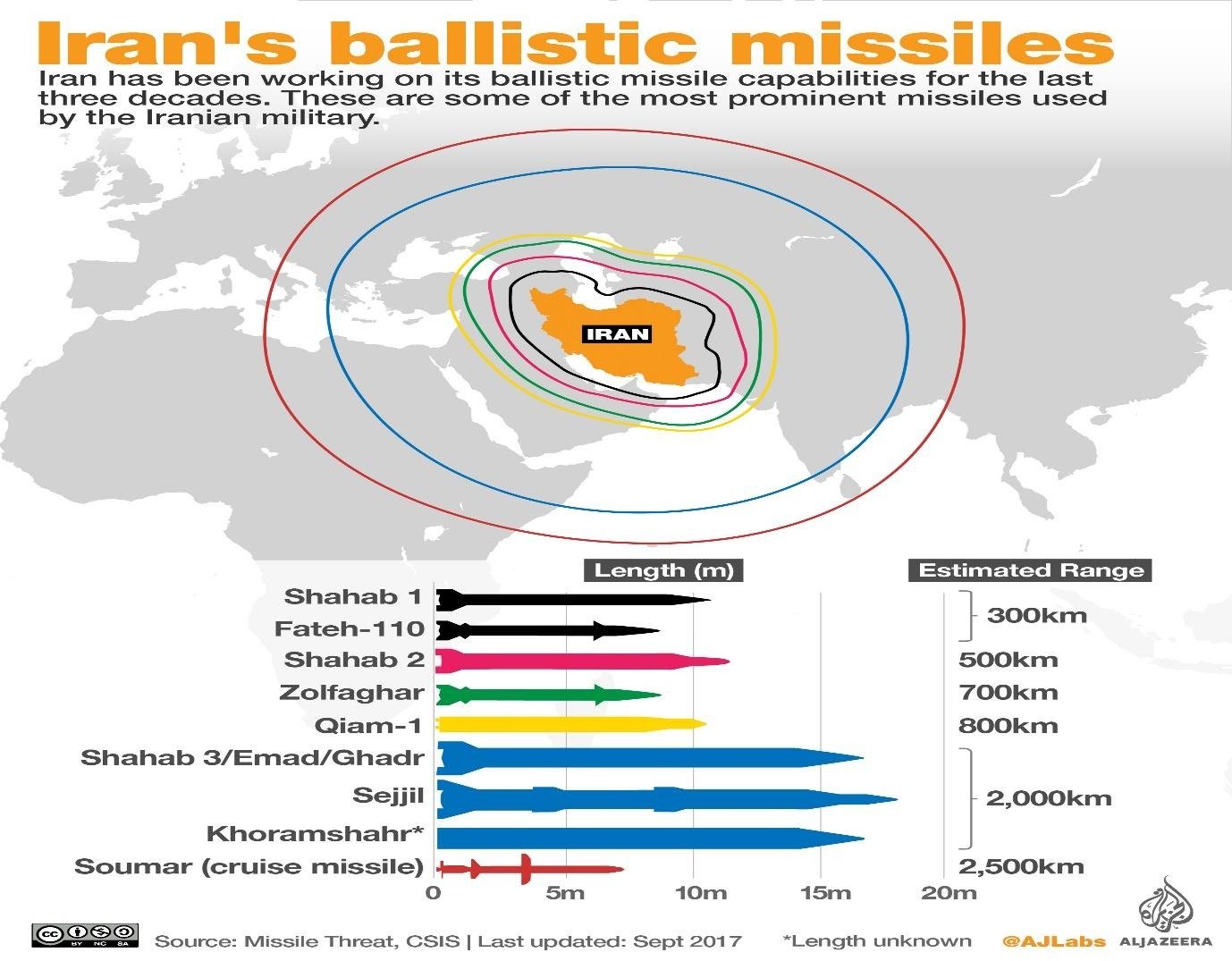
Extended Range and Emerging Capabilities (2,000–3,000 km and Beyond): Iran has demonstrated the ability to extend missile ranges through payload optimisation, particularly in systems like the Khorramshahr-4. These capabilities extend Iran’s strike envelope beyond Israel to include parts of Europe and strategic maritime zones such as the Indian Ocean.
At a structural level, Iran’s missile force is diversified across ballistic, cruise, and UAV-integrated systems. Ballistic missiles form the backbone, providing long-range strike capability. Cruise missiles contribute low-altitude penetration and radar evasion, while drones serve both as strike assets and as force multipliers for saturation attacks. This layered architecture is central to Iran’s operational philosophy
Although Iran does not yet field a confirmed intercontinental ballistic missile, its space launch vehicle programme provides a credible technological pathway towards such capability in the future.
Payload Diversity: Expanding Lethality Options
Iran’s missile arsenal is not defined solely by range but also by payload versatility, which enhances operational flexibility.
High-Explosive Warheads: These remain the standard configuration, designed for infrastructure destruction and area impact. They are particularly effective against urban and industrial targets.
Cluster and Submunition Warheads: More recent deployments indicate the use of cluster warheads, which disperse multiple bomblets over a wide area. These are especially effective against airfields and soft targets and complicate interception due to fragmentation in the terminal phase.
Penetration and Hardened Target Warheads: Iran is also developing warheads designed to penetrate fortified structures. While their effectiveness remains uncertain, they signal intent to target hardened military installations.
Latent Nuclear Delivery Capability: Although Iran does not possess nuclear weapons, many of its missile systems are inherently capable of carrying such payloads, providing a latent strategic dimension.
Velocity Spectrum: Supersonic to Hypersonic Dynamics
Iran’s missile inventory spans a broad velocity spectrum, with implications for interception and survivability.
Supersonic Systems: Cruise missiles typically operate in the subsonic to low supersonic range, relying on terrain-following flight profiles for evasion rather than speed.
Ballistic Hypersonic Speeds: Most medium-range ballistic missiles achieve hypersonic speeds during re-entry. However, these are not true hypersonic weapons in the modern sense, as they follow largely predictable trajectories.
Quasi-Hypersonic Systems: Systems such as the Fattah-1 are claimed to possess hypersonic manoeuvrability. In practice, they likely represent an intermediate capability, enhancing terminal manoeuvres rather than achieving full hypersonic glide vehicle performance.
Medium-Range Ballistic Missiles (1,000–2,000 km) form the core of Iran’s strategic strike capability against Israel. Shahab-3, Ghadr, Emad, Sejjil, and the Khorramshahr fall into this category. With payload capacities ranging from 700 to 1,800 kilograms, these missiles can cover the entire Israel from Iran. Their Mach 8 to Mach 12 speed places them in the hypersonic regime. However, their trajectories are largely ballistic and therefore predictable
Accuracy and Guidance Evolution
Iran’s missile accuracy has improved significantly over time, though it remains uneven across the arsenal. Older liquid-fuel missiles exhibit CEP values in the range of 500 to 1,000 metres, limiting their effectiveness to the area of bombardment. Newer solid-fuel systems incorporate advanced guidance mechanisms, including inertial navigation, satellite updates, and terminal guidance, reducing CEP to below 100 metres in some cases. This evolution marks a transition from indiscriminate strike capability toward selective precision targeting, particularly against high-value military assets.
Survivability and ‘Stealth by Design’
Iran compensates for the absence of true stealth technology through a combination of survivability measures and operational deception. Mobile launch platforms, including transporter erector launchers, enable rapid relocation and concealment. Extensive underground tunnel networks, often referred to as ‘missile cities’, provide hardened storage and launch infrastructure, ensuring second-strike capability.
Additionally, Iran employs decoys, electronic countermeasures, and coordinated multi-vector attacks involving drones and cruise missiles. These measures collectively reduce detection probability and increase the likelihood of penetration.
Targeting Doctrine Against Israel
Iran’s missile targeting strategy against Israel is layered, calibrated, and aligned with both military and psychological objectives.
Military Targets: Primary targets include airbases such as Nevatim and Tel Nof, as well as missile defence installations. The objective is to degrade Israel’s air superiority and defensive capacity.
Although Iran does not possess nuclear weapons, many of its missile systems are inherently capable of carrying such payloads, providing a latent strategic dimension. Iran is also developing warheads designed to penetrate fortified structures. While their effectiveness remains uncertain, they signal intent to target hardened military installations
Critical Infrastructure: Energy facilities, ports like Haifa and Ashdod, and transportation networks are key targets aimed at economic disruption and systemic paralysis.
Urban and Psychological Targets: Major urban centres, including Tel Aviv and Jerusalem, are targeted to exert psychological pressure and influence political decision-making.
Strategic Targets: At higher escalation levels, targets may include nuclear infrastructure such as Dimona and central command nodes like the Kirya complex.
Operational Employment Patterns in Conflict
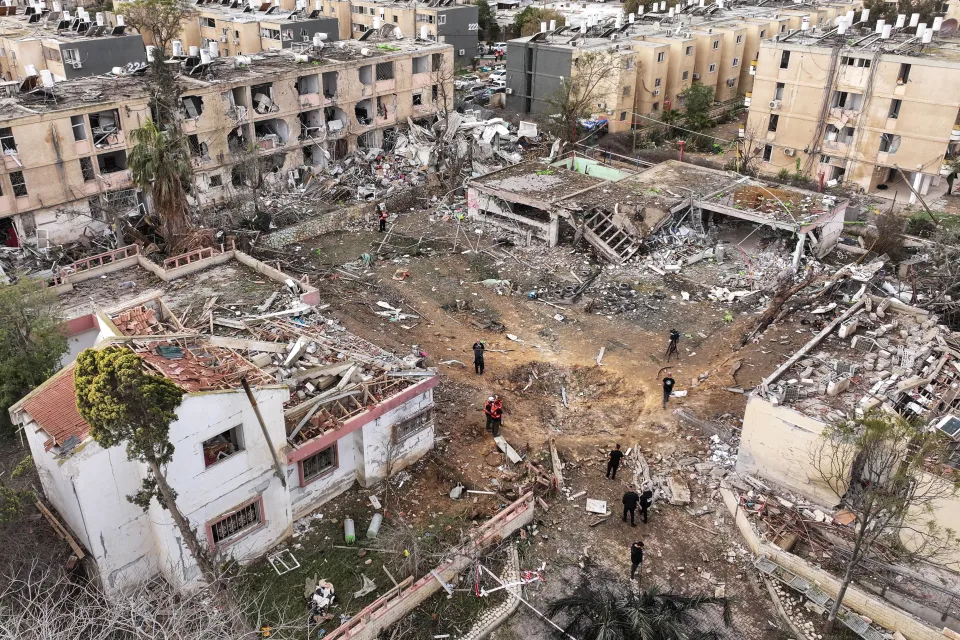
Recent conflict patterns reveal a phased approach to missile employment. Initial operations involve large-scale salvos designed to overwhelm air defences and establish shock effects. This is followed by a transition to sustained, lower-intensity strikes as inventories and launch platforms are degraded. Iran has also demonstrated tactical adaptation, increasing reliance on cluster munitions and integrating drone swarms to enhance saturation effects.
Strengths and Structural Limitations
Iran’s missile arsenal possesses several clear strengths: numerical depth, indigenous production capability, and a layered operational approach that complicates interception. However, it also faces limitations, including inconsistent accuracy, vulnerability of launch systems to pre-emptive strikes, and the absence of advanced stealth or true hypersonic glide technologies.
Iran’s missile arsenal possesses several clear strengths, including numerical depth, indigenous production capability, and a layered operational approach that complicates interception. However, it faces limitations, including inconsistent accuracy, vulnerability of launch systems to pre-emptive strikes, and the absence of advanced stealth or true hypersonic glide technologies
Net Assessment: Deterrence Through Endurance
A comprehensive assessment indicates that Iran’s missile arsenal is fundamentally a system of deterrence by punishment and endurance. It is not designed to achieve rapid, decisive military victory but to impose sustained costs, create uncertainty, and maintain strategic pressure over time.
Against Israel, this translates into the ability to conduct prolonged disruption and psychological warfare, even if decisive military degradation remains unlikely.
Sustainability Over Sophistication
Iran’s missile arsenal is best understood not as a technologically superior force, but as a resilient and adaptive one. Its effectiveness lies in its capacity to endure, regenerate, and integrate across multiple domains of warfare. In the evolving conflict environment, the critical variable is not whether Iran can strike Israel; certainly it can, but whether it can sustain high-tempo operations under attrition while preserving its deterrent credibility. The answer to that question will eventually define the strategic balance in the region.

-The author retired as Major General, Army Ordnance Corps, Central Command, after 37 years of service. A management doctorate and expert on defence modernisation, he is the author of four books, including the Amazon bestseller “Breaking the Chinese Myth,” and a frequent media commentator. He is affiliated with several leading defence and strategic studies institutions in New Delhi. The views expressed are of the writer and do not necessarily reflect the views of Raksha Anirveda
