

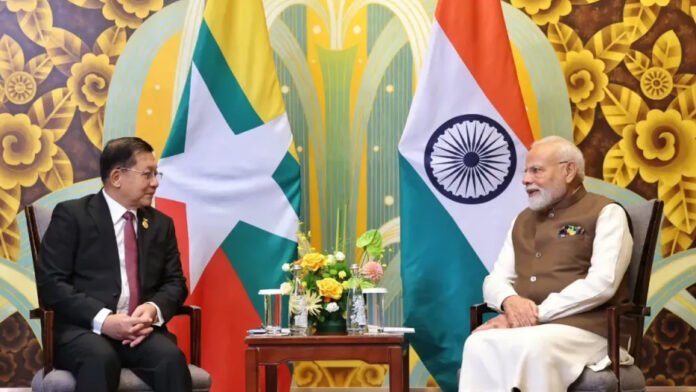
After almost four years of the Coup, the on-going elections in Myanmar, which by definition, do not appear to be free and fair, are just being held to legitimise the military rule. The most important aspect of this election is that the generals’ consolidation of power could influence South Asia’s geo-stability and balance in the immediate future, especially for India, at the centre of the region.
Until now, the strategic and security complexities of Myanmar have been quietly assessed, but post-elections, there would be a sense of renewed patriotism accompanied with associated complications, for which India must revisit its strategy in a pragmatic manner now, to deal with Myanmar in future.

The Complex Tug of War
Myanmar’s socio-political landscape has been dominated by a triangular contest among the civilian government, the military, and the rebels. The pre-coup scenario suggests that the relationship between the civilian government and the army was governed by the nationalist spirit and the establishment of a strong state, which was glaringly visible when the Arakan Army (AA) attacked the police in 2019. Aung San Suu Kyi’s government officially labelled them as “terrorists” in 2020 and ordered the military to crush them.
While the military used the National Ceasefire Agreement to weaken rebels adopting a rule-based strategy, major rebel groups, the Arakan Army and the Kachin, refused to sign the agreement. By November 2020 elections, the relationship between the civilian government (NLD) and the military had soured.
The civilian government won a landslide victory, while the military-backed political party suffered defeat, threatening the military’s grip on Myanmar’s political system, which was guaranteed by the 2008 constitution through 25 per cent of seats and control of key ministries.
Until now, the strategic and security complexities of Myanmar have been quietly assessed, but post-elections, there would be a sense of dynamism, for which India must revisit its strategy to deal with Myanmar
Along with political reasons, the Myanmar military chief, Min Aung Hlaing who was scheduled to retire almost six months after the 2020 elections, had his own ambitions for power, which further fuelled the drive to capture power through a coup.

The rebels’ struggle for greater autonomy reached its peak after the coup, when all guns turned against the military. The Bamar nationalist population, the country’s majority ethnic group, and the ethnic divide with the rebels dissolved, and the People’s Defence Forces, comprising Bamar youth, was formed, backed by ethnic rebels.
In this complex tug-of-war, the civilian government, aligned with the military, turned against the military after the coup and, through a shadow government and its pro-democratic government, sided with the rebels.

India’s Strategy with Government and Generals
India’s strategy for Indo-Myanmar affairs was simple—engage with pro-democratic forces, especially after its support for the 1988 pro-democratic uprising in Myanmar. However, during the 1990s, the Northeast faced an ethnic insurgency that pushed India to rethink its engagement with Myanmar.
In 1993, India began to shift its engagement by opening diplomatic channels with the generals. From late 90s to early 2000s, especially under the Vajpayee government, the relationship began to develop constructively, with high-level visits, such as the Vice Chairman of the Junta, General Maung Aye’s visit to India in 2000. By 2003, the Junta began sharing intelligence on the movements of anti-India insurgents.
The relationship between the generals and Delhi further developed at strategic and economic levels, when China began building a listening post on the Coco Islands to spy on India’s DRDO missile tests in Odisha. India began to provide military and strategic aid to the Junta to create an alternative to the Generals and prevent them from a full strategic embrace of China.
India’s opening-up to generals primarily focused on security and strategic interests—first to counter insurgents and to check China’s influence, as generals were widely perceived to be close to the Chinese and could become a tool in China’s hands to disrupt India’s eastern front.
India’s strategy for Indo-Myanmar affairs was simple—engage with pro-democratic forces, especially after its support for the 1988 pro-democratic uprising in Myanmar. However, during the 1990s, the Northeast faced an ethnic insurgency that pushed India to rethink its engagement with Myanmar
The logic of this engagement with generals echoed India’s expanding strategic interests in the east under the umbrella of India’s Look East policy at one end. However, on the other end, it created friction with the pro-democratic forces, such as NLD. When pro-junta mobs attacked Suu Kyi in the Depayin Massacre (2003), India’s response was notably muted.
The Twin Track Era
In 2015, NLD won the first truly open general elections. Suu Kyi became State Counsellor (de facto leader) and formed the government in Myanmar, but remained restricted by the military from assuming the full presidency, as the military-drafted 2008 constitution barred individuals with foreign spouses or children from becoming the country’s president. Aung San Suu Kyi’s late husband and two children are British nationals, thus making her ineligible for the presidency.
However, the State Counsellor post functioned in practice as a Prime Ministerial office, despite its de facto status. The civilian government led by Aung San Suu Kyi was responsible for education, economy and foreign affairs, while the military was responsible for Defence, Home Affairs and Border Security.
The logic of this engagement with generals echoed India’s expanding strategic interests in the east under the umbrella of India’s Look East policy at one end. However, on the other end, it created friction with the pro-democratic forces, such as NLD. When pro-junta mobs attacked Suu Kyi in the Depayin Massacre (2003), India’s response was notably muted
This dual arrangement realigned India’s strategy into a twin-track approach, allowing it to balance relations with both the civilian government and the military. The core aspects of this strategy were the balance between socio-economic and strategic interests.
The maintenance of cultural-economic ties with the civilian government to preserve India’s political influence at the national level and to contain China’s influence.
Strategic balance with the Junta to ensure reducing the strategic interests of reducing China and securing the security of the North East. To some extent, India successfully pursued this twin-track diplomacy by expanding personal and cultural outreach through a development partnership with Aung San Suu Kyi, thereby reinforcing India’s political influence in Myanmar, particularly with Aung San Suu Kyi.
On the other hand, India maintained its influence among the generals and began cultivating deeper ties. India gifted a Kilo-class submarine (INS Sindhuvir, renamed UMS Minye Theinkhathu) to the Myanmar Navy, making it the first submarine for the Myanmar Navy. India continued to supply military aid in exchange for intelligence and to flush out anti-India insurgents, thereby presenting the military with a strategic alternative to China.
This strategic balancing act was put to the test in 2017 during the early phases of the Rohingya crisis. The West was criticising both the government and the military, further complicating the situation. Bangladesh was also in the centre of attention, as supporting military action against the Rohingya would most likely anger Bangladesh, which saw the crisis as a humanitarian issue.
India’s strategic balancing approach gave equal weight to both sides. At one end, it did not directly and assertively condemn Myanmar and further abstained from a resolution that would sanction the generals. On the other hand, it adopted a development approach, signing an agreement with Suu Kyi’s government to construct prefabricated houses for returning refugees as part of Rakhine State’s development.
This kept India’s political engagement with the government intact and eased the issue with Bangladesh. This twin approach, combining strategic action with the Junta and political action with the de facto civilian government, kept India’s long-term interests in Myanmar secure and functional.
Coup and Elections
After the coup in 2021, India’s strategic balance faced a strong challenge from China, putting India’s security and strategic interests in the Northeast at stake. China demonstrated full control of the situation at one end, while providing a diplomatic shield at the UN through a veto on sanctions proposals.
India’s strategic balancing approach gave equal weight to both sides. At one end, it did not directly and assertively condemn Myanmar and further abstained from a resolution that would sanction the generals. On the other hand, it adopted a development approach, signing an agreement with Suu Kyi’s government to construct prefabricated houses for returning refugees as part of Rakhine State’s development
On the other hand, it played a strong role as a broker between the rebels and the Junta. China’s brokering of peace between the Three Brotherhood alliance and the Junta after Operation 1027, when the Junta saw significant losses against the rebels, gave clear signals that China is controlling both the war and peace switches in Myanmar, which could threaten India’s eastern frontier and make it vulnerable to external influence ever since the Manipur crisis started.
In return for these diplomatic and security assurances, Myanmar’s military accelerated mega CMEC projects and granted China access to the strategic Kyaukphyu Port, giving China direct access to the Indian Ocean by bypassing the Malacca Strait.
Until India’s strategic balancing act could give equal weight to relations between the de facto government and the military, the power balance was right. Post-coup, this balance shifted, strengthening the Junta and aligning it more closely with China as longstanding military relations deepened.
India was left with one option: to return to the Vajpayee-era approach and begin developing deeper ties with the Junta. But within a few years, as the Junta began losing significant ground to rebels, it became clear that India couldn’t work in isolation or negotiate with one power; it had to open its twin-track diplomacy to include the rebels, as the stakes had risen.
The Kaladan Multi-Modal Transit Transport Project is India’s gateway to the Northeast via sea. The project is physically located in Rakhine State, now controlled by the Arakan Army (AA).
The Manipur rebels also have traditional ties with other rebels, which have further complicated the security scenario and pushed India to rethink its approach to dealing with the Junta. The challenge is that negotiating with rebels might strain relations with the Junta and push it closer to China, attracting Chinese attention as well.
A Realistic Pragmatism
India perhaps realised that negotiating with a single power in Myanmar is unlikely to work in India’s favour. New Delhi has opened its backdoor channels—clandestine diplomacy through intelligence networks and political channels, including the Mizoram government, thus leveraging ethnic linkages—to engage with rebels and ensure its strategic and security interests remain secure. On the other hand, it keeps silence on the Junta’s actions and repatriate Junta soldiers who often flee into India when overrun by rebels.
As Generals are likely to be legitimised soon through elections, India must prepare to strategically intervene with both actors—no political or strategic pragmatic balance is required; rather, sharper, more ruthless or risky pragmatic actions are required, where India not only has strong negotiating power but also strong bargaining power
The current approach suggests that previously India engaged on a need to basis – a fragmented balancing act with both actors, keeping their boats afloat in choppy waters. However, in the long run, it may not work as China’s influence grows and India’s bargaining power erodes. India needs a sharper balance, putting equal weight on both ends by assertively negotiating to maintain a strong bargaining posture.
Which could be further leveraged through strong economic and logistical engagement with rebels to reduce their dependence on Chinese brokers who control them through weapons and trade supplies. For the Arakan Army, access to the Indian market via Mizoram is a strategic alternative to China and can further help India deepen its ties with the rebels.
On the other hand, India could maintain influence over the Junta through continued intelligence sharing on the Rohingya militants and providing hardware and military aid to the Junta.
But as Generals are likely to be legitimised soon through elections, India must prepare to strategically intervene with both actors—no political or strategic pragmatic balance is required; rather, sharper, more ruthless or risky pragmatic actions are required, where India not only has strong negotiating power but also strong bargaining power.
Following the elections, China will further expand its influence in Myanmar, which could affect India’s influence and regional security as well. Thus, India must have all its negotiating levers ready, even if it is by deploying hard power.

The writer is a national security analyst specialising in intelligence and strategic affairs. He has worked extensively with national security and foreign policy think tanks of repute, and has written for publications including The Telegraph, The Print, Organiser, and Fair Observer. He has also been a guest contributor to the School of International Studies at Jawaharlal Nehru University (JNU).
