

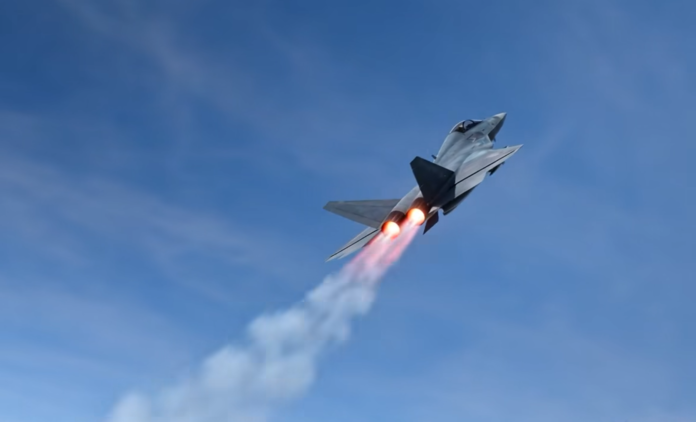
New Delhi: India’s formidable Air Force has sharpened its modernisation blueprint, pivoting towards a tightly controlled direct procurement of fifth-generation stealth fighters instead of committing to a sprawling domestic production setup for an imported platform.
This recalibration stems from the pressing imperative to close a burgeoning “stealth deficit” across the region, as rivals such as China aggressively scale up their J-20 and J-35 inventories.

By favouring a modest off-the-shelf purchase, the Indian Air Force seeks swift combat readiness, sidestepping the protracted timelines—often spanning a decade or more—needed to erect indigenous manufacturing infrastructure for what amounts to a stopgap platform.
Strategic architects have pinpointed a precise demand for 40 to 60 aircraft, earmarked as elite “bridge” units to tide over operations until the homegrown Advanced Medium Combat Aircraft (AMCA) reaches fruition.
High-ranking officers contend that such a compact order scarcely warrants the colossal outlay required to forge a full-fledged local production apparatus. Establishing bespoke tooling, stealth-coating plants, and rigorous certification protocols for a foreign airframe demands sustained, large-scale commitments that the Air Force deems untenable.
This stance guards against diverting precious funds from the flagship AMCA initiative, which embodies India’s sovereign aspirations in advanced aerospace design.

Time sensitivity looms largest in this doctrinal shift. The AMCA’s prototype is slated for its maiden flight by 2029, with frontline induction eyed for the mid-2030s. Any interim import would thus enjoy a slender service lifespan of about seven years as the premier stealth mainstay.
Planners view lavish expenditure on local assembly lines for a fleeting foreign jet as fundamentally inefficient, prone to locking in resources during an ephemeral phase.

The Indian Air Force is thus gravitating towards a government-to-government pact, primed to expedite deliveries and fast-track pilot training in fifth-generation warfare doctrines.
Ongoing assessments centre on the Russian Sukhoi Su-57M1E, a refined iteration boasting enhanced stealth exhaust nozzles and AI-fused avionics suites. Though the American F-35 lingers in discussions, Moscow’s pledge of prompt availability and synergies with AMCA co-development tips the scales in Russia’s favour.
This lean, fully imported interim buy safeguards the “fiscal bandwidth” vital for the AMCA to solidify as the cornerstone of India’s aerial shield.
At its core, the manoeuvre constitutes a shrewd “capability hedge,” fortifying near-term technological parity without obstructing the runway for indigenous prowess. The emphasis stays firmly on bolstering the AMCA endeavour, which has lately drawn amplified involvement from private heavyweights like Tata Advanced Systems and Larsen & Toubro.
This pragmatic equilibrium empowers the service to rectify immediate vulnerabilities while upholding the north star of Aatmanirbharta—self-reliance—in cutting-edge aviation.
China’s stealth proliferation underscores the urgency. Beijing’s J-20 fleet has surged past 250 units, with J-35 carrier variants poised to reshape Indo-Pacific naval dynamics. India’s sole stealth recourse remains the nascent AMCA, leaving a yawning void exploitable by adversaries.
Pakistan’s rumoured acquisition of Chinese J-31 fighters has been framed as a move that could compress timelines and intensify two‑front pressures on India, demanding swift countermeasures. Yet, recent international reports suggest the supposed deal was little more than bluster—a propaganda exercise orchestrated by ISPR rather than a genuine procurement plan.
The Su-57M1E emerges as a frontrunner owing to its export-tailored upgrades: radar-absorbent materials refined for low observability, a next-gen Irbis-E AESA radar with multi-spectral prowess, and integrated AI for swarm tactics and autonomous decision loops.
Russia’s overtures include technology transfers pertinent to AMCA’s stealth shaping and engine tech, fostering quid pro quo without the strings of full tech disclosure.
In contrast, the F-35’s appeal dims under source-code access hurdles and US export curbs, which clash with India’s strategic autonomy ethos. Geopolitical frictions, including CAATSA sanctions risks, further cloud the path.
A government-to-government route circumvents tender delays, mirroring the swift S-400 deal that evaded bureaucratic snags.
Fiscal prudence reigns supreme. Localising even 60 Su-57s would necessitate billions in upfront capex for jigs, fixtures, and supply chains—funds better channelled to AMCA’s ₹15,000 crore prototype phase. The interim fleet’s brevity—peaking mid-2030s before AMCA ramps up—renders transfer-of-technology investments marginal at best.
Fifth-gen proficiency demands sensor fusion mastery, data-linking, and low-observability regimes, best inculcated via early imports rather than simulator proxies.
IAF squadrons could operationalise within 24-36 months post-contract, equipping Ladakh and Eastern Command bases against PLA Air Force incursions.
AMCA’s trajectory bolsters this logic. With DRDO targeting metal mock-ups by 2026 and private partners handling 70% airframe work, the program accelerates under “Make in India 2.0.” TATA’s composite expertise and L&T’s precision machining plug critical gaps, ensuring AMCA MK-1 boasts 1.1+ thrust-to-weight ratios via GE-F414 integrations.
The “bridge” buy thus buys breathing room, letting AMCA iterate unencumbered—potentially incorporating sixth-gen traits like laser weapons and hypersonic munitions.
Regionally, this hedges against J-20/J-35 numerical superiority, where quality stealth trumps quantity in beyond-visual-range duels. India’s Rafale backbone, while formidable, lacks low-observable edges, exposing vulnerabilities in contested airspace.
Critics decry over-reliance on Russia amid Ukraine war strains, yet Su-57 production stabilises at 20+ units yearly, with exports to Algeria proving feasibility. India’s diversification—Tejas MK-2, Rafale-M for carriers—complements the stealth interim without portfolio bloat.
Ultimately, this calculus prioritises operational tempo over industrial vanity, a mature pivot reflective of IAF’s doctrinal evolution from Su-30MKI mass to precision elites. By ring fencing AMCA, India cements a fifth-gen spine by 2040, outpacing peers in indigenous stealth mastery.

