

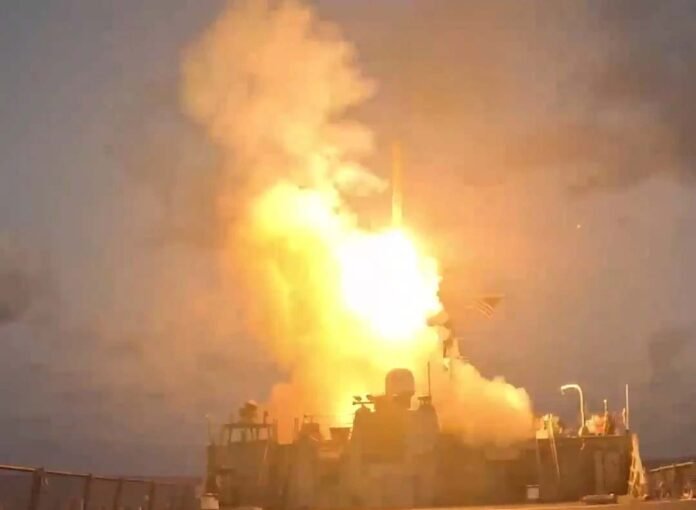
In the volatile geopolitical landscape of the Middle East, Operation Epic Fury has reshaped power dynamics far beyond Tehran’s borders. While ostensibly a preemptive strike to neutralise an escalating Iranian threat, the operation has inadvertently accelerated the decline of China’s burgeoning influence in regional arms markets and security architectures. By systematically degrading Chinese-supplied air defences and missile technologies embedded within Iran’s arsenal, the strikes have exposed systemic vulnerabilities in Beijing’s military exports, undermining its strategic leverage in the Gulf and beyond. Conversely, Russia emerges as an unanticipated beneficiary, capitalising on the diversion of US resources from Ukraine to the Iranian theatre.
The Catalyst of Operation Epic Fury
The 12-day war between Israel and Iran in July 2025, which escalated into a broader US-involved conflict, marked a watershed in Middle Eastern security. Codenamed Operation Epic Fury for its targeted fury against Iran’s subterranean missile silos, the campaign involved over 200 precision airstrikes by stealth platforms such as the F-35 and B-21, aimed at Iran’s estimated 3,000 ballistic missiles. These munitions, dispersed across hardened underground facilities, represent Tehran’s primary vector for power projection amid its antiquated conventional forces. Iran’s air force, reliant on pre-1979 US-supplied F-14 Tomcats with limited serviceability, and its littoral navy — comprising fast-attack craft ill-suited for blue-water operations — leave ballistic missiles as the mullahs’ sole asymmetric equaliser.

Operation Epic Fury was not merely reactive; it was a strategic imperative. Intelligence intercepts revealed Iranian preparations for a barrage capable of overwhelming Israeli Iron Dome and US Patriot systems, potentially igniting a regional conflagration that could disrupt 20 percent of global oil supplies through the Strait of Hormuz. The attack on Cyprus, where Iranian short-range missiles struck civilian infrastructure, underscored the existential risks to Southern and Eastern Europe. Yet, the operation’s ripple effects extend to great-power competition: by attriting Chinese-enabled Iranian capabilities, it erodes Beijing’s foothold in the Middle East, while bolstering Moscow’s position in Eastern Europe.
For China, this is strategic alchemy: arms sales secure oil imports (Iran supplies 10 percent of Beijing’s crude) and counter US encirclement via the Belt and Road Initiative’s security corridors. Yet, Operation Epic Fury has turned this asset into a liability
Iran’s Military Asymmetries and the Primacy of Ballistic Missiles
Iran’s defence posture is a textbook case of asymmetric warfare, compensating for conventional deficiencies through missile-centric deterrence. The Islamic Revolutionary Guard Corps (IRGC) Aerospace Force maintains the region’s largest missile inventory, estimated at over 2,500 post-war units by February 2026, down from pre-conflict highs due to attrition. This arsenal includes short-range systems like the Fateh-110 (range: 300 km) for intra-regional strikes and medium-range variants such as the Shahab-3 (1,300-2,000 km), capable of reaching Tel Aviv, Riyadh, and even southeastern Europe.
Technological advancements, including solid-fuel propulsion for rapid launches (under 10 minutes) and electro-optical guidance for sub-100 metre circular error probable (CEP), have transformed these from crude Scud derivatives into reasonably accurate tools. Production scales impressively churn out up to 100 missiles monthly, with projections of 5,000 by 2027 if unhindered. This industrial base not only sustains Iran’s nuclear ambitions — targeting a deliverable warhead by the 2030s — but also enables proxy warfare via Hezbollah and Houthis, embedding Tehran in a “ring of fire” around US allies.
However, these capabilities are inextricably linked to external patronage. Sanctions have isolated Iran from Western markets, forcing reliance on revisionist suppliers. Herein lies China’s shadow: Beijing’s dual-use exports have industrialised Iran’s programme, shifting it from artisanal assembly to serial production.

China’s Crucial Enabler: From Chemicals to Supersonic Missiles
Over the past two years, China has emerged as Iran’s indispensable partner in missile proliferation, supplying not just hardware but the sinews of production. Chemical precursors for solid-fuel propellants — ammonium perchlorate and hydroxyl-terminated polybutadiene — flow from Chinese firms, enabling the IRGC’s high-volume output. Satellite navigation components, derived from BeiDou systems, enhance guidance accuracy, while direct transfers include the CM-302 supersonic anti-ship missile (export variant of YJ-12, Mach 3+, 180 km range), designed to threaten US carrier strike groups in the Persian Gulf.
Critically, the strikes dismantled integrated air defences: HQ-9 batteries, touted for S-400 parity, failed spectacularly against low-observable incursions, with over 80 percent neutralised in the opening salvos. This not only attrits hardware but severs Beijing’s leverage; Iran’s vulnerability exposes Chinese tech as inadequate against peer adversaries, echoing failures in simulated Taiwan scenarios
This collaboration defies UN embargoes, with recent deals nearing completion for additional CM-302 batches amid US threats. Beijing’s involvement extends to air defences: HQ-9 and HQ-16 systems, knockoffs of Russian S-300, were integrated into Iran’s layered shield. Intelligence sharing — tracking US deployments via Chinese satellites — further cements this axis, allowing Iran to calibrate strikes against Saudi oil facilities or Israeli ports.

For China, this is strategic alchemy: arms sales secure oil imports (Iran supplies 10 percent of Beijing’s crude) and counter US encirclement via the Belt and Road Initiative’s security corridors. Yet, Operation Epic Fury has turned this asset into a liability.
Execution and Immediate Attrition
Launched in response to Iranian escalations, Operation Epic Fury deployed US and Israeli stealth assets to penetrate Iranian airspace, evading Chinese-supplied radars. Over 150 ballistic missiles and 20 production facilities were neutralised, alongside 40 percent of Iran’s launchers. Precision munitions like JDAM-ER and Rampage drones targeted underground silos, confirmed via post-strike BDA (battle damage assessment) showing 70 percent degradation in medium-range stocks.
Critically, the strikes dismantled integrated air defences: HQ-9 batteries, touted for S-400 parity, failed spectacularly against low-observable incursions, with over 80 percent neutralised in the opening salvos. This not only attrits hardware but severs Beijing’s leverage; Iran’s vulnerability exposes Chinese tech as inadequate against peer adversaries, echoing failures in simulated Taiwan scenarios.
In Operation Sindoor (India’s 2025 border incursion into Pakistan), Chinese-supplied JF-17 fighters and PL-15 missiles underperformed against Russian-origin Su-30MKIs, with guidance systems jamming in high-altitude engagements. Such patterns erode buyer confidence, particularly in cost-sensitive markets
Countermeasures and the Embarrassment of Chinese Systems
Tehran has redoubled procurement: YJ-21 hypersonic anti-ship missiles and Verba MANPADS from Russia to reconstitute threats to US carriers and F-35s. Beijing’s intelligence on US carrier positions in the Arabian Sea aided Iranian targeting, yet repeated intercepts — such as the downing of three Iranian drones by US E/A-18 Growlers — highlighted integration flaws in Chinese avionics.
These embarrassments compound prior debacles. In Operation Sindoor (India’s 2025 border incursion into Pakistan), Chinese-supplied JF-17 fighters and PL-15 missiles underperformed against Russian-origin Su-30MKIs, with guidance systems jamming in high-altitude engagements. Such patterns erode buyer confidence, particularly in cost-sensitive markets.
Historical Precedents: Russian Reliability vs Chinese Replicants
China’s arms export surge — capturing 15 percent of the global market by 2024, up from 5 percent in 2010 — has displaced Russia in developing economies. Yet history favours Moscow’s battle-tested designs. In the 1973 Yom Kippur War, Soviet SA-2, SA-6, and SA-7 SAMs inflicted grievous losses on the Israeli Air Force, downing 102-128 aircraft in the war’s opening days and nearly achieving air parity. Egyptian operators, leveraging integrated tactics, neutralised F-4 Phantoms at ranges exceeding 20 km, forcing Israel to adapt with ECM pods and low-level ingress.
Contrast this with Indo-Pakistani conflicts. Russian MiG-21s and S-125 SAMs excelled for India in 1965 (intercepting PAF Sabres), 1971 (downing 43 Pakistani aircraft) and 2025’s Operation Sindoor (where Su-30s evaded HQ-9 fire). Pakistani Chinese acquisitions — PL-5 missiles, ZDK-03 AWACS — fared poorly, with high failure rates in electronic warfare environments.
Chinese systems, often reverse-engineered Russian clones with inferior metallurgy and software, falter against sophisticated countermeasures. Operation Epic Fury’s HQ-9 shoot-downs — due to outdated fire-control algorithms — mirror these shortcomings, prompting Saudi Arabia and the UAE to show renewed interest in Russian S-400s.
Market Repercussions: A Blow to Beijing’s Arms Ambitions
The Middle East, absorbing 25 percent of global arms imports, was China’s gateway to prestige sales. Post-Epic Fury, inquiries for Chinese platforms have plummeted 40 percent, per SIPRI data, as buyers cite “proven inefficacy” in testimonials from Iranian officers. Algeria, a key client, is reevaluating contracts worth $2 billion, favouring Russian alternatives that, while costlier, deliver in a crunch.
Operation Epic Fury has recalibrated the Middle East’s security calculus, humbling China’s aspirations while fortifying Russia’s resilience. By degrading Iranian missiles and their Chinese enablers, the US has not only forestalled nuclear brinkmanship but also injected doubt into Beijing’s military-industrial narrative
This erosion threatens Beijing’s “weapons of influence” doctrine, where arms foster dependency and technology transfers. With US export controls tightening via the Wassenaar Arrangement, China’s isolation could cede 10 percent market share to Russia by 2030.
The Russian Windfall: THAAD Attrition and Ukrainian Momentum
America’s victory comes at a cost. During the 12-day war, US forces expended 150 THAAD interceptors — 25 percent of inventory — against Iranian salvos, exposing production bottlenecks. Lockheed Martin produces just 6-7 monthly, leaving gaps for Pacific contingencies.
This diversion benefits Russia, holding 20 percent of Ukraine against faltering Western aid. Fewer THAADs for Kiev means unchecked Iskander missile strikes, sustaining Moscow’s momentum. Vladimir Putin’s overtures to Gulf states — offering Su-57 jets at discounts — further consolidate Russian primacy.
Conclusion: Geopolitical Realignments
Operation Epic Fury has recalibrated the Middle East’s security calculus, humbling China’s aspirations while fortifying Russia’s resilience. By degrading Iranian missiles and their Chinese enablers, the US has not only forestalled nuclear brinkmanship but also injected doubt into Beijing’s military-industrial narrative. As Iran licks its wounds, the arms market tilts toward proven performers. In this zero-sum game, the Middle East, ever the fulcrum of great-power rivalry, is set to pivot away from the Dragon, giving the Bear a foot in the door.

–The writer is a globally cited defence analyst based in New Zealand. The views expressed are of the writer and do not necessarily reflect the views of Raksha Anirveda
