

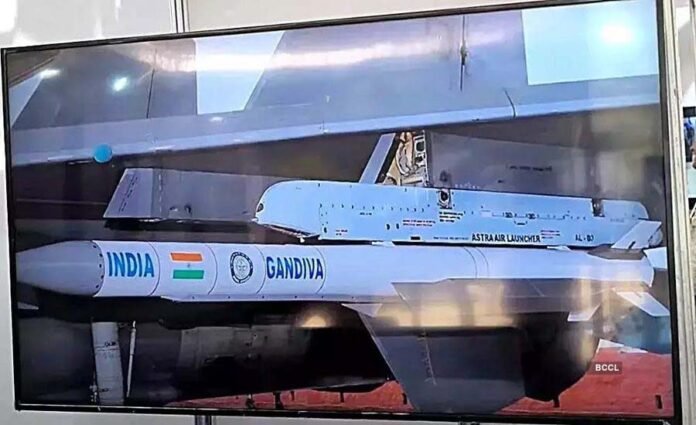
New Delhi. The Defence Research and Development Organisation (DRDO) is advancing the Astra MK‑III beyond visual range air‑to‑air missile (BVRAAM) with a major emphasis on artificial intelligence‑assisted identification‑friend‑or‑foe (IFF) and spoof‑resilient guidance technologies.
The integration of these intelligent systems is designed to safeguard the missile against deceptive jamming and false target cues in contested electronic environments, particularly during long‑range engagements exceeding 300 kilometres.

The AI‑aided IFF capability is being developed to enable autonomous target discrimination when datalink information from the launch aircraft or supporting airborne warning and control systems (AWACS) becomes delayed, partial or unavailable. This system enhances the missile’s reliability in network‑degraded conditions, ensuring correct target acquisition even during beyond‑horizon intercepts.
A key area of focus is the development of spoof‑resistant mid‑course guidance algorithms that can adaptively verify datalink consistency and correct trajectory deviations caused by electronic deception or GPS interference.
The AI module dynamically assesses radar, infrared and telemetry data to prevent misguidance by decoys, countermeasures or electronic spoofing during the missile’s terminal phase.
The Astra MK‑III, also referred to as Astra ‘Gandiva’, is being calibrated to complement the Astra Mk‑II within the Indian Air Force’s layered BVR engagement strategy. The MK‑III’s dual‑pulse solid rocket propulsion and improved seeker electronics significantly extend its effective envelope, allowing engagement of high‑value aerial assets such as AEW&C aircraft and tankers at standoff distances.

Integration trials are expected to begin with the Su‑30MKI platform, with subsequent deployment planned for Tejas Mk‑IA and upcoming AMCA variants. Production clearance is currently projected around 2028, contingent upon successful validation of advanced guidance and seeker subsystems. Initial operational induction into the IAF is expected by early 2030.
Propulsion shift to SFDR ramjet enables higher and sustained terminal velocity, and engagement flexibility against agile threats at extreme ranges.

Guidance and IFF enhanced by AI modules, allowing discrimination against decoys and spoofing under contested EW conditions.
Broader target profile, covering high-value enablers like AWACS and tankers in addition to fighters.

