
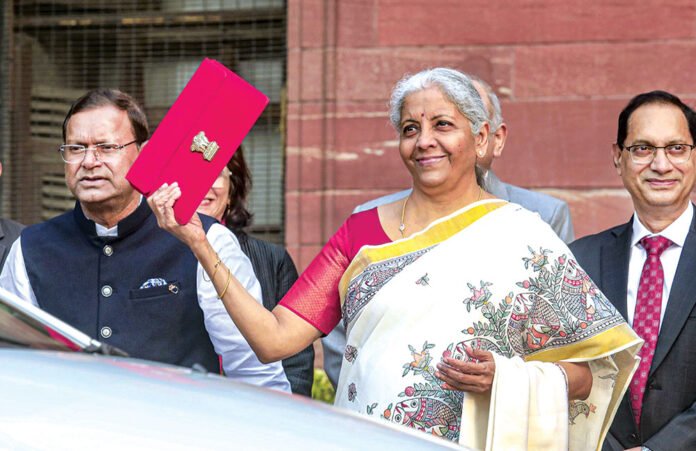
Since its constitution in April 1993 to exercise legislative oversight of the Ministry of Defence (MoD), parliament’s Standing Committee on Defence (SCoD) has examined and reported on such diverse issues as stress management in the armed forces, construction of border roads, welfare measures for the war widows, and defence public sector undertakings, but the annual defence outlays are one area it has anatomised and reported on with unfailing regularity. This exercise will be undertaken again next month shortly after Finance Minister Nirmala Sitharaman presents the union budget for 2026-27.
The committee’s reports on defence budget are a virtual mine of information and statistics, but the analysis and recommendations of the committee are rather staid, based as these are on a desultory assessment of the hike in outlay, its relation to the central government expenditure (CGE) and gross domestic product (GDP) in percentage terms, ratio of revenue expenditure to capital outlay, budgetary support for military modernisation, underutilisation of allotted funds, and the like. This has had little impact on the trajectory of the defence budget or its utilisation.

The defence outlay grew by a compound annual growth rate (CAGR) of 13.18% between 2004-05 and 2013-14, but this rate declined to 8.26% between 2014-15 and 2024-25. The corresponding CAGR of the capital outlay, which funds modernisation of the armed forces and consequently remains in focus all the time, declined from 9.99% to 6.16%. Meanwhile, the share of defence expenditure in the CGE fell from 13.59% in 2011-12 to 9.55% in 2024-25, and its share in the GDP fell from 1.96% to 1.39% during the same period.
On several occasions in the past SCoD had commented on underutilisation of capital outlay and exhorted the MoD to make sure that the funds are fully utilised. And yet, funds were continuously underutilised between 2011-12 to 2015-16 and then again from 2022-23 onwards. The underutilisation ranged from ₹1,296 crore in 2011-12 to ₹ 14,602 in 2014-15. Even last year (2024-25), there was underutilisation to the tune of ₹ 12,232 crore.
These facts are too palpable to be glossed over by the committee, but its response to this stark reality has generally been by way of generic instructions to MoD, such as to seek more funds from MoF for expediting modernisation of the armed forces, ensure full utilisation of allotted funds by reforming the procurement procedures, and maintain a balance between revenue and capital expenditure. These are common sense precepts which MoD’s civil and military bureaucracy is expected to follow anyway even without any external prodding.
To be fair, sometimes the committee does transcend such generalities and makes specific recommendations, but most of them have turned out to be impractical. For example, ignoring the protestations of the Ministry of Finance (MoF), SCoD ‘strongly recommended’ in its 16th report on the Demands for Grant for the FY 2007-08 that MoD should ask MoF to provide ‘a minimum 3% of GDP for Defence Services every year in order to ensure a fixed amount to carry out their modernisation, Capital acquisition and R&D Programme and fulfil the need based requirements of the Defence Forces’. In the event, this feat was never achieved and, as a matter of fact, the percentage has consistently remained below 2% at least since 2011-12.

It’s time SCoD tried a different and pragmatic approach to examining MoD’s Detailed Demands for Grant which at the present juncture, are four in numbers: Ministry of Defence (Civil), Defence Services (Revenue), Capital Outlay on Defence Services, and Defence Pensions. Some of these demands are not appropriately structured
Likewise, for a long time, SCoD kept rooting for creation of a non-lapsable ‘Defence Capital Fund Account’ for modernisation of the armed forces. In its 32nd report of August 2016, the committee called it ‘an imperative need for enhancement and heightened operational preparedness of our Defence Forces’ and argued that ‘even if certain financial rules and regulations have to be amended for creation of a ‘ Non-lapsable Defence Capital Fund Account’ to meet the requirements of our Defence forces, it can and should be done in the interest of the nation’. This recommendation too was contrary to the reservations expressed earlier by MoF and MoD itself. Though subsequently the government did take some initial steps to set up the fund, the move seems to have fizzled out, not least because MoD has not been able to utilise in full even the allocated funds in the last three years.
These are but a few examples of SCoD’s unproductive efforts specifically in relation to its ‘examination’ of the annual defence outlays. It’s time SCoD tried a different and pragmatic approach to examining MoD’s Detailed Demands for Grant which at the present juncture, are four in numbers Ministry of Defence (Civil), Defence Services (Revenue), Capital Outlay on Defence Services, and Defence Pensions. Some of these demands are not appropriately structured. For example, the Demand for capital outlay on defence services includes the outlay for Ex-servicemen Health Scheme, National Cadet Corps, Research and Development, etc., but excludes Border Roads, Coast Guard, and JAK LI which is an infantry regiment of the Indian Army. This distorts the overall picture of defence budget. It will be a good starting point for SCoD to ‘examine’ the need for setting right this anomaly.

The larger point, however, is that it is futile to be fixated on numbers and percentages, draw innocuous conclusions from specious statistical analyses, and proffer the same advice, sometimes with change of phrase, year after year, or recommend measures which lack rationale. Consisting of members from both houses of the parliament, SCoD is placed in a vantage position to bring about seminal budgetary reforms. What forms the core of these reforms is the need to arrest downward slide in the allocation for defence, especially in view of the contemporary developments in India’s immediate neighbourhood and the wider geopolitical unpredictability, which impart a sense of unprecedented urgency to strengthening India’s military capabilities. This is possible only by institutionalising financially viable defence planning.
SCoD has dealt with the issue of defence planning sporadically in the past but it always stops short of enquiring what ails defence planning in that why defence planning hasn’t taken roots in India the way it has in other leading countries of the world. There are questions like whether enunciation of a national security strategy is a sine qua non for defence planning and whether we have the right organisational structures and professionally qualified personnel for planning. These are the fundamental issues that SCoD must first address to harmonise budgetary allocations with planned outcomes which, in turn, would make its examination of the annual outlays more meaningful.
Space constraint doesn’t permit a detailed elaboration of the areas in which SCoD could make a more meaningful and long-lasting contribution with its erudite analysis of the budget outlays, their utilisation, and most importantly, the outcomes. It would be presumptuous to suggest how SCoD should go about this task, but the change in its approach must be based not only on a dispassionate self-assessment of its current approach and efficacy of its observations and recommendations, but also on the inputs from a cross section of experts, institutions and think tanks.

–The writer is a former Financial Advisor (Acquisition), Ministry of Defence. The views expressed are personal and do not necessarily reflect the views of Raksha Anirveda
