

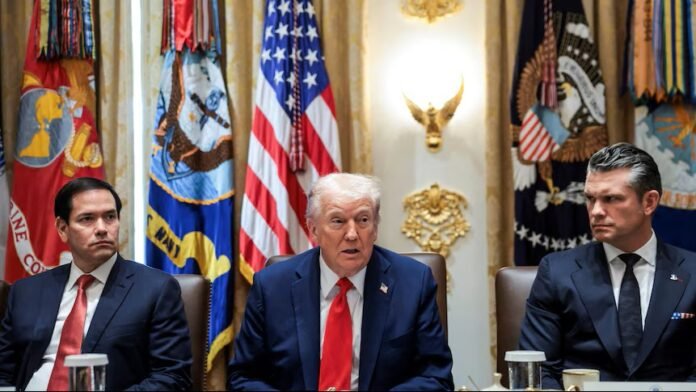
Amidst the wreckage of what is now a ruined Gaza, state actors are engaged in a flurry of diplomatic activities to restore peace in the beleaguered enclave. It is in that context that the American administration under President Donald Trump unveiled a significant 20-point peace plan. Some of the important provisions include, implementation of a ceasefire followed by the return of all hostages, both alive and deceased, demilitarization of the enclave via the disarming of Hamas, constitution of a ‘Board of Peace’ that will oversee the restoration of Gaza’s infrastructure and necessary amenities which lie in shambles and transition to a civilian government comprising technocratic administrators that would ensure proper management of the enclave.
The first phase of the peace deal saw the enforcement of a ceasefire followed by a relatively smooth exchange of Israeli hostages and Palestinian prisoners lodged in Israeli jails. However, it is the second phase of the peace deal that has seemingly opened up a Pandora’s Box. This concerns the structure, functions and the future of the Trump-led ‘Board of Peace’. The Trump administration has extended an invitation to India to oversee the “transformation of Gaza from a ruined land to a sprawling metropolis.”

However, India has politely declined the invitation by not attending the inaugural meeting of the body recently, preferring instead to adopt a wait-and-watch approach. At a surface level, it may seem like any other diplomatic action of trivial importance, but a deeper analysis reveals the significance behind India’s bold diplomatic step.
The legitimacy of the ‘Board of Peace’ is questionable. It is part of an initiative led almost exclusively by the United States, with other countries acting as mute spectators to American actions
Questions of Legitimacy
The very legitimacy of the ‘Board of Peace’ is questionable. It is part of an initiative led almost exclusively by the United States, with other countries acting as more or less mute spectators to American actions. It signals an attempt by the Trump administration to place the United States as the ‘world’s peacemaker’.
In addition, it raises pertinent questions in the realm of international law, particularly the role of the United Nations Security Council, which has been the de facto international body responsible for the maintenance of international peace and stability, particularly on issues concerning the defusing of wars and enforcing peace. Even though the board is backed by UNSC Resolution 2803, the Trump-led body can be seen as an attempt at usurping the mandate provided to the UNSC.
Once the Trump administration is gone, the status of the board will be questioned, with its members changing their stance in accordance with the approach of the next administration
Questions of Temporality
It is essential to bear in mind that the ‘Board of Peace’ is the brainchild of Donald Trump. It is the outcome of his transactional style of diplomacy that craves optics and showbiz, more than substance. Now, given that the Trump administration has already completed one year in office, only three years are left. In that context, obvious preemptive speculations will be raised about the very continuance of the Trumpian board. Also, given that the US Constitution limits a President to two terms only, it is a signal that no individual, no matter how powerful, can undermine a sacred contract like the Constitution.

Hence, once the Trump administration is gone, the very status of the board will be questioned with its members changing their strategic positions in accordance with the approach of the next administration, especially one which may attach more importance to international law and renewed commitment to liberal internationalism.
Interventionist Intentions
The ‘Board of Peace’ is a subtle American attempt to undertake something far more audacious — use the peace-building and peace-enforcement narratives in Gaza and apply them to other conflict zones. This is pertinent when it comes to India’s strategic sensitivities concerning Pakistani cross-border terrorism. Over the past year, since Operation Sindoor, Trump has repeatedly claimed credit for stopping hostilities between the two nuclear-armed countries.

The ‘Board of Peace’ is a US attempt to undertake something far more audacious, using the Gaza peace narrative in other conflict zones, including the India-Pakistan dispute over Kashmir
The ‘Board of Peace’ in that context gives the Trump administration the legal backing via UNSC Resolution 2803 to extrapolate the Gaza template as far as the South Asian theatre of conflict is concerned.
The US would then intervene on several issues, particularly on Kashmir, which is the red line for New Delhi. India has repeatedly rejected attempts at intervention and has made it clear in no uncertain terms that Kashmir was, is and will be an inalienable part of India; there is not to be an iota of doubt as far as this issue is concerned.
Hence, by declining to join the ‘Board of Peace’, India has not only done the right thing but also ensured that it can see how developments unfold over the coming period regarding Gaza’s future and India’s presence in the Middle East.

–The writer is currently working as a Research Associate at Defence Research and Studies (dras.in) and is a columnist. The views expressed are personal and do not necessarily reflect the views of Raksha Anirveda
