
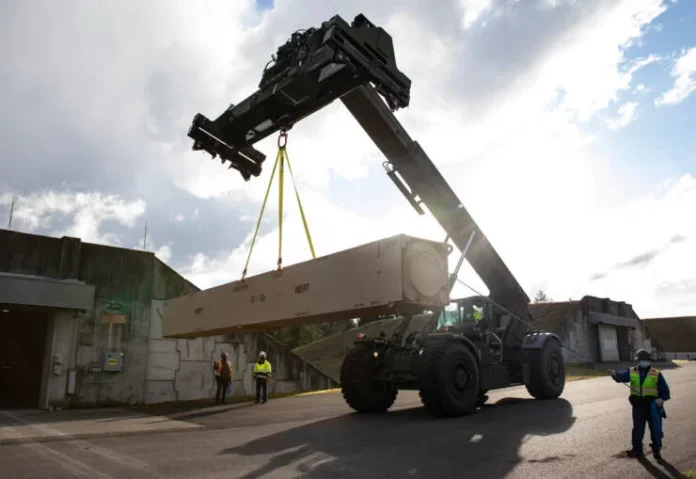
Washington: The US Navy and its industry team conducted the first live-fire test of the rocket motor May 27, which will propel the Navy’s Conventional Prompt Strike offensive hypersonic missile and the Army’s Long Range Hypersonic Weapon.

The Navy’s Strategic Systems Programs office tested the first-stage solid rocket motor, or SRM, in Promontory, Utah. Northrop Grumman developed the motor and Lockheed Martin serves as the prime weapon systems integrator to provide boost capability to the two armed services’ respective hypersonic strike missile.
“The first stage SRM will be part of a new missile booster for the services, and will be combined with a Common Hypersonic Glide Body (CHGB) to create the common hypersonic missile. Each service will use the common hypersonic missile, while developing individual weapon systems and launchers tailored for launch from sea or land,” a Navy news release said. “This successful SRM test represents a critical milestone leading up to the next Navy and Army joint flight test, which will take place in the first quarter of Fiscal Year 2022, and ultimately the fielding of the CPS and LRHW weapon systems.”
The common glide body was successfully tested in March 2020, and the Army and Navy are now working with government-run national laboratories and industry on development and production. The Navy led the glide body design effort, and the Army is leading the production effort.
The director of Strategic Systems Programs, Vice Adm. Johnny Wolfe, said last year at the Naval Submarine League annual conference that a key challenge ahead for the Navy, Army and industry would be to “take all the successes we’ve had in the research and development of flight testing. And how do we start to productionize that? And how do we transition that into a military capability that we can give to the Army — because we’re kind of doing this collaboratively with the Army — for what they want to do for their first all-up round capability in about the 2023 time frame? And then how do we continue to push that forward so that we get to a Navy capability on [guided-missile submarines] in the 2025 time frame?”

The Navy has since changed its plans for the Conventional Prompt Strike hypersonic missile. Rather than fielding it on a guided-missile submarine first, Chief of Naval Operations Adm. Mike Gilday said last month, the Navy will instead prioritize putting the large missiles on its Zumwalt-class destroyers. The common hypersonic weapon will fit into an Army ground launcher or a Navy launcher installed on a submarine or surface ship.
Hypersonic weapons can fly at greater than five times the speed of sound and would put most targets around the globe at risk within minutes. The Navy has talked about hypersonic weapons being a top priority as the service modernizes its fleet for a high-end threat like China.