

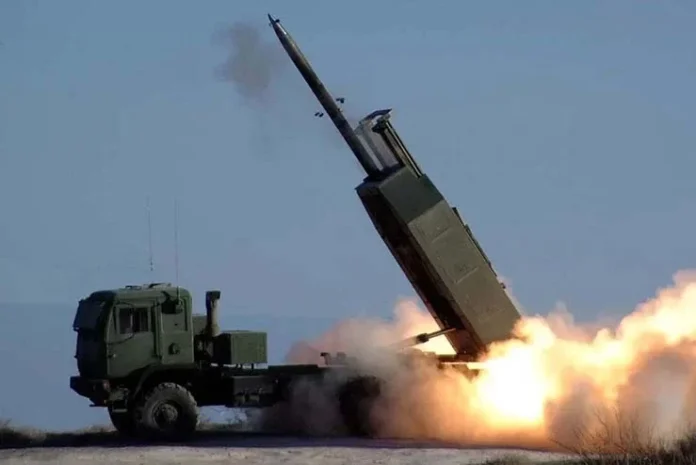
Tel Aviv: The US backed militias in Syria are being trained with American made weapon systems to counter the growing aggression of the Iranian terror groups in this country. The initiative is in parallel to an enhanced Israeli effort to prevent the Iranian master plan to get a strong foot hold in different areas in Syria to be used as sites that can initiate missiles and UAV attacks against Israel.
Last week, the Maghawir Al – Thawra militia announced that the US has provided it with a HIMARS guided rocket system. American sources said that the militia was only trained in the operation of this weapon system.

The High Mobility Artillery Rocket System (HIMARS) is the newest member of the MLRS launcher family. HIMARS carries a single six-pack of rockets or one ATACMS missile on the Army’s Family of Medium Tactical Vehicles (FMTV) 5-ton truck, and can launch the entire MLRS family of munitions.
The Maghawir Al – Thawra is a Syrian opposition group which controls territory near the Syria – Jordan border. In the past this militia claimed that it received training from the CIA and Jordan.
According to Middle East Institute, during February and early March 2022, the militias of the Iranian Islamic Revolutionary Guard Corps (IRGC) located in Syria’s al-Hasakah Governorate brought in several shipments of weapons and military equipment in an effort to strengthen their military and security presence in the governorate, which is considered the richest in Syria in terms of oil and agricultural wealth.
“Three Iranian shipments arrived at the airport during February and March,” one of the employees of the Qamishli Airport in al-Hasakah stated. “Two of them were loaded with various weapons and ammunition, while the third shipment was logistical equipment and about 50 small drones to be used for training in collecting espionage images and information.”

Dr Mordechai Kedar, a senior Israeli expert on middle east issues told Raksha Anirveda that Iran is seeking greater control on parts of Syria and is sending more militia members from Iraq and Afghanistan. “The US interest is mainly to protect the oil producing area in Eastern Syria,” Kedar added. He further said that Russia is backing the Assad regime and is trying to disrupt the Iranian plan to get to the shore of the Mediterranean.
“Syria is a torn country and each power that is active in this country finds itself more frequently muddling in deep and sticky mud,” he concluded.

According to the Just Security website, since 2014, the United States has conducted periodic airstrikes and maintained hundreds of troops in Syria as part of broader counterterrorism efforts against the self-proclaimed Islamic State (IS) and al-Qaeda (AQ).
“Most notably, the conflict has expanded to include US hostilities against Iranian-backed militia groups supporting Syrian President Bashar al-Assad’s embattled regime, without explicit congressional authorisation or any clear military objective beyond deterring future attacks. Instead, the United States and these militia groups have devolved into a cycle of “tit-for-tat” strikes. The US military footprint in north-eastern Syria, alongside sporadic strikes against IS in the country, risks bringing the United States into direct military confrontation with pro-Assad forces, including Iran and potentially Russia. In light of these risks, it is crucial to reconsider US strategic objectives in Syria, the legal basis for the use of force there, and whether US military operations within Syria are the best means of meeting US goals.”
While the US is helping Syrian militias that are against Iran’s effort to get control on parts of the country, Israel is continuing to target shipments of Iranian made weapon systems that go the Hezbollah in Lebanon via Syria. The intensity of the Israeli attacks resulted in a Russian demand to stop them. The Foreign Ministry Spokeswoman, Maria Zakharova, condemned what she called ” irresponsible actions and called for their unconditional cessation.”

-The writer is an Israel-based freelance journalist. The views expressed are of the writer and do not necessarily reflect the views of Raksha Anirveda
