

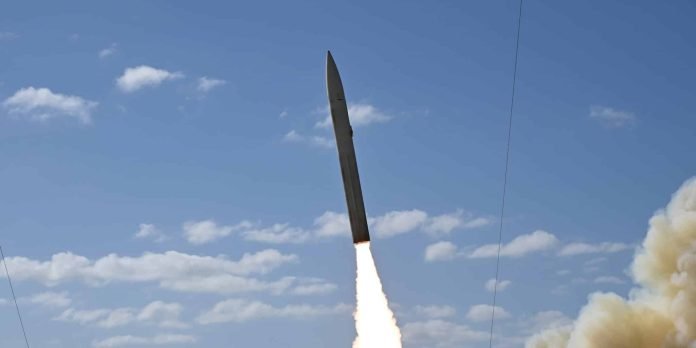
Washington: The US Army has scheduled a test of its Long-Range Hypersonic Weapon, or LRHW, for December, the service’s program executive officer for missiles and space said in a recent interview.
After a lengthy delay as the Army and Navy struggled to test a jointly developed hypersonic glide body capability, the Army said earlier this year that it would field its ground-launched missiles to the first unit by the end of fiscal 2025. In fact, the Army is forecasting that the first unit to get the hypersonic capability will begin receiving the rounds at Joint Base Lewis-McChord in Washington state, in the May time frame, Maj Gen Frank Lozano said.

The 1st Multidomain Task Force, 5th Battalion, 3rd Field Artillery Regiment, 17th Field Artillery Brigade unit at JBLM received all equipment for the LRHW capability except for the actual live rounds in 2021. The unit was supposed to get the missiles in the fall of 2023 but several aborted test events forced the Army to push back its fielding plans.
The Army is working to transition the LRHW program from the Army’s Rapid Capabilities and Critical Technologies Office (RCCTO) to Program Executive Office Missiles & Space, but it won’t formally join the portfolio until the first round is delivered, Lozano noted.
Lockheed Martin, the lead weapon integrator for the truck-launched capability, is wrapping up work on the first round at its facility in Courtland, Alabama, according to Lozano. Leidos’ Dynetics manufactures the common hypersonic glide body that will be supplied to both the Army and Navy versions of the weapon.
The Army unit at JBLM will continue to receive rounds as they come off the production line throughout the year. The Army plans to couple a test firing of the round with soldiers from the unit at the console as part of their operational training in December because the rounds are “very expensive,” Lozano said. “We’re trying to be efficient.”

The US is in a race to field the capability and develop systems to defend against hypersonic missiles, as China and Russia are actively developing and testing hypersonic weapons. Hypersonic weapons can fly faster than Mach 5 — or more than 3,836 miles per hour — but their ability to maneuver between varying altitudes sets them apart. Their maneuverability makes them much harder to detect and defeat.
The Army conducted a successful end-to-end flight test of its hypersonic missile at the Pacific Missile Range Facility in Hawaii in May 2024, bringing the initial fielding to the first unit closer to the horizon.

The Army and Navy completed another successful all-up round test in December at Cape Canaveral Space Force Station, Florida, of the Common Hypersonic Glide Body, or C-HGB. The test provided additional confidence to move forward with the system, which consists of a weapon’s warhead, guidance system, cabling and thermal protection. The Navy’s version, dubbed Conventional Prompt Strike, will be launched from ships.
While the plan to field the weapon to the Army has taken nearly two years longer than planned, Army officials have been quick to point out that missile development programs typically take about 10 years. The LRHW program is just beyond the five-year mark.

