

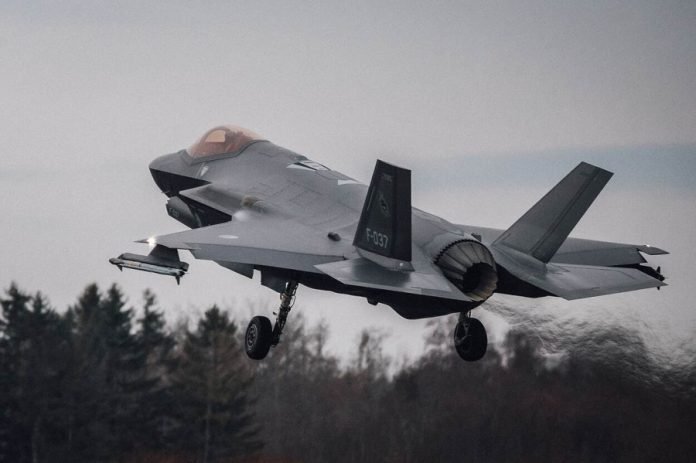
Tel Aviv: The US Air Force will implement many of the changes the Israeli Air Force made to its F-35. These changes enabled the attack on the Iranian nuclear facilities in June 2025.
Israel’s unique F-35I “Adir” modifications were central to making the June 2025 long-range, heavily defended strikes on Iranian nuclear sites like Natanz, Fordow, and Isfahan, feasible and survivable.
Israel fielded extended-range solutions allowing F-35Is to spearhead strikes roughly 1,500 km from Israel while reducing dependence on the small, vulnerable tanker fleet.
Sources here were only ready to say that the F-35 operated by the IAF carry more fuel “in special tanks”. This in the non-stealth phase of the flight.
Israel Aerospace Industries (IAI) has developed special fuel tanks for various types of fighter aircraft.
In recent tests, the special F-35 test aircraft was armed with an Israeli-made precise bomb weighing 1000 kgs. This bomb was designed to fit the weapons bay of the F-35 . It is described as a bomb with “super penetration”. No further details have been released but one of the Israeli company Rafael’s family of smart bombs is the Spice 2000 – an add-on kit for 900 kg warheads such as the MK-84, BLU-109, RAP-2000 and others.
It can be assumed that the new bomb is based on the experience gathered by using this bomb. In recent tests, this unique bomb developed for the IAF’s F-35 achieved a CEP of 3 metres.
The F-35 test aircraft operated by the IAF’s main test unit has been also equipped with systems that enable it to fly and launch weapon systems in an EW-saturated area.
The recent years GPS denial events caused by the Russian forces in Syria accelerated the development of systems that will make Israeli-developed military systems immune to such disruptions. Some are already in operation while others are being tested.
Officially no one in Israel was ready to address the problem. By analysing the Russian GPS denial systems operated in Syria, Israel took some action to be better ready to a more aggressive GPS denial. The proliferation of Russian-made GPS jamming systems in the Middle East accelerated the process of equipping the Israeli Air Force’s aircraft with anti-jamming systems .
In 2021, the IAF revealed that an advanced anti-jamming system developed by Israel Aerospace Industries (IAI) has been integrated into advanced platforms used by its different squadrons.
The system is the ADA Anti-Jam GPS System, designed to protect GPS/GNSS navigation from jamming.
According to IAI, the system has been integrated into advanced platforms used by the Israeli Air Force (IAF), including F-16 fighter jets and various types of UAV. The ADA System has demonstrated operational maturity and is in use by a number of international customers on various airborne, land, and marine platforms.
According to Israeli sources, in the June operation the F-35 used Israeli developed -augmented electronic warfare (EW) and “counter-defence integration” systems were designed specifically to neutralise or degrade radars and SAMs, enabling F-35Is to operate in heavily defended airspace beyond what a baseline F-35A is optimised for.
In the 2025 strikes, F-35Is conducted intensive SEAD, knocking out key air-defence radars and S-300 components to open corridors for large follow-on waves of F-15 and F-16 aircraft.
Israeli F-35Is are integrated with indigenous precision-guided munitions and targeting software, improving accuracy against hardened and underground facilities like Natanz and Khondab.
Israel turned the F-35I into a central sensor and C4I node: enhanced data-gathering, processing, and advanced datalinks allowed each jet to fuse intelligence and share targeting in real time with other fighters, ISR assets, and ground networks.
During Operation Rising Lion, this meant F-35I’s could silently map Iranian air defences and targets, then pass refined coordinates and threat data to non-stealth aircraft, multiplying the effectiveness of the ~200-aircraft strike package.
Israel’s ability to control F-35I software and integrate its own “app stack” and EW libraries meant the IAF could rapidly tailor threat databases and tactics specifically for Iranian radars and SAMs, without waiting for US baseline updates.

-The writer is an Israel-based freelance journalist. The views expressed are of the writer and do not necessarily reflect the views of Raksha Anirveda
