
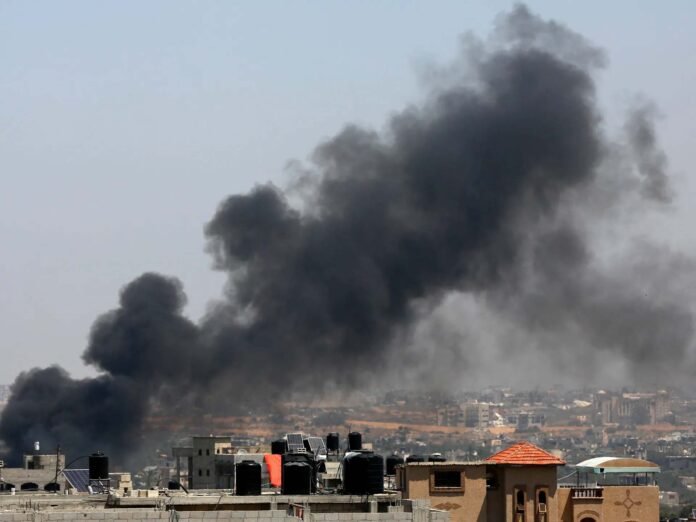
In the aftermath of Ayatollah Khamenei’s death, the Islamic Revolutionary Guard Corps’ (IRGC) retaliatory targeting of US assets in Muslim countries across the Middle East (West Asia) may create deep fissures among the 56 Muslim-majority nations. There would be a plethora of adverse side effects affecting Iran, the Middle East, and even the globe at large.
Let us take Iran first. Iran does not enjoy an effective air defence system. Israel and the USA would dominate Iranian airspace. Such domination of airspace by the USA and Israel would cause extensive damage to Iran’s stored arsenal of missiles, drones, and their launchers. The manufacturing facilities for these weapons could be slowed down or even destroyed. This will affect Iran’s capacity to sustain the war.

The indiscriminate firing of missiles and drones at non-military targets will rapidly deplete its arsenal. If the current intensity of firing continues, it will deeply affect its ability to replenish its stockpiles. With the elimination of 40 or more top commanders, the second and third rung of the IRGC and military leadership may lack a coherent war strategy beyond retaliation. It appears to be expending its drones and missile arsenal (main weaponry) indiscriminately on non-military targets. Thus, if there is no immediate replenishment, it will affect Iran’s ability to sustain the war effort for a long period. At the present rate, such capacity may not last beyond 30–45 days.
Thus, the reduced capacity to sustain the war could facilitate a “regime change”—the primary objective of Israel and the USA. Should that happen, Iran’s sovereignty may effectively be compromised, as the new regime would likely be a “puppet regime.” Such a regime would do the bidding of the United States, similar to what critics say has happened in Pakistan under its powerful military leadership, led by Field Marshal Syed Asim Munir.
The first task of the so-called puppet regime would be to dismantle the assets and facilities required for the creation of a nuclear bomb. It is believed that Iran possesses around 400 kg of enriched uranium, enriched up to 60 per cent purity, a level that can be quickly raised to the 90 per cent threshold required for nuclear weapons. The survival of the puppet regime would likely depend on handing over Iran’s enriched uranium stockpile to the USA.
However, it is essential to understand that the decimation of pro-Khamenei supporters with radicalised mindsets would be extremely difficult. The US and Israel would require BOG (Boots on the Ground) rather than SOG (Stooges on the Ground) in the form of a puppet regime. However, the physical involvement of US troops is highly unlikely. The lessons of the 21-year war in Afghanistan cannot be ignored by the US President and his military strategists. Therefore, “total victory” remains a distant prospect.

Even if a puppet regime were installed, it could prove to be an outright liability. Its installation would likely lead to an “anti-puppet regime movement,” culminating in full-blown militancy. The bigoted and regimented minds (BARM) of IRGC cadres would prove extremely difficult for any puppet regime to control.
Evidence of such BARM-driven insurgency can be seen from the fact that another hardline Shia Islamist has replaced Khamenei as Supreme Leader. The new Supreme Leader is Murtaza Khamenei, the son of the late Ayatollah Khamenei. His appointment has reportedly been validated by 88 members of the “Assembly of Experts.” However, he is known to be equally hardline and uncompromising as his late father. He will preside over the Interim Council, along with the Islamic Republic’s President, Masoud Pezeshkian, and Judiciary Chief, Gholam-Hossein Mohseni Ejei.

The current Iranian leadership has already indicated that Iran reserves the right to seek revenge and will not stop until it has taught its enemies a lesson. The way Iran has responded so far by targeting multiple Middle Eastern nations and Israel suggests that peace remains a distant prospect—even if the current ruling “trio of Iran” were forced out of Tehran.
This war will have serious economic repercussions not only for Iran but also for the entire West Asian region. Oil supply will be affected and prices would rise sharply. Extensive damage caused to infrastructure would take years to rebuild and restore. What is more, hardline elements within several nations may rise up against their existing governments.
Thus, the entire West Asian region could be destabilised. A growing sense of insecurity among nations would trigger an arms race. New military alignments would emerge across the Middle East. The cohesiveness of the Organisation of Islamic Cooperation (OIC) would be damaged by factionalism. The Shia–Sunni divide may widen further. Internecine conflict would raise the levels of insecurity, violence, and bloodshed. The Middle East may never be the same again.
The entire West Asian region could be destabilised. A growing sense of insecurity among nations would trigger an arms race. New military alignments would emerge across the Middle East. The cohesiveness of the Organisation of Islamic Cooperation (OIC) would be damaged by factionalism
Concerns over safety and security would compel nations to increase defence spending to create their own security umbrellas. Air defence systems would need to be substantially strengthened. The current drone and missile offensive by Iran on US allies in West Asia has exposed significant gaps in their defensive capabilities.
This insecurity would affect business, investment, and the tourism industry. There would be a deficiency of skilled and unskilled workers, 70–80 per cent of whom come from India, Pakistan, Bangladesh, and Nepal. India alone contributes nearly 8.9 million workers in the region.
The economies of South Asian nations would also be affected because of the reduction in the flow of remittances generated by migrant manpower. Unemployment would increase, with a corresponding rise in crime among unskilled and unemployed youth. Countries like Pakistan and Bangladesh, already on the verge of economic collapse, would find survival increasingly difficult.
Pakistan, in particular, may face serious internal instability, as unemployed and idle youth may join the ranks of insurgent movements in Khyber Pakhtunkhwa, Balochistan, and Sindh. Many of these unemployed young men could fall easy prey to recruitment by religious extremist organisations.
Besides, it will cause a fissure in the “Muslim Ummah.” The Shia–Sunni conflict would not only affect West Asia but could also have a cascading effect across Asia.
Reports emerging from Pakistan suggest that divisions within the military along Shia–Sunni lines may be deepening. It is alleged that the Karachi-based Corps Commander, Lt Gen Avas Dastgir (a Shia), has revolted against Field Marshal Asim Munir (a Sunni) for siding with the USA. Lt Gen Dastgir is said to support Iran. It is alleged that the mob attack on the US Embassy Council was orchestrated by him. Reportedly, US Marine guards killed around 60 protesters and many others were injured. Islamabad, Lahore, and Skardu are reportedly witnessing widespread unrest.
It may be noted that two months ago Saudi Arabia and Pakistan signed a comprehensive defence pact. A key clause of the agreement stated that an external attack against either country would be treated as an attack against both. In such a scenario, the partner country would be obligated to assist the affected state. Surprisingly, despite missile and drone attacks on Saudi Arabia, Pakistan has not come to its aid by confronting Iran. This raises questions about the credibility and utility of the agreement.
At the global level, the restricted supply of oil would drive global prices upward. It is estimated that the first 24 hours of the air strikes on Iran alone cost the US around $779 million. According to US President Donald Trump, the war could continue for at least 30 days. If the war drags on for that duration, the US could end up spending around $210 billion, according to Kent Smetters, Director of the Penn Wharton Budget Model.
With West Asia in turmoil and both the USA and China facing strategic pressures, the world may gradually witness the emergence of a multipolar order without a single dominant “ringmaster”
In addition to the cost of the war, the destruction caused in affected countries, including Israel, would require massive reconstruction efforts. Rebuilding would demand huge financial resources, triggering an inflationary spiral. The cost of living would rise sharply.
Asia in general, and the Middle East in particular, may face an economic crisis similar to that experienced by war-ravaged Europe in the 1920s after the First World War. However, there will be no equivalent of the “Marshall Plan” to rebuild Asia, because even the USA itself may struggle financially to restore its global position.
Thus, with West Asia in turmoil and both the USA and China facing strategic pressures, the world may gradually witness the emergence of a multipolar order without a single dominant “ringmaster.”
In the ultimate analysis, the world could acquire a “new look” in the post-war scenario. The United Nations Organisation (UNO) may be restructured, with new players such as India, Germany, or even Japan entering the UN Security Council. The veto powers of the “Big Five” could potentially be replaced with a more democratic system of majority decision-making. Representation from Africa and Southeast Asia would become essential.
Thus, the dominant role of the traditional “Big Five” could gradually diminish, and the United Nations may eventually be reorganised to settle international disputes more effectively and introduce stronger deterrent mechanisms for defaulters.

-An ex-NDA and Wellington Staff College graduate, Col Rajinder Singh is a renowned author and security analyst. He has authored four books, two individually and two in collaboration. His best-selling books are Kashmir – A Different Perspective and The ULFA Insurgency. The views expressed are of the author and do not necessarily reflect the views of Raksha Anirveda
