

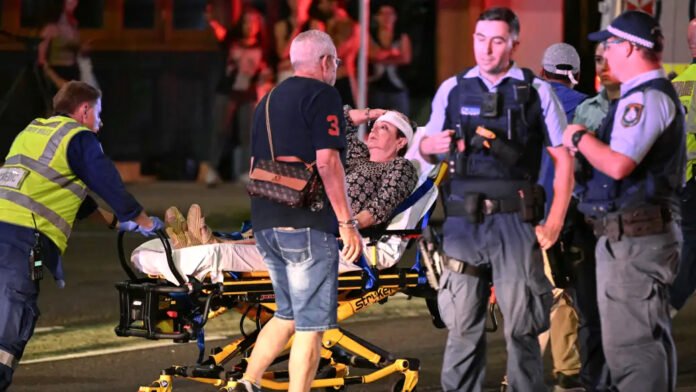
The recent Sydney Bondi Beach attack, where two gunmen carried out mass shootings on the beach, specifically targeting the Jewish community. However, what was concerning about this terror attack was the ISIS influence. According to a report, one of the Bondi Beach gunmen came to the attention of Australia’s domestic intelligence agency six years ago for his close ties to a Sydney-based Islamic State (IS) terrorism cell. The report further stated that two IS flags were found in their car at Bondi Beach. This attack occurred 24 hours after the ISIS ambush in Syria, which killed three Americans and two US soldiers.
The Same Design
Last year, a 42-year-old US Army veteran, Shamsud Din Jabbar, crashed a Ford F-150 pickup truck into a crowd-packed street celebrating New Year’s Eve in New Orleans and then exited the vehicle and opened fire on the crowd. According to reports, this attack resulted in the killing of at least 15 people and wounding more than 30. This kind of lone wolf attack on US soil came after almost eight years.

The last was in the 2017 New York City Truck Attack, where eight people were killed, and 12 were injured — ISIS then took the responsibility. However, since last year, the terror dynamics have changed, and this recent attack has perhaps indicated a dangerous shift in ISIS’s striking pattern.
Two lone wolf attacks occurred in October 2023 in France and Belgium. The assessment indicates that ISIS was unable to carry out a deadly lone wolf attack in the West like the one in France in July 2016, where a truck ploughed into a crowd celebrating Bastille Day, resulting in 86 deaths and injuring 434 people
ISIS Lone Wolf Attacks
ISIS exhibits a typical pattern of attacks — suicide bombings and lone wolf assaults, with the former being more frequent since the twin bombing in Iran in January last year and the Moscow concert hall attack. Over the past year, ISIS has carried out high-intensity terror strikes, primarily through bombings, although its capabilities have diminished. The last reported lone wolf attack in a metropolitan area occurred the previous year in Solingen, Germany, where a Syrian ISIS member stabbed three men during a festival.
Similarly, two lone wolf attacks occurred in October 2023 in France and Belgium. The assessment indicates that ISIS was unable to carry out a deadly lone wolf attack in the West like the one in France in July 2016, where a truck ploughed into a crowd celebrating Bastille Day, resulting in 86 deaths and injuring 434 people.
Most ISIS strikes occurred in Africa, Central Asia, and the Middle East, mainly involving suicide bombings or coordinated mass shootings. In Western countries, ISIS attacks were fewer and mostly consisted of stabbing incidents, which can be considered multiple attempts at lone wolf attacks or large-scale coordinated lone wolf assaults like those in Paris in November 2015 and July 2016.

ISIS Limited Capabilities
Since 2017, ISIS’s capabilities have started diminishing after the US intensified its counter-terrorism operations against ISIS. The US’s ongoing operation Inherent Resolve has achieved notable successes against ISIS, leading to significant losses in ISIS’s terrorist presence from 2017 to 2019. In 2019, ISIS was defeated in Syria and Libya. In October 2019, the US killed ISIS chief Abu Bakr al-Baghdadi in Operation Kayla Mueller. In 2023, the US killed several senior ISIS leaders and detained around 79 ISIS terrorists. US anti-ISIS operations have fragmented ISIS, at least eliminating its capabilities for over-the-horizon strikes targeting the West. This has resulted in a limited presence of ISIS in Africa, Central Asia, and the Middle Eastern region. In the past one to two years, high-intensity attacks have mainly occurred in these regions. The most significant decline happened when the US killed ISIS’s intelligence/foreign branch head Abu Muhammad al-Adnani in October 2016.
Last year, US Army veteran Shamsud Din Jabbar crashed a pickup truck into a crowd-packed street celebrating New Year’s Eve in New Orleans and then exited the vehicle and opened fire on the crowd. This attack resulted in the killing of at least 15 people and wounding more than 30
The killing of Adnani had significantly affected ISIS’s striking and recruitment capabilities, which limited high-intensity strikes on Western soil. Multiple major blows to ISIS over five years, from 2016 to 2020, and again in 2023, weakened ISIS, but the potential for a resurgence was not taken too seriously. The patterns also suggest that whenever ISIS’s influence is seen to be dwindling, it has tried to send a message to the West by carrying out high-intensity terror attacks in West Africa or Middle Eastern countries.

ISIS Resurgence and Shift in Pattern
The US-led coalition against ISIS has intensified its operations against the organisation’s limited and fragmented presence for a year, conducting 200 missions against Daesh since January 2024. According to reports, the US-led forces have killed 44 ISIS terrorists and detained around 166. Despite intensified operations, the organisation maintains a tight grip on its fragmented network and has attempted to capitalise on various opportunities to resurge. Three primary reasons have contributed to the periodic resurgence of Daesh.
- US shifting focus on Iran due to the Israel-Hamas conflict
- Increased destabilisation in Syria and West Africa, and eventual fall of the Syrian Government
- ISIS Khorasan’s increasing freedom of operation in South and Central Asia, especially in Afghanistan.
ISIS exhibits a typical pattern of attacks — suicide bombings and lone wolf assaults, with the former being more frequent since the twin bombing in Iran in January last year and the Moscow concert hall attack. Over the past year, ISIS has carried out high-intensity terror strikes, primarily through bombings
These three reasons have directly or indirectly facilitated ISIS’s regrouping at the regional level, providing the outfit with occasional opportunities to carry out low-intensity terror strikes worldwide. The fall of the Assad government last year and the mobilisation of various Islamic coalitions in Syria have given ISIS, especially Khorasanis, a window to resurgence and to enhance their capabilities to strike. However, the resurgence factor is not the only concern; a potential shift in ISIS’s striking pattern could also be significant and worrisome, enabling Daesh to demonstrate its capabilities while managing its resurgence.
Shift in Striking Pattern
ISIS terror strikes can be classified into three patterns. The first is direct, in which ISIS carries out attacks. The second involves ISIS enabling an attack and indirectly participating, as seen in the 2015 Texas attack, where one attacker who opened fire at a community centre was in contact with ISIS through encrypted texts.

Third is Inspired, where individuals carry out lone wolf attacks on their own after becoming self-radicalised through ISIS online propaganda, such as the 2016 France attack, in which a self-radicalised man drove a vehicle into a crowd and opened fire, killing 80 people and injuring around four hundred. Later, ISIS claimed responsibility, but the driver had no direct link to ISIS. A critical incident was the 2017 Stockholm attack, where a similar vehicle ramming occurred by a self-radicalised man who was later arrested; in this case, however, ISIS did not claim responsibility. During 2017, ISIS was under intense pressure, and its presence and capabilities were significantly weakened, helping US-led coalition forces to defeat ISIS in Iraq by the end of the year.
The US-led coalition has intensified its operations against ISIS’s limited and fragmented presence, conducting 200 missions since January 2024. The US-led forces have killed 44 ISIS terrorists and detained around 166. Despite intensified operations, the organisation maintains a tight grip on its fragmented network
Similarly, ISIS is once again under pressure in Syria from US air strikes, while seeking opportunities to resurge. In such a situation, it can be argued that ISIS may have resorted to enhancing online propaganda and carrying out inspired attacks without direct involvement.
The reason for such a change in Daesh’s striking pattern is to ensure resurgence and maintain limited strike capabilities without exposing itself, thereby avoiding an immediate retaliatory and offensive response from the US, which could harm Daesh’s chances of resurging in Syria and elsewhere. If left unchecked, a new wave of ISIS terror could emerge, potentially being dangerously lethal because the detection of such inspired attacks is quite minimal.

The writer is a national security analyst specialising in intelligence and strategic affairs. He has worked extensively with national security and foreign policy think tanks of repute, and has written for publications including The Telegraph, The Print, Organiser, and Fair Observer. He has also been a guest contributor to the School of International Studies at Jawaharlal Nehru University (JNU).
