

Russia’s unjustified invasion of Ukraine in February 2022 has indubitably led to one of the bloodiest conflicts in Europe since the Second World War. Ukraine, a former Soviet Republic, has had inveterate cultural, economic, and political linkages with Russia. This invasion has irreparably harmed their relations, while collaterally affecting other European nations.
There is a possibility that the ongoing Russia-Ukraine crisis is a manifestation of renewed geopolitical rivalry between major global powers. It must be kept in mind that Russia is an energy giant, with Europe relying heavily on Russian energy exports, especially crude oil and natural gas. Furthermore, the crisis between Russia and Ukraine can also be viewed as an outcome of the American attempt to steer regional politics with productive outcomes in the Eurasian region to promote its national interests.

There is a disagreement in terms of possible causes and potential solutions to this ongoing conflict. Even though there are occasional ceasefires, there are negligible prospects for the re-establishment of diplomatic relations and affinity between Russia and Ukraine to the norms that prevailed before 2014, attributed to heavy damages to infrastructure and human casualties.
The Outbreak of Hostilities
In February 2022, Russia initiated “special military operations” against Ukraine. There were no existing diplomatic or bilateral relations between Russia and Ukraine—only bellicosity and an acute sense of hatred—as both nations have been in confrontation since Russia invaded the Crimean Peninsula in February 2014. At that time, Russian-controlled armed groups illegally captured government buildings in Donbas in May 2014. There are several reasons which have been cited by Russian leadership justifying the military operations.
While these objections included the long-simmering disagreement related to the North Atlantic Treaty Organization’s (NATO) enlargement and the security architecture of the post–Cold War scenario in Europe, President Putin’s speech focused on a much more essential question: the legitimacy of Ukrainian identity and statehood themselves. It projected an idea that President Putin had been emphasizing for a protracted period. It discussed the innate unity among the Eastern Slavs—i.e., Russians, Ukrainians, and Belarusians. All of these people trace their origins to the medieval ‘Kyivan Rus’ commonwealth.
The idea suggested that the modern nation-states of Russia, Ukraine, and Belarus should have a common political destiny, both at present and in the future. The result of this view is the claim that diverse Ukrainian and Belarusian identities are the product of foreign manipulation. Presently, the West is following the pattern that Russia’s imperial rivals utilised in Ukraine (and Belarus) as part of an “anti-Russia project”.

The Russia-Ukraine conflict which began in February 2022 marked the dramatic escalation of the eight-year-old struggle that initially began with the Russian annexation of Crimea in 2014. This can be further considered as a significant decisive moment for European security architecture. In 2015, after the beginning of the conflict, several analysts of defence and foreign policy referred to this conflict as a major strategic error by Russian President Vladimir Putin.
Historical Context and the Soviet Era
There is a deep cultural, economic, political, and historical connect between Russia and Ukraine. During the Cold War era, Ukraine was considered the cornerstone of the Soviet Union. It was politically dominant, the second most populous of the fifteen Soviet republics, and accounted for much of the Soviet Union’s agricultural production, defence industries, and military, including the Black Sea Fleet and aspects of the nuclear arsenal.

Ukraine was considered a vital factor in the Soviet Union’s disintegration by severing its ties with the Union in 1991. This was evidenced as the coup de grâce (final blow) for the debilitated superpower at that time. Ukraine has carved its own path since gaining its independence as a sovereign state by tilting more towards Western institutions like the European Union (EU) and NATO. However, for this reason, Ukraine has had to constantly struggle in terms of balancing its foreign relations. The internal domestic divide in Ukraine in terms of supporting its integration with Europe has been a problematic issue, rife with dichotomy and differing perceptions with precipitous fault lines.
The Tangled History of Russia and Ukraine
According to Russian President Putin, Russians, Ukrainians, and Belarusians are all descendants of Ancient Rus, which was the largest state in Europe in ancient times. Slavic and various other tribes spanning across Ladoga, Novgorod, Pskov to Kyiv and Chernigov were linked together through one language (which is now often referred to as Old Russian) along with economic ties and the rule of the princes of the Rurik dynasty after the baptism of Rus (the Orthodox faith). Also, Kyiv held a dominant position in Ancient Rus, which was a custom since the late 9th century.
It is not an overestimation to say that Russia considers Ukraine as a region necessary for its ‘geostrategic depth’. The West’s influence in the region adjoining Russia is manifested through NATO and the EU, which can be detrimental to Russian interests”
The term “Ukraine” was often used to denote the meaning of the Old Russian word “Okraina” (periphery). There are sources from the 12th century which referred to this term to denote various border territories. The word “Ukrainian” originally referred to frontier guards who protected the peripheral borders.
Independence and the Path to Conflict
Almost three decades back, the countries of the former Soviet Union declared their independence. At that time, Ukraine also declared its independence from the Soviet Union in 1991. It emerged as an independent sovereign nation after seventy years of totalitarianism. It also suffered from the civil war during the Bolshevik revolution, famine in the 1930s, the ruthless Nazi occupation, the Holocaust of World War II, and political expulsions and stagnation.
The Soviet Union was a Russian-dominated political construct, and the Ukrainian communist party was almost remote-controlled by the central authority in Moscow. Ukrainian political and cultural elites were siphoned off to Moscow to serve the Soviet administration. As was the case with other Soviet republics, Ukraine was essentially colonized by Moscow. This was a relationship that continued from the pre-revolutionary years of Tsarist Russia, where Ukrainian wealth and population were exploited for the benefit of the ruling Russian class. Due to this historical baggage, Ukraine, upon independence, lacked the statecraft traditions which are a prerequisite for establishing a new, sovereign nation.
Despite the disintegration, Ukraine’s energy, trade, and cultural ties with Russia remained strong. After declaring independence in August 1991, the Ukrainian declaration was ratified by a majority referendum and Leonid Kravchuk was elected as its first president. Ukraine’s transition to independence had been peaceful, with both the communists and democrats agreeing to this breaking away from the Soviet Union. An important factor supporting this was the predicted economic potential of the country.
The US decided to remain closely engaged, attributed to its own self-centred strategic reasons and conforming to its foreign policy in pursuit of its national interests as related to NATO’s concerns regarding Ukraine’s large Soviet nuclear arsenal. Furthermore, the Budapest Memorandum in 1994 provided an agreement to decommission the weapons after receiving security guarantees from the US, United Kingdom, and France aimed at guaranteeing the territorial integrity of Ukraine.
Economic Struggles and Shifting Allegiances
However, after independence from the Soviet Union, the Ukrainian economy suffered from shortages, blackouts, inflation, and spiking emigration. A considerable rise in economic prosperity in Ukraine between 2004 and 2007 coincided with its aspirations for a stronger democratic process.
It can be said that the origins of the contemporary conflict lie with long-standing Russian aspirations to control its periphery since 2000. Initially, President Putin’s strategy was soft coercion, but it became more assertive and aggressive over time. It was the ‘Orange Revolution’ of 2004 that made Putin reconsider his tactics. Victor Yushchenko, a pro-Western opposition candidate, came to power in his place. Yushchenko was poisoned during the electoral race but survived to serve as Ukraine’s president from 2005–2010.
However, Russia retained its control over Ukraine’s key industrial sectors. Ukrainian exports were still reaching Russia, and top security positions were held by people with Russian passports. In fact, Ukraine had undeclared propensities in a multispectral domain towards Russian material resources and signed a deal for natural gas trade in 2008. This committed Ukraine to being the largest purchaser of Russian gas, and at a higher cost than the market price. Furthermore, before 2018, Ukraine had no independent Orthodox church, and the Russian Orthodox church had total jurisdiction over the established territory in Ukraine. This included almost a similar number of parishes or communities in Ukraine as in Russia.
Geopolitical Triggers
The Russian Navy’s Black Sea fleet continues its presence in Crimea. This is due to a deal signed in 2010 which ensures its presence for future decades. At the same time, it is to be kept in mind that neutrality was embedded in the Ukrainian constitution. This was done at the insistence of Russia in order to prevent Ukraine from joining NATO. However, all Ukrainian presidents (including Yanukovych) had to address the issue related to the rising public demand for closer integration with the EU. Wishing to prevent a democratic Ukraine from becoming part of the EU market, Russia upped its hostile rhetoric against the EU as well as NATO.
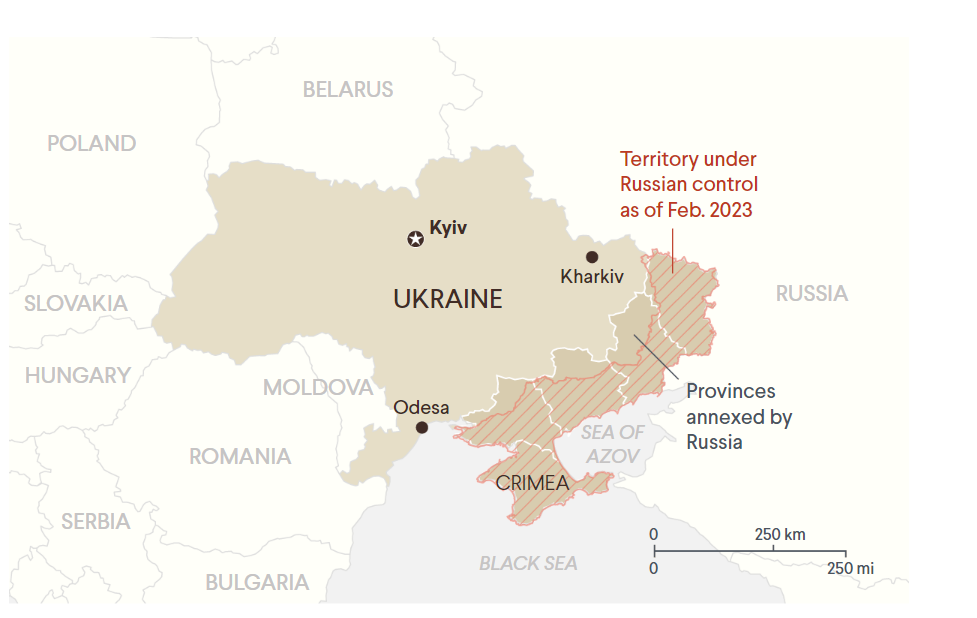
The Russian geostrategic interest and numerous geopolitical factors related to Ukraine are the primary triggers for this current Russia-Ukraine conflict. During the Cold War, the Soviet Union maintained strong control over Ukraine while dealing with financial crises and Western interference in its critical territorial security areas. Russia has been overly sensitive and concerned about being encircled by NATO and the EU. As a result, President Putin is eager to extend his influence and create strategic buffer zones along its land borders.
Ukraine’s transition to independence had been peaceful, with both the communists and democrats agreeing to this breaking away from the Soviet Union. An important factor supporting this was the predicted economic potential of the country
Secondly, the Russian idée fixe on acquiring Ukraine’s rich resources, such as oil, gas, and crops, is also a crucial cause of the present crisis. Russia is also deeply concerned about increasing Western influence in the Eurasian region. It is not an overestimation to say that Russia considers Ukraine as a region necessary for its “geostrategic depth”. The West’s influence in the region adjoining Russia is manifested through NATO and the EU, which can be detrimental to Russian interests.
Thirdly, Russia had ethnic interests in Ukraine due to the large ethnic Russian population that practices the Orthodox Russian religion and has religious, economic, and cultural roots with Russia. Fourthly, following the disintegration of the Soviet Union, the West has maintained its watch on countries formed after the disintegration and launched policies to bring about reforms in these nations through the promotion of democracy and human rights preservation. The main aim was to keep Russia away and allow NATO to establish deeper roots of influence in the Eurasian region. As President Putin was apprehensive of the threat of encirclement, he vehemently opposed Western advancement and encroachment through NATO.
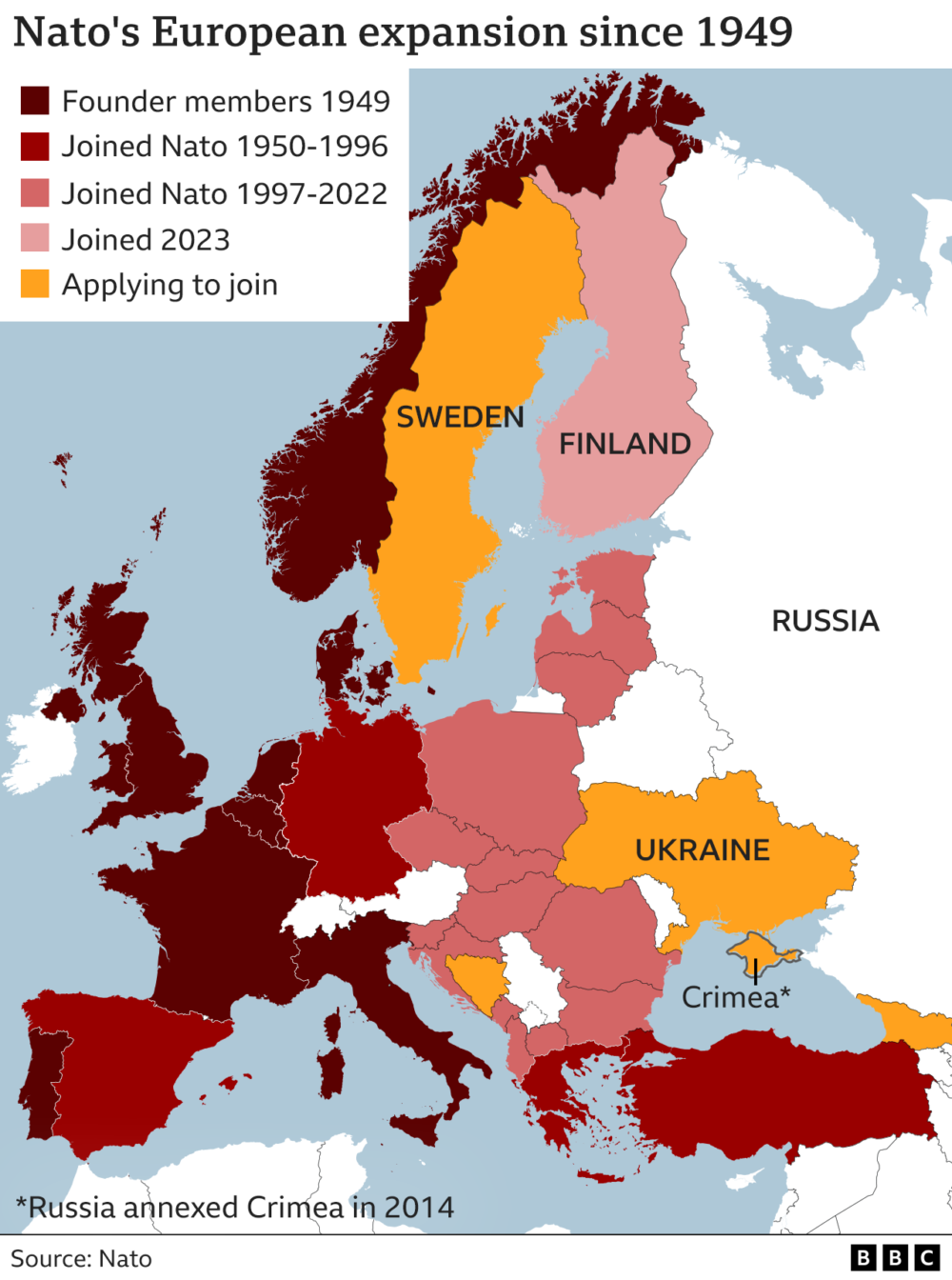
Fifthly, various indigenous or local issues—such as ethnic and economic factors—have become significant triggers for this contemporary conflict. On the other side, Ukraine perceived that economic relations with the West—i.e., with the United States and Europe—provided more economic gains than its relations with Russia. Although Russia was reluctant to lose its circle of influence, the Ukrainian social structure consists of several ethnic minorities, which became a justified cause for Russia to support and help ethnic Russians in Southeast Ukraine, like the Donbas and Luhansk regions. Russia has also provided military and economic support to minority groups in this region.
The anti-Russian groups in Ukraine wanted agreements with the West to achieve economic development as well as to put an end to the friction caused by Russian ethnic interests. The strong proclivities of these groups for an expeditious Western alliance with NATO were gathering momentum, thereby driving a wedge against pro-Russian groups, creating divisive forces, disruption, and a non-convergence of strategies in the political construct of a progressive nation.

Lt Gen S K Gadeock is a distinguished military leader, global strategist, and scholar who served as the Commandant of the Defence Services Staff College. A decorated veteran and former Logistics Advisor to the Botswana Defence Force, he has held numerous high-ranking appointments including Director General of the Amity Institute of Defence & Strategic Studies. Serving on the Advisory Board of Raksha Anirveda, he is a prolific writer and motivational speaker.
