

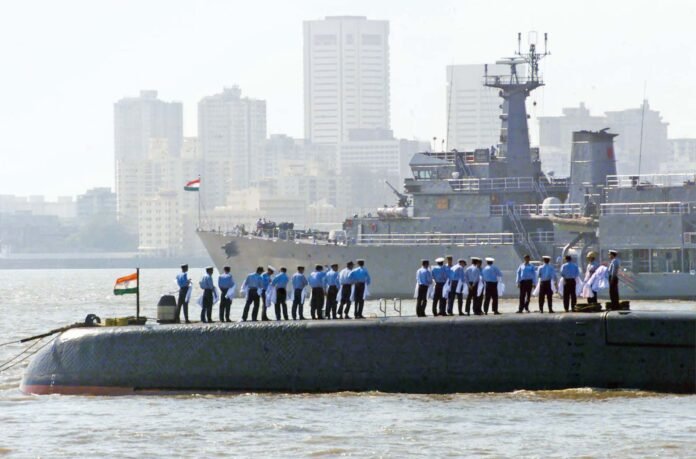
New Delhi:The Defence Ministry is poised to seek approval from the Cabinet Committee on Security (CCS) for the construction of six advanced air-independent propulsion (AIP) submarines under Project 75 India.
This ambitious initiative, valued at approximately $8 billion or ₹66,000 crore, will be executed primarily at Mazagon Dock Shipbuilders Limited (MDL) with technical support from Germany’s ThyssenKrupp Marine Systems (TKMS).

The Cost Negotiating Committee (CNC) has successfully concluded its deliberations, securing construction costs for each submarine within the predefined budgetary envelope. Sources indicate that the Indian Navy anticipates CCS clearance within the current fiscal year, pending final nods from the finance department. Delivery of these vessels is targeted for commissioning by the close of the decade, bolstering India’s underwater warfighting capabilities.
This fast-tracking stems from heightened regional tensions, particularly Pakistan’s impending acquisition of eight Yuan (Hangor)-class AIP-equipped diesel-electric attack submarines from China. Scheduled for induction between 2026 and 2028, four of these submarines are under construction in China, with the remainder to be built in Karachi.
These platforms will enhance Rawalpindi’s ability to enforce area denial and access denial strategies against Indian naval assets in the northern Arabian Sea, while serving as a potent sea-based deterrent.
Pakistan currently claims a fleet of eight operational submarines, though assessments suggest the actual number is lower due to ageing hulls lacking modern upgrades. The strategic calculus has sharpened following recent confrontations, such as Operation Sindoor, where Indian submarines ventured within 200 nautical miles of Karachi, prompting major Pakistan Navy surface combatants to relocate to safer harbours like Ormara, Pasni, and Gwadar. The operation concluded on May 10 after Pakistan’s Director General of Military Operations sought a ceasefire.

India’s submarine fleet currently comprises two nuclear-armed, nuclear-powered ballistic missile submarines (SSBNs) patrolling the Indo-Pacific.
However, the Navy requires additional AIP-equipped submarines armed with submarine-launched cruise missiles to fortify its sea denial posture. Unlike conventional diesel-electric boats, which must surface almost daily for battery recharging, AIP systems employ fuel cell technology to extend submerged endurance without sacrificing speed or stealth.

Once AIP fuel cells are exhausted, these submarines revert to diesel-electric mode, albeit with marginally reduced performance. The Project 75 submarines will integrate seamlessly into this ecosystem, enhancing tactical flexibility in contested waters.
India’s maritime deterrence will receive further impetus from the lease of a Russian Akula-class nuclear-powered submarine armed with conventional weapons, expected in 2027-2028. Complementing this are the forthcoming inductions of INS Aridhaman and INS Arisudan, two additional SSBNs expanding the nuclear triad’s underwater leg.
In a landmark decision, the Narendra Modi government greenlit the construction of two nuclear-powered attack submarines (SSNs) for the Strategic Forces Command in 2025, with Project 77 now underway. These platforms will project power across the Indian Ocean Region, countering adversarial build-ups.
Project 75 India represents a cornerstone of India’s indigenous defence production drive, aligning with the Aatmanirbhar Bharat initiative. Mazagon Dock’s proven track record in Kalvari-class submarine construction underscores its readiness, while TKMS’s expertise in AIP integration—pioneered in Type 212/214 boats—ensures technology transfer and local absorption.
The $8 billion outlay encompasses design refinement, steel procurement, propulsion systems, and weapon suites, including Klub or Nirbhay cruise missiles. Negotiations have optimised costs, mitigating overruns that plagued earlier programmes.
Geopolitically, this acquisition addresses the creeping Chinese submarine presence via the China-Pakistan Economic Corridor, where Gwadar emerges as a potential base. Pakistan’s Yuan-class boats, featuring advanced sensors and quiet propulsion, could tilt low-intensity naval skirmishes in Islamabad’s favour without India’s countermeasures.
India’s response emphasises numerical superiority and qualitative edges: AIP endurance surpassing Pakistan’s Agosta-90B fleet, coupled with VLS cells for land-attack precision strikes. Lessons from Operation Sindoor highlight the psychological edge of persistent submerged threats.
Long-term, these submarines will integrate with P-8I maritime patrol aircraft, BRAHMOS coastal batteries, and indigenous UAVs for networked undersea warfare. Interoperability with SSBNs and SSNs will enable layered deterrence, from tactical interdiction to strategic patrols.
Challenges persist, including supply chain dependencies on specialised alloys and lithium-ion batteries under evaluation for future iterations. Delays in vendor clearances could slip timelines, though CNC’s groundwork minimises fiscal risks.
The CCS approval signals resolute intent amid a volatile neighbourhood. With China’s Type 039A/ Yuan proliferation and regional alliances shifting, India’s submarine armada—projected to exceed 24 boats by 2030—will safeguard vital sea lines of communication.
This development reaffirms the Modi administration’s commitment to naval modernisation, blending foreign partnerships with self-reliance. As the Indo-Pacific grows contestable, Project 75 submarines will anchor India’s blue-water ambitions for decades ahead.

