

New Delhi: India is set to procure Israel’s cutting-edge drones, long-range missiles, and laser-based defence systems, aiming to fortify its security apparatus in the wake of last year’s Operation Sindoor. This strategic move seeks to establish a robust, multi-layered shield capable of neutralising future threats from Pakistan, including missiles, drones, and airstrikes.
The backdrop to these plans is Operation Sindoor, which highlighted the efficacy of Israeli weaponry in combat scenarios. During that operation, India deployed Rampage missiles, Harpy loitering munitions—often termed kamikaze drones—and Harop variants against Pakistani terror infrastructure and military installations.

Israel’s Iron Beam system, a 100kW-class high-energy laser weapon, is a key focus. Deployed to augment the Iron Dome, it intercepts drones, rockets, and mortars at a negligible cost of mere dollars per engagement. This contrasts with India’s indigenous 30kW Directed Energy Weapon (DEW), the MK-II(A) system developed by DRDO, underscoring the appeal of Israel’s more potent technology.
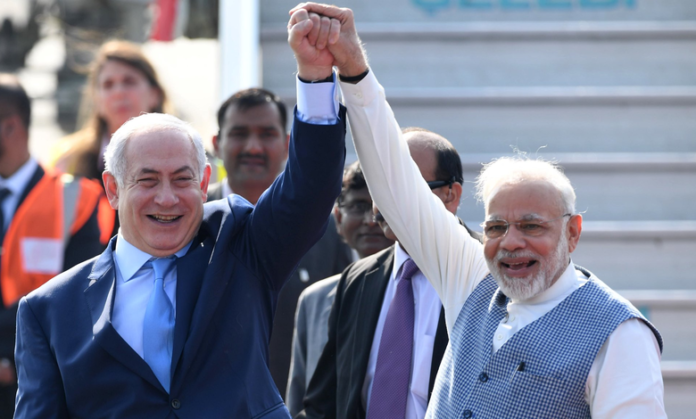
Prime Minister Narendra Modi’s impending two-day visit to Israel, is poised to formalise these ambitions. An MoU on defence cooperation is anticipated, marking his second trip since 2017. Beyond outright purchases, the emphasis lies on technology transfers for advanced weaponry.
Israeli Prime Minister Benjamin Netanyahu has framed the visit as a pivotal moment for bilateral ties. He noted that Modi will address the Knesset, with discussions encompassing economic, diplomatic, and security collaboration. Netanyahu invoked a “hexagon” of alliances encircling the Middle East, incorporating India alongside Arab, African, Mediterranean (Greece and Cyprus), and Asian nations to counter “radical axes.”
India’s homegrown Sudarshan Chakra programme targets a comprehensive air defence network by 2035, safeguarding urban centres and critical assets from missile and drone incursions. Collaboration with Israel will infuse elements akin to Iron Dome, Arrow, and David’s Sling, integrating Barak-8 MR-SAM/LR-SAM missiles with artificial intelligence, sophisticated sensors, and cyber-defence layers.

This forthcoming MoU builds on a November pact inked during Defence Secretary Rajesh Kumar Singh’s visit to Israel. That agreement pledged enhanced defence linkages via joint ventures and co-production of frontier technologies.
Forbes India reports that Israel has greenlit arms agreements totalling $8.6 billion with India in 2026, eclipsing all suppliers except France. The package encompasses Rafael’s SPICE 1000 precision-guided bombs, Rampage air-to-surface missiles with a 250km reach, Air Lora air-launched ballistic missiles, and the Ice Breaker system extending to 300km. These acquisitions align with India’s push for military modernisation, blending indigenous innovation with proven foreign systems. Operation Sindoor’s success with Israeli assets has evidently catalysed this deepened partnership, positioning India to deter aerial aggressions more effectively.

Netanyahu’s rhetoric signals a broader geopolitical realignment, with India emerging as a cornerstone in Israel’s security architecture. As tensions persist in South Asia, such integrations promise to render India’s defences “impregnable,” reshaping regional deterrence dynamics.

