
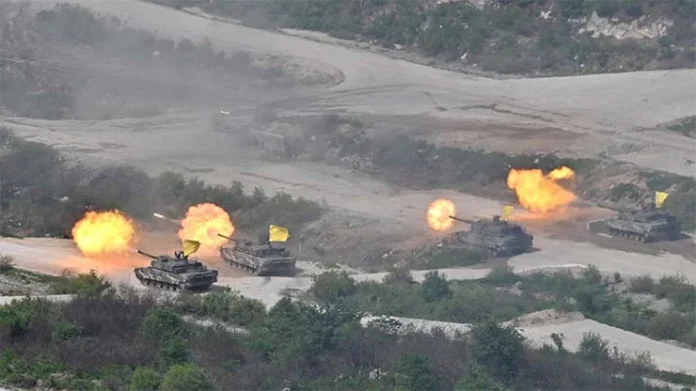
Seoul: North Korea launched two short-range ballistic missiles toward its eastern waters, its neighbours said, in a resumption of weapons tests to protest just-ended South Korea-US live-fire drills that it viewed as an invasion rehearsal. The launches are the first by North Korea since it failed to put its first spy satellite into orbit in late May.
South Korea’s Joint Chiefs of Staff said the missiles were launched from North Korea’s capital region and travelled about 780 kilometres before landing in waters between the Korean Peninsula and Japan. It called the launches “a grave provocation” and said South Korea’s military will maintain a firm readiness in close coordination with the United States.

Japanese Prime Minister Fumio Kishida said the missiles landed inside Japan’s exclusive economic zone. He called the launches a “violent action” that threatened international peace and safety.
The chief nuclear envoys from South Korea, Japan and the US held a three-way telephone call and agreed to continue efforts to get North Korea to halt weapons activities and return to talks, according to Seoul’s Foreign Ministry.
The launches came hours after South Korean and US troops ended a fifth round of large-scale live-fire drills near the Koreas’ heavily fortified border earlier June 15. About 30 minutes before the launches, North Korea’s military vowed an unspecified response to the drills, which it called “provocative and irresponsible.”
“Our response to (the South Korean-US drills) is inevitable,” an unidentified spokesperson of the North Korean Defence Ministry said in a statement carried by state media. “Our armed forces will fully counter any form of demonstrative moves and provocation of the enemies.”

Experts say North Korea may be using the US-South Korean exercises as a pretext to conduct test launches to develop more powerful missiles and increase its leverage in future diplomacy.
On May 31, a North Korean long-range rocket carrying its first spy satellite crashed off the Korean Peninsula’s west coast. North Korea admitted the failure and vowed to push for a second launch. A spy satellite is among a slew of high-tech weapons that leader Kim Jong Un wants to develop to cope with what he calls US hostility.

“This launch is not to make up for the recent failure, because North Korea will almost certainly make another attempt later to put a spy satellite into orbit,” said Leif-Eric Easley, a professor at Ewha University in Seoul. “The message of today’s missiles is more likely Pyongyang’s protest against South Korea’s combined defence exercises with the United States, as well as a demonstration of North Korea’s own military capabilities and readiness.”