


Modern warfare has progressively shifted from an attrition-based contest of platforms to a competition defined by information superiority, speed of decision-making, and system resilience. The Indian Army’s selection of “Year of Networking and Data Centricity” as the theme for Army Day 2026 reflects a conscious recognition of this shift. Contemporary conflict environments, characterised by persistent surveillance, multi-domain operations, and compressed decision cycles, demand forces that can sense, analyse, decide, and act faster than their adversaries.
This article examines how the Indian Army is operationalising this vision through integrated digital architectures, unmanned systems, AI-enabled sustainment, and indigenous innovation. Rather than focusing on individual technologies in isolation, the analysis emphasises system-level integration as the decisive factor in future combat effectiveness.

Army Day 2026 as a Manifestation of Transformation
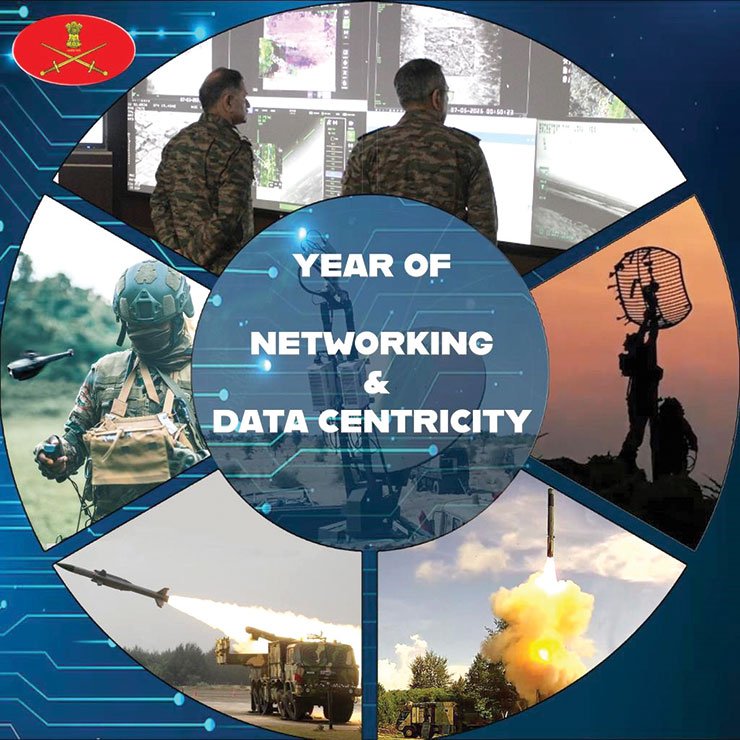
Army Day observances have progressively evolved into platforms that showcase the Indian Army’s advancing operational capabilities, moving beyond ceremonial tradition to reflect tangible transformation. The 2026 celebrations clearly underscored this evolution, seamlessly integrating legacy military ethos with cutting-edge technologies, offering the nation a compelling demonstration of combat capability augmented by deep-tech applications.
The Shaurya Sandhya event, highlighted by a synchronised aerial display of nearly a thousand drones, demonstrated the maturity of autonomous coordination and network-enabled control architectures. Beyond its visual impact, the display served as a powerful indicator of doctrinal direction, illustrating how large-scale unmanned systems, when intelligently networked and centrally orchestrated, can fundamentally reshape paradigms for reconnaissance, deception, and precision strike.
In parallel, the operational enactment of Operation Sindoor reinforced the Army’s enduring emphasis on adaptability and the integrated employment of combat power. It reaffirmed a core principle of modernisation, that technology acts as a force multiplier for the soldier, enhancing human judgment and battlefield effectiveness rather than supplanting the central role of the warrior.
Agile Formations and the Evolution of Tactical Units
The participation of specialised Bhairav Battalion contingents during the celebrations marked an important milestone. These units symbolise the Indian Army’s shift towards highly mobile, mission-oriented combat groupings capable of rapid deployment and independent action.

Such formations rely heavily on secure communications, real-time situational awareness, and decentralised decision-making. Networking and data fusion enable these units to operate effectively despite dispersion, ensuring coherence without rigid command structures. This represents a move away from linear, hierarchical control towards distributed command architectures supported by digital systems.
Firepower in a Networked Battlespace

Conventional firepower, armour, artillery, and rocket forces remain central to land warfare. However, its effectiveness increasingly depends on integration with ISR assets, targeting networks, and command systems. Modern artillery and armour platforms function not as isolated weapons, but as nodes within a broader combat ecosystem. This integration enables rapid sensor-to-shooter loops, enhanced target discrimination, and coordinated fires across domains. Consequently, combat effectiveness is determined less by individual platform capability and more by network reliability and data fidelity.

Unmanned Aerial Systems: From Assets to Ecosystems
Unmanned Aerial Systems (UAS) have transitioned from niche ISR tools to multi-role operational enablers. The Indian Army’s expanding drone inventory supports surveillance, logistics, targeting, training evaluation, and force protection. However, global conflict experience underscores a critical lesson: numerical superiority in drones does not guarantee battlefield advantage. Operational effectiveness emerges from integration. Diverse drone types, tethered, untethered, swarm-enabled, must feed synchronised data into unified command-and-control systems. Fragmentation caused by OEM-specific control stations limits situational awareness and slows decision-making. The requirement, therefore, is not merely for more drones but for networked drone operations supported by AI-assisted data fusion.
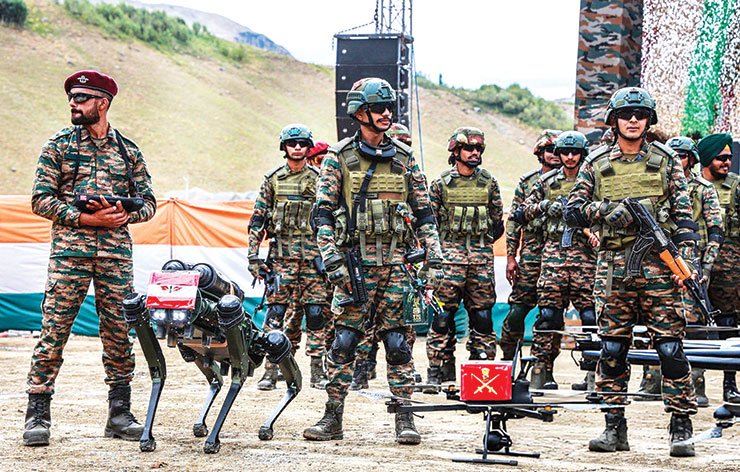
In parallel with drone proliferation, the Army has invested in training units to manage basic unmanned operations organically, while also strengthening counter-UAS capabilities. As drone density increases, effective detection, identification, and neutralisation become indispensable elements of battlefield survivability.
Artificial Intelligence as an Operational Enabler
Artificial Intelligence has tangible military utility when applied to practical problems such as sensor fusion, target recognition, predictive maintenance, and counter-UAS operations. Its value lies in compressing the cognitive burden on commanders and staff by filtering information and highlighting actionable insights. The next major inflection point lies in Generative AI (GenAI) deployed as a secure, sovereign decision-support capability. When implemented on-premise, GenAI systems can function as intelligent staff assistants, processing natural-language queries and synthesising insights from operational databases, technical manuals, SOPs, and historical records.
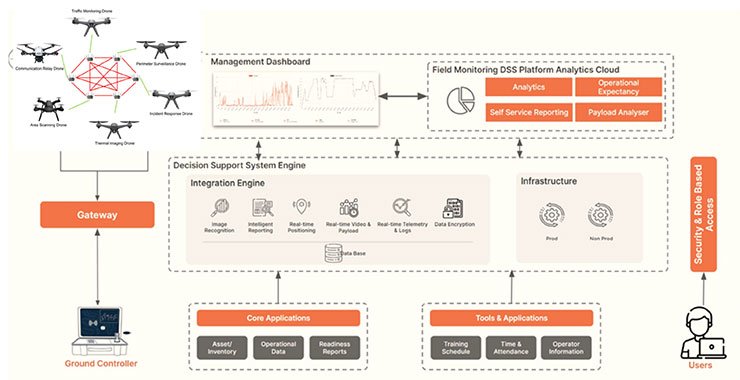
A relevant example is TATHYA, developed by Zenerative Minds, which exemplifies a mil-grade GenAI platform designed for knowledge management and decision support. Built on an agentic swarm AI architecture, TATHYA preprocesses large volumes of data into explainable intelligence, enabling planning support while preserving data sovereignty. Its design philosophy demonstrates how GenAI can augment human judgment without compromising security or command authority.
MUMT using Robotics
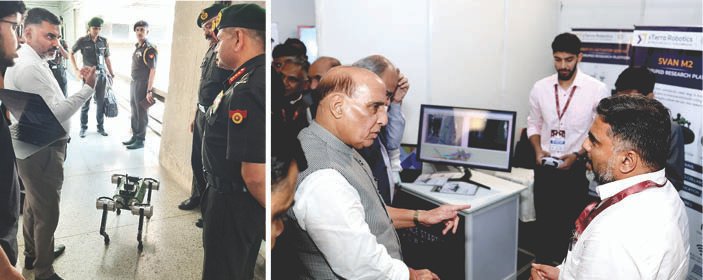
Robotics adoption within the Indian Army has followed a pragmatic, mission-driven trajectory. Applications such as explosive ordnance disposal robots, surveillance platforms, and autonomous sensors prioritise immediate operational value and risk reduction. The emerging paradigm of man unmanned teaming recognises complementary strengths. Machines excel in endurance, speed, and pattern recognition; humans retain judgment, ethics, and command responsibility. The goal is synergy rather than substitution. Within this framework, legged robotic systems, including robotic dogs, offer potential advantages in reconnaissance, perimeter security, and operations in complex terrain. Strategic advantage, however, lies not in limited imports but in indigenous development, enabling terrain-specific adaptation and long-term sustainment.
Maintenance Philosophy and Sustainment Transformation
Operational readiness depends fundamentally on sustainment. The Indian Army’s maintenance philosophy has evolved into a structured system guided by six pillars: skilled manpower, tools, infrastructure, spares, timely repairs, and major interventions. Maintenance infrastructure has advanced from basic facilities to integrated static and mobile repair ecosystems. Digital initiatives such as the Workshop Automated System Program (WASP) have enhanced transparency, enabling real-time tracking of job cards, spares, and equipment status. Inventory management has similarly transitioned toward data-driven provisioning, leveraging analytical techniques for demand forecasting and reliability assessment. Layered maintenance responsibilities ensure faults are addressed at appropriate echelons, minimising downtime across dispersed deployments.
AI-Enabled Predictive Maintenance
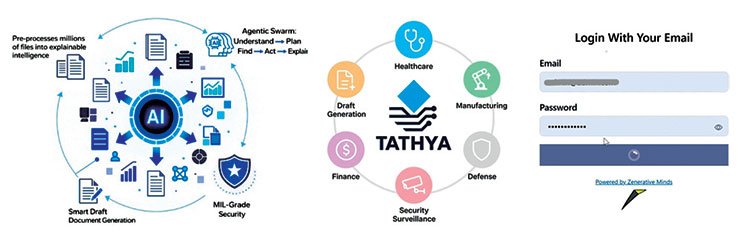
AI enables a shift from reactive to predictive maintenance, improving equipment availability and reducing lifecycle costs. This requires a secure, mission-aware data architecture aligned with operational constraints. On-premise data lakes at unit and upto command levels store structured and unstructured operational data. IoT-based sensors embedded in critical platforms log performance parameters, with data processed locally at the edge and transmitted securely when feasible. A multi-tiered architecture supports immediate diagnostics at the tactical level, trend analysis at intermediate echelons, and advanced predictive analytics at central hubs. Federated learning allows AI models to be trained locally without transferring sensitive data, preserving confidentiality and sovereignty.
A Phased Roadmap for Defence Tech Adoption
A credible roadmap for the adoption of Artificial Intelligence in defence must be phased, resilient, and operationally grounded. The initial phase should prioritise comprehensive digitisation and sensorisation of legacy and contemporary platforms, establishing a reliable data foundation. This must be followed by carefully controlled pilot deployments in secure, air-gapped environments, enabling validation of AI use cases without compromising operational security. Proven applications can subsequently be scaled across Services under the oversight of a centralised Defence Maintenance and AI Integration Hub, operating on hardened, on-premise infrastructure.
Equally critical to this roadmap is the establishment of high-quality training and experimentation infrastructure for AI, unmanned systems, and robotics. Dedicated AI and robotics laboratories, simulation centres, and drone test ranges should be created as structured learning ecosystems where personnel can acquire hands-on proficiency, experiment with emerging technologies, and understand their operational implications. These facilities would serve as technology incubation and assimilation environments, enabling troops, technicians, and commanders to internalise new concepts in a controlled and purpose-built setting before field deployment.
The final phase envisages full-spectrum integration of Artificial Intelligence across sustainment and operational domains, including AR-enabled maintenance, autonomous diagnostics, and predictive logistics, with systems engineered to function reliably in contested, degraded, and denied environments while retaining robust human-in-the-loop mechanisms to preserve command authority, accountability, and operational judgement. Central to the success of this transformation is the manner in which deep technologies are imparted to the force, with the most effective training achieved through the involvement of seasoned subject matter experts from the defence ecosystem, particularly military veterans with strong academic foundations from institutions such as IIsT, IIsM and IISc, and proven experience across military operations and the defence industry, who uniquely combine operational insight, industrial execution, and academic rigour, thereby creating an optimal environment for the structured assimilation and responsible adoption of AI, robotics, and unmanned systems within the Armed Forces.
Towards Intelligent Sustainment & Networked Combat Power
The Indian Army’s emphasis on networking and data centricity reflects a strategic understanding that future conflicts will be won by forces that integrate sensors, shooters, sustainment systems, and commanders into coherent digital ecosystems. Artificial intelligence, unmanned systems, and predictive logistics are not adjuncts but core enablers of combat power. Over the next decade, AI-driven sustainment, human–machine teaming, and sovereign digital architectures will redefine readiness and resilience. With balanced policy support, indigenous innovation, and doctrinal clarity, the Indian Army is well positioned to transition from platform-centric strength to an intelligent, integrated warfare capability.

–The writer is an SME and independent consultant in military technology. The views expressed are of the writer and do not necessarily reflect the views of Raksha Anirveda
