

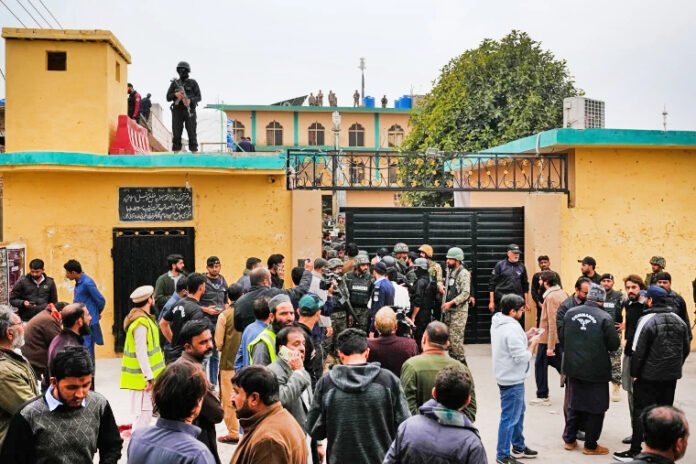
The suicide attack at the Khadija-tul Kubra Mosque in Islamabad is not just another terrorist incident in Pakistan’s troubled history. When a sectarian strike hits the federal capital and is claimed by an Islamic State affiliate, it indicates something more serious than an intelligence failure. It suggests that the system Pakistan relied upon to keep militancy confined to the margins is no longer holding.
The claim for the strike by the Islamic State Pakistan Province (ISPP) comes against the backdrop of sustained violence in Balochistan, followed by extensive military operations. These events are connected less by coincidence and more by consequence. They reflect pressure building across multiple fault lines at the same time.

Pakistan has witnessed a steady rise in violence over the past three years. Data released by the Pakistan Institute of Peace Studies for 2025, recorded 699 attacks nationwide, a 34 per cent increase compared with the previous year.
This trajectory continues with greater violence this year. Responsibility has repeatedly been pushed outward, towards Afghanistan and India, rather than addressing the long-standing practice of distinguishing between terrorists, based on convenience.
The bombing marked the second major attack in the federal capital since a suicide blast targeted a district court in November last year. It points to a loss of control, with sectarian violence earlier kept at a distance now striking at the centre of authority.
The claim for the strike by the Islamic State Pakistan Province (ISPP) comes against the backdrop of sustained violence in Balochistan, followed by extensive military operations
The Shia population constitutes over 20 per cent of the estimated Pakistani population of 250 million. Frequent sectarian clashes have occurred in the Kurram district in the northwestern Khyber Pakhtunkhwa province of Pakistan that borders Afghanistan.

Kurram, bordering Afghanistan, has an equal percentage of Sunni and Shia populations and has long been associated with sectarian conflict and violence.
An analysis of Pakistani nationals who joined the ISIL and other related organisations reveals that several members are anti-Shia, of Sunni orientation.

Such violence does not end with the attack itself; it feeds further radicalisation and keeps sectarian networks alive. It is well documented that Sunnis and Shias are fighting each other in Syria and Yemen, and Pakistani Shias fought for Iranian proxies.
The sectarian nature of the attack is central to its strategic meaning. Sectarian violence in Pakistan has never been accidental or episodic. It has been cultivated over decades through ideological patronage, selective tolerance, and the instrumental use of religion as a mobilising force.
What began as theological differentiation was gradually transformed into political weaponisation. The state assumed that such forces could be channelled outward and contained inward. The emergence of Islamic State-linked factions inside Pakistan demonstrates the fallacy of that belief.
The sectarian nature of the attack is central to its strategic meaning. Sectarian violence in Pakistan has never been accidental or episodic. It has been cultivated over decades through ideological patronage, selective tolerance, and the instrumental use of religion as a mobilising force
It is also claimed that the Balochistan Liberation Army (BLA) has ties with both the TTP and ISIL’s affiliate in Khorasan Province (ISKP), indicating a convergence of groups with distinct but intersecting agendas.
This convergence of threat targets the core of the internal security fabric of Pakistan and reflects the long-term effects of treating terrorists as state instruments.
At the core of Pakistan’s predicament is the erosion of its monopoly over organised violence. This erosion was gradual and deliberate. It began when armed non-state actors were treated as policy instruments rather than strategic liabilities.
It deepened through selective enforcement and differentiated tolerance. These groups accumulated autonomy, ideological legitimacy, independent funding, and external linkages.
The state ceased to be the sole arbiter of force and transformed from being a hunter to being hounded. It is the failure of thinking about “core” and “periphery”, and what was once described as strategic depth has become a source of persistent exposure.
For India, the implications are real, not abstract. Historically, any internal turmoil in Pakistan has resulted in a deflection towards India to divert the attention of the nation away from an embarrassing core issue.
At the core of Pakistan’s predicament is the erosion of its monopoly over organised violence. This erosion was gradual and deliberate. It began when armed non-state actors were treated as policy instruments rather than strategic liabilities
A security establishment under pressure does not necessarily turn inward; it frequently seeks strategic distraction. Proxy war has been contained, not eliminated, and could rekindle. India cannot assume that Pakistan’s internal pressure will remain internally absorbed.
A state within the state under pressure at home has more incentive to remind its own public that the “real” threat lies outside. New Delhi must assume that internal turbulence in Pakistan can translate into border friction.
There is also the risk inherent in a spillover of the terror ecosystem. Semi-autonomous actors operating with ideological zeal and tactical initiative reduce the margin for escalation control. It underscores the importance of intelligence, preparedness and deterrence.
The normalisation of sectarian mass-casualty attacks within a nuclear-armed state carries implications that extend well beyond its borders. Islamic State affiliates have historically demonstrated an ability to translate domestic violence into regional ambition. While their current focus remains internal, strategic complacency would be misplaced.
Pakistan is a country condemned to fight, both the shadows it once cast abroad and the fires it lit at home. Strategic assets that no longer obey strategy are not assets; they are the clearest warning a state can receive that the methods it once considered smart have become a threat to its own survival.
For India, the implication is straightforward. Instability across the border will continue to generate external friction. The response lies in preparedness, intelligence depth, and deterrence discipline, not in reaction or rhetoric
The Islamabad mosque bombing should be read as a warning emerging from within Pakistan itself. Terrorism that was actively aided, harboured, and fostered by Pakistan, targeting India and Afghanistan, has boomeranged inward.
Sectarian violence, insurgency, and strategic blowback are now an integrated challenge confronting Pakistan.
For India, the implication is straightforward. Instability across the border will continue to generate external friction. The response lies in preparedness, intelligence depth, and deterrence discipline, not in reaction or rhetoric.

The author, a PVSM, AVSM, VSM has had an illustrious career spanning nearly four decades. A distinguished Armoured Corps officer, he has served in various prestigious staff and command appointments including Commander Independent Armoured Brigade, ADG PP, GOC Armoured Division and GOC Strike 1. The officer retired as DG Mechanised Forces in December 2017 during which he was the architect to initiate process for reintroduction of Light Tank and Chairman on the study on C5ISR for Indian Army. Subsequently he was Consultant MoD/OFB from 2018 to 2020. He is also a reputed defence analyst, a motivational speaker and prolific writer on matters of military, defence technology and national security. The views expressed are personal and do not necessarily carry the views of Raksha Anirveda
