
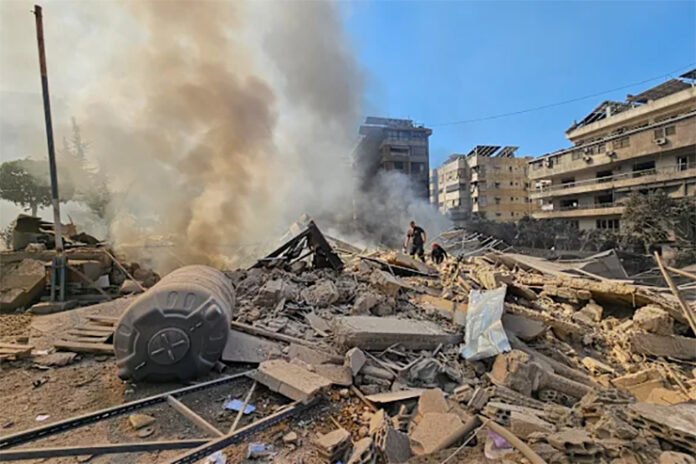
The ongoing Iran–Israel war impels one to take notice of the fragility of the West Asian nations (tiny tots—with no natural defence) but rich in petrodollars. They do not have adequate manpower and not even natural defence. What they have is a wasteland of sand but rich with petroleum—currently the world’s main source of energy.
In the sharp ideological divide between Sunni–Shia factions of Islam, headed by Saudi Arabia and Iran respectively, a state of conflict has existed since the Iranian Revolution of 1979. Comparatively, Iran is much bigger in geography and population than the “micro-dots” of the Persian Gulf. Besides the Shia–Sunni divide, the region is further tormented by the Palestine issue, arising from the creation of the Jewish state of Israel in 1948 through the “Balfour Declaration.”

Three “Arab–Israel” wars took place on this issue in 1948, 1967, and 1973. Egypt was the kingpin of these anti-Israel wars. But after the Camp David Peace Agreement in 1978, Egypt made peace with Israel. It was then that Iran stepped in with the ideological motto of “Death to Israel.”
Though all these tiny tots of West Asia supported the Palestine issue, none of them actively took concrete action against Israel. In fact, prior to 1979, Iran had excellent relations with Israel. But after the ouster of the king, Shah Pahlavi, in 1979, Iran took up the cudgels on behalf of Palestine. The lip service paid by other Gulf nations infuriated the new rulers of Iran. This further widened the Shia–Sunni gulf. A general sense of insecurity regarding defence had gripped the entire Gulf region.
This was the time when the Cold War between the USSR (Union of Soviet Socialist Republics) and the US was at its peak. Both were looking for military bases around the world. The Camp David Agreement facilitated the US to acquire bases in the region. Thus, the US stepped into the Gulf region, while the USSR aligned itself with Syria and Iran. The US and the West, which had created the state of Israel, naturally became its allies.
With the presence of the US, a sense of relief and complacency had gripped the Gulf region. The US sold them expensive armaments such as fighter jets and guns. This made these tiny tots contented and happy. At the same time, Iran travelled on a road to militarise itself, with the strict control of Ayatollah Khomeini over the government. Besides, it created an extremely loyal organisation called the IRGC (Islamic Revolutionary Guard Corps) to keep a deep vigil on the internal situation. The IRGC stands above the Iranian Army in influence and is much stronger and resourceful.

Intoxicated under the US military umbrella, Saudi Arabia and the rest of the “Lilliputs” never carried out a true assessment of the evolving security threats and the transforming concept of war.
Iran is an old civilisation stretched between the Caspian Sea and the Persian Gulf. Sixty per cent of its terrain is mountainous, which provides natural defence. A population of about 90 million provides sufficient motivated recruits for defence
Unfortunately for them, the form of war has graduated to “no-contact warfare,” where standoff weapons like drones and missiles dominate warfighting. These BVR (Beyond Visual Range) weapon systems play havoc. They have changed the very definition of a war zone. There are “no fronts and no rear.” Their accuracy and lethality add a new dimension to the devastation unleashed on an adversary.

While Saudi Arabia and its “hangers-on” got inebriated with petrodollars, Iran went ahead to create a self-sustaining system of defence. Its missiles and drones have taken on US allies in the Gulf region. Therefore, without US protection, Iran could make mincemeat of these unstable “micro-dots” on the Persian Gulf map.
Iran, on the other hand, is an old civilisation stretched between the Caspian Sea and the Persian Gulf. Sixty per cent of its terrain is mountainous, which provides natural defence. A population of about 90 million provides sufficient motivated recruits for defence.
One gathers the impression that Ayatollah Khomeini, the first Ayatollah, was imposed in Iran by the West to create a street bully to scare these tiny tots of the Gulf region, who would then look towards the West (US) for protection. This is not only colonisation of the region but also colonisation of the mind—a geopolitical game played by powerful nations.
Ali Khomeini, the first Ayatollah, had lived in Paris. He had no role in the student movement against Shah Pahlavi. Like Mohammad Yunus in Bangladesh, he was brought in to capitalise on a student rebellion. The lack of proper leadership among the students provided a grand opportunity for Ali Khomeini to emerge as a leader. Eventually, he turned against his own creators. The rest is history.
Anyway, it does not matter whether regime change takes place in Iran or not—but the US economy would receive a major shock and could be in shambles in the post-war scenario. It is estimated that the opening day of the war cost the US around $780 million. If this were the daily expenditure, one cannot imagine the cost of the war to the US if it extends to three to four months. The US is already under a debt of around $38 trillion. The dollar’s domination as a global reserve currency is already under threat. It may therefore lose its dominating status.
It does not matter whether regime change takes place in Iran or not—but the US economy would receive a major shock and could be in shambles in the post-war scenario. It is estimated that the opening day of the war alone cost the US around $780 million
Even its competitor, China, is suffering from an internal struggle between Xi Jinping and the People’s Liberation Army (PLA), as evidenced by the sacking of top General Zhang Youxia—a contender for Xi’s position. The situation remains unclear, though General Zhang has been purged. However, he leaves traces of dissent within the PLA. Another factor is the downward trend in China’s economy. It is therefore in no position to replace the US as the “ringmaster” of the world.
It is assessed that from the ruins of Gulf War 3.0, new global players will emerge to transform the world into a multipolar order. It is not rocket science to guess who these new players might be. If one looks dispassionately, one could bet on India, Australia, Germany, and Japan—perhaps even Brazil and South Africa.
There is a worldwide demand for the reorganisation of the United Nations (UN) so that it becomes a more effective instrument for global peace and conflict resolution. The veto powers of the Big Five may be reworked and converted into a democratic majority system within the UN Security Council.
Weakened and exhausted, the US and other powers may not be in a position to resist this genuine demand. A new dawn may therefore await the world, replacing the old-world order.
Also Read:
Gulf War – 3.0: No Victor; No Vanquished
https://raksha-anirveda.com/gulf-war-3-0-no-victor-no-vanquished/
Toward a Devastating Aftermath
https://raksha-anirveda.com/toward-a-devastating-aftermath/

-An ex-NDA and Wellington Staff College graduate, Col Rajinder Singh is a renowned author and security analyst. He has authored four books, two individually and two in collaboration. His best-selling books are Kashmir – A Different Perspective and The ULFA Insurgency. The views expressed are of the author and do not necessarily reflect the views of Raksha Anirveda
