

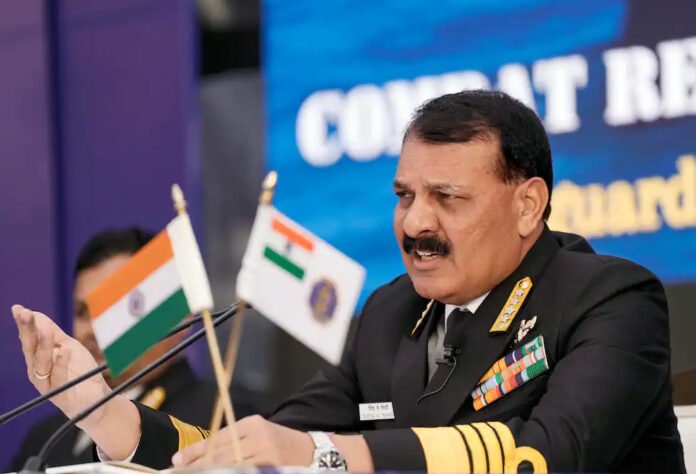
Chennai: Chief of Naval Staff Admiral Dinesh K Tripathi, speaking after commissioning the warship ‘Dolphin Hunter’ INS Anjadip, an anti-submarine shallow watercraft, at the Chennai Port here, said, “India’s journey towards Viksit Bharat – developed nation unfolds amid a challenging maritime environment around the country – characterised by escalating strategic competition, growing contestation across surface, sub-surface, and air domains, and an increasing tendency for continental frictions to spill over into the maritime domain.”
He observed, “In such an environment, the region is witnessing a new reality – that even small disruptions at sea can produce disproportionate strategic consequences – amplified by the convergence of technology, geography, and the sheer scale of maritime activity.”

“The Red Sea crisis showed us how disruption at a single choke point can ripple across continents. Freight rates on key Asia–Europe routes surged – in some cases by as much as 300 to 350 % — impacting supply chains and driving up food and fuel costs”, he added.
Observing that the ongoing tensions in the Strait of Hormuz – a vital global energy corridor – have also reflected this reality, Admiral Tripathi said even a precautionary closure of the strait for live-fire exercises last week, led to Brent crude prices rising by about 4.4 % in a single trading session, reaching their highest level in weeks.
“In such a complex and sensitive security environment, the Indian Navy has been actively ensuring the continuity of our maritime trade and energy flows”, he added.
“Since October 2023, our deployments in the Red Sea have enabled the safe transit of nearly 400 merchant vessels, carrying approximately 16.5 million metric tonnes of oil and cargo, worth over 7 billion US dollars bound for India”, he said, adding, “even as I speak, our ships continue to operate alongside partner navies, strengthening maritime cooperation and interoperability to enhance security and stability in the region.”

Citing experts who had termed the 21st Century as a Maritime Century, Admiral Tripathi said the Indian Ocean Region will probably be at the epicenter of this Maritime Century.
“Nearly 2.9 billion people from 33 nations which constitutes nearly 40% of the world’s population live in the IOR littorals. What make this maritime space even more critical is that of the 1,20,000 ships that transit the IOR every year, carrying 2/3rd of oil shipments, 1/3rd of bulk and 50% of the world container traffic, only 20% of this trade is between littoral nations of IOR while 80% is extra-regional,” he said.

“The recent International Fleet Review and Exercise MILAN at and off Visakhapatnam on the Eastern Seaboard – with participation of 60 Indian warships and 19 ships from our partner nations, reaffirmed our commitment to maritime security cooperation at the global level,” he remarked.
He also said Indian Navy has been the First Responder and its ships reach the partner nations first in their times of crises – be it handing over relief material to Myanmar under Operation Brahma within 48 hours of the earthquake to saving lives and delivering aid to Sri Lanka after Cyclone Dithwah under Operation Sagar Bandhu.
“Our operational footprint today extends across the Indian Ocean Region and beyond, with Indian Naval units persistently forward-deployed on surveillance, anti-piracy and coordinated patrols, reflecting sustained reach and credible operational depth,” Admiral Tripathi said.
Even as Indian Navy maintain operational momentum now it is simultaneously shaping its future through deliberate capability induction guided by a clear approach — to build credible capability across the spectrum of maritime operations; address evolving threat perceptions on both the Western and Eastern seaboards; balance immediate readiness with long-term resilience, the Navy Chief said.
Within this broader design, during the year 2025, the Indian Navy commissioned 12 warships and one submarine. This momentum continues with plans to induct about 15 more ships in 2026, setting an unprecedented benchmark and marking the highest rate of induction in our history, CNS Admiral Tripathi said.
“Beyond the numbers, our focus has been on sharpening critical warfighting capabilities – particularly in Anti-Submarine and under-sea warfare. The platforms inducted over the past year are equipped with highly advanced and sophisticated ASW capabilities”, he said.
Today’s commissioning, the fourth of 16 Shallow Water ASW Craft, marks a substantive strengthening of our under-sea warfare capability — particularly in the coastal and littoral waters of the Eastern Seaboard.
INS Anjadip – equipped with state-of-the-art shallow-water sonars, lightweight torpedoes, anti-submarine rockets and Combat Management System – is engineered for agility, precision and combat effectiveness.
The ship and her systems distinctly reflect the growing strength of India’s indigenous design and industrial ecosystem – a clear affirmation of Aatmanirbharta in the vital domains of shipbuilding and under-sea warfare.
Citing Defence Minister Rajnath Singh’s statement – “Indigenisation in defence production enhances operational preparedness and strengthens national security, ” Admiral Tripathi added, “In that spirit, our pursuit of Aatmanirbharta – both in intent and execution – has ensured that this ship enters service with robust capability and operational effectiveness from the very outset, with minimal shipbuilders liability.”
He stated that from an Indian perspective, self-reliance or Aatmanirbharta, today, is moving beyond “Make in India” to “Trust in India” – sovereign competence rooted in iterative design, technological ownership, and mission ready ships.
“We have embraced Aatmanirbharta not only as a strategic imperative but also as an investment towards future assurance. We have progressively strengthened our Warship Design Bureau, deepened industry partnerships, and accelerated innovation in concert with MSMEs, start-ups, and academia, building sovereign capabilities across the maritime domain,” he added.

