

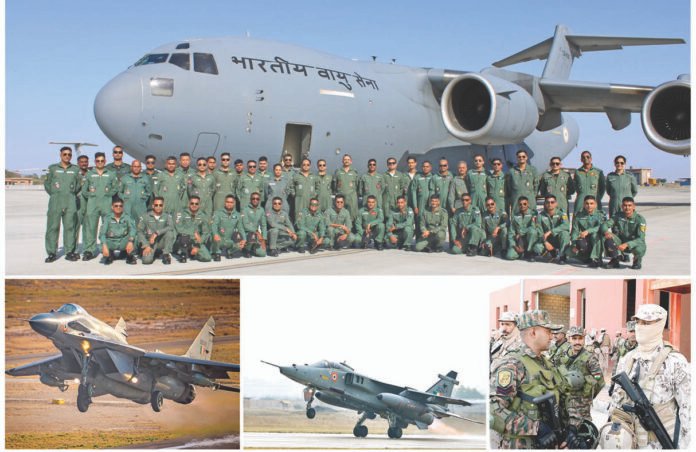
Defence and security have emerged as a consequential and increasingly visible domain of India’s engagement with West Asia. Once confined largely to energy security, migrant mobility, and remittances, India’s relations with the region have gradually expanded to include defence cooperation, military diplomacy, intelligence sharing, and strategic capacity building. This shift reflects both India’s growing military confidence and the changing security landscape of West Asia, where traditional alliances are being recalibrated and new security arrangements are being explored. Against this backdrop, the reported evolution of a Strategic Mutual Defence Agreement (SMDA) between Saudi Arabia and Pakistan, with Türkiye reportedly exploring accession, has added a new layer of complexity to the region’s defence architecture and presents both challenges and opportunities for India’s defence diplomacy.
Over the past two decades, New Delhi has steadily institutionalised defence and security cooperation with several West Asian states. India has signed defence cooperation agreements or memoranda of understanding with Iran in 2002, Oman in 2008, the UAE in 2003 (expanded in 2016 and further elevated to strategic defence pact on January 19, 2026), Qatar in 2008, Saudi Arabia in 2014 (significantly advanced in August 2025), and Egypt in 2022. These frameworks cover a range of activities including joint military exercises, training and capacity building, defence industry collaboration, maritime security, counter terrorism cooperation, and regular strategic dialogues. While India’s defence relationship with Israel remains among its most robust globally in terms of arms procurement, technology transfer, and operational cooperation, it is noteworthy that the relationship has evolved pragmatically without being formalised through a single overarching defence cooperation agreement, reflecting its unique strategic character.

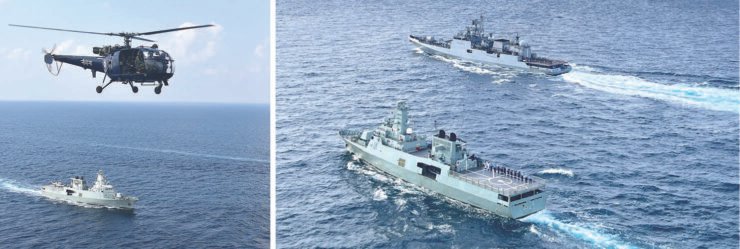
India’s defence footprint in West Asia has grown both qualitatively and quantitatively. Indian armed forces regularly conduct bilateral and multilateral exercises with regional partners. Exercises such as Desert Cyclone with the United Arab Emirates, Al Mohed Al Hindi with Saudi Arabia, Naseem Al Bahr with Oman, and maritime exercises with Qatar and Egypt have deepened operational familiarity. Naval deployments across the Gulf of Aden, the Arabian Sea, and the Red Sea have enhanced India’s role in the region. Indian military training institutions host officers from West Asian countries, while Indian defence personnel are increasingly exposed to desert warfare environments and maritime security operations relevant to the region.
India’s defence footprint in West Asia has grown both qualitatively and quantitatively. Indian armed forces regularly conduct bilateral and multilateral exercises with regional partners. Exercises such as Desert Cyclone with the United Arab Emirates, Al Mohed Al Hindi with Saudi Arabia, Naseem Al Bahr with Oman, and maritime exercises with Qatar and Egypt have deepened operational familiarity
The expansion of India’s defence diplomacy has also coincided with the growing momentum of Aatmanirbhar Bharat and Make in India in defence manufacturing. India’s defence exports crossed the ten thousand crore rupee mark in recent years, with West Asia emerging as a promising market for Indian platforms, systems, and components. Coastal surveillance radars, patrol vessels, artillery systems, unmanned aerial platforms, electronic warfare equipment, and ammunition are areas where Indian capabilities align with regional requirements. For West Asian states seeking to diversify defence procurement and reduce over dependence on traditional Western suppliers, India offers a credible alternative that combines affordability, reliability, and political predictability. Joint production and co development initiatives also hold potential as India seeks to integrate itself into global defence supply chains.
However, the evolving regional security environment necessitates careful strategic calibration. The Strategic Mutual Defence Agreement signed between Saudi Arabia and Pakistan in September 2025 represents a significant development. The agreement reportedly includes a collective defence clause stating that any aggression against one signatory would be considered an aggression against the other. Although the full text remains undisclosed, available information suggests that the pact encompasses wide ranging military cooperation including joint deterrence, intelligence sharing, defence industry collaboration, technology transfer, training, and potentially nuclear related coordination. Türkiye’s reported interest in joining this framework would further internationalise the arrangement and elevate its strategic implications.
The Saudi Pakistan defence relationship has deep historical roots, dating back to the Treaty of Friendship in 1951 and the 1982 agreement that allowed Pakistani troops to be stationed in the Kingdom for training and support. Over decades, Pakistani military personnel have played advisory roles in Saudi Arabia, and bilateral cooperation has been driven by converging security perceptions, particularly following the Iranian Revolution. The current agreement appears to formalise and expand this long standing relationship in a manner that reflects Saudi Arabia’s desire to enhance defence autonomy and diversify security partnerships amid regional uncertainty.

As Saudi Arabia deepens defence ties with Pakistan and potentially Türkiye, the UAE’s emphasis on India underscores a preference for partnerships anchored in economic strength, political stability, and strategic predictability. India’s secular polity, self-sustained economic model, and expanding global footprint offer a stark contrast to Pakistan’s aid dependent economy and persistent political fragility
For India, the emergence of such an arrangement raises legitimate strategic questions. Pakistan remains a declared adversary, and its inclusion in any collective defence framework involving key West Asian powers inevitably complicates India’s strategic calculus. Türkiye’s position adds another layer of complexity. Ankara’s posture toward India has been constrained, particularly on issues related to Kashmir and broader ideological alignments. Despite Indian humanitarian outreach during Operation Dost following Türkiye’s devastating earthquakes, political relations have not warmed substantially. This underscores the limits of goodwill diplomacy in altering entrenched strategic positions.
At the same time, internal divergences within West Asia indicate that the region is far from coalescing around a singular security axis. The Yemen conflict has exposed serious rifts between Saudi Arabia and the United Arab Emirates. Riyadh has publicly accused Abu Dhabi of undermining Saudi national security, an unusually direct expression of tension between two long time partners. Competing interests in southern Yemen, divergent approaches to proxy groups, and broader ambitions for regional influence have strained ties. Saudi strikes on UAE linked shipments in Yemen underscore the depth of these differences and highlight the fragmentation within the Gulf security landscape.

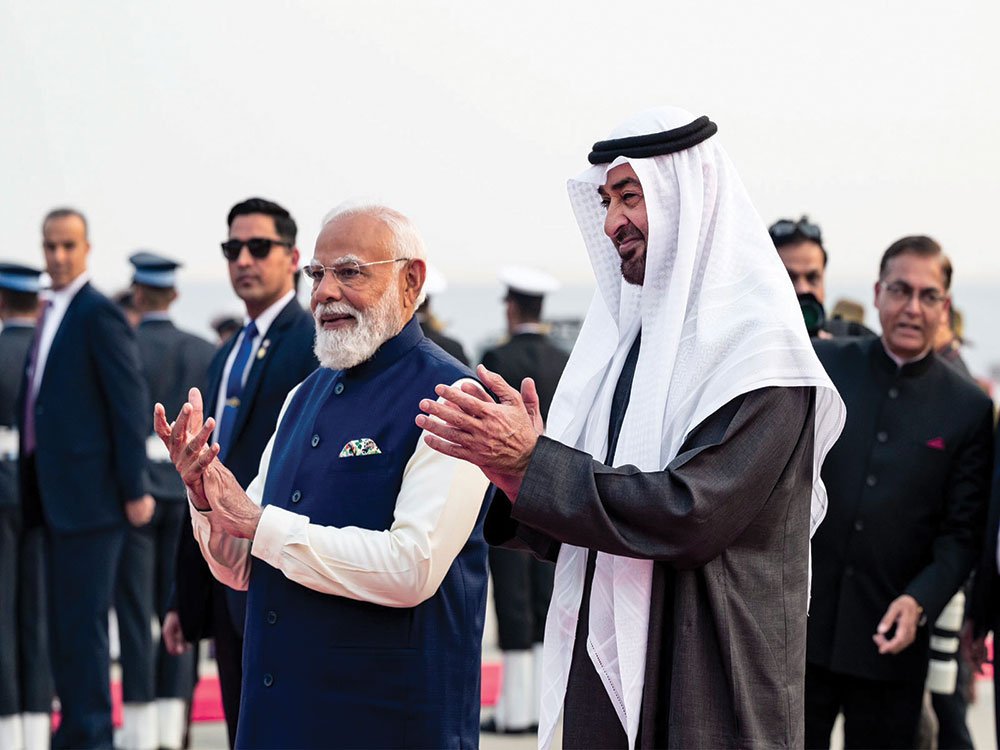
It is within this context that India’s defence diplomacy acquires added relevance. Rather than being viewed as an outsider, India is increasingly perceived as a rational and stabilising actor capable of engaging across fault lines. High level visits in 2025 and early 2026, including the visit of the UAE President to India on January 19, 2026 with advancement of existing defence cooperation to strategic defence pact along with US $200 billion trade deal by 2032, reflect this perception. While the duration of the President’s visit was brief, its symbolism was significant. It conveyed continuity, strategic reassurance, and a shared commitment to long term partnership amid regional flux.
There is a subtle strategic messaging embedded in this engagement. As Saudi Arabia deepens defence ties with Pakistan and potentially Türkiye, the UAE’s emphasis on India underscores a preference for partnerships anchored in economic strength, political stability, and strategic predictability. India’s secular polity, self-sustained economic model, and expanding global footprint offer a stark contrast to Pakistan’s aid dependent economy and persistent political fragility. For Abu Dhabi, closer alignment with India represents a rational hedge rather than an act of rivalry, aimed at balancing uncertainties and diversifying strategic options.
From India’s perspective, this moment calls for a measured but proactive approach. Rather than reacting defensively to emerging alignments, New Delhi should deepen parallel defence engagement with trusted regional partners such as the UAE, Israel, Oman, and Egypt. Expanding defence industrial collaboration, increasing the frequency and complexity of joint exercises, enhancing maritime domain awareness cooperation, and institutionalising strategic dialogues can reinforce India’s position as a credible security partner. Defence diplomacy should also be integrated with economic and technological cooperation, reflecting the interconnected nature of contemporary statecraft.
New Delhi should deepen parallel defence engagement with trusted regional partners such as the UAE, Israel, Oman, and Egypt. Expanding defence industrial collaboration, increasing the frequency and complexity of joint exercises, enhancing maritime domain awareness cooperation, and institutionalising strategic dialogues can reinforce India’s position as a credible security partner
Importantly, India’s approach must remain consistent with its broader strategic autonomy. New Delhi has successfully transitioned from the ideologically driven posture of the Non-Aligned Movement era to a pragmatic framework rooted in national interest. In West Asia, this has translated into the ability to maintain relations with competing actors while avoiding entanglement in zero sum rivalries. Defence diplomacy, when pursued as strategic statecraft rather than alliance politics, allows India to expand influence without compromising flexibility.
On balance, the evolving defence landscape of West Asia presents both challenges and opportunities for India. The emergence of new defence pacts and shifting alignments underscores the fluidity of the region’s security architecture. Yet it also reinforces the value of India’s steady, interest driven engagement. By leveraging its growing defence capabilities, expanding industrial base, and reputation as a responsible actor, India is well positioned to strengthen its defence diplomacy in West Asia. Rather than being marginalised by emerging alignments, New Delhi can use this moment to consolidate partnerships, project stability, and contribute meaningfully to regional security in a manner aligned with its long term strategic objectives.

The writer focuses on contemporary Middle Eastern affairs and is the author of 'India and the Gulf: A Security Perspective'. She is also a subject matter expert at the Centre for Joint Warfare Studies.
