

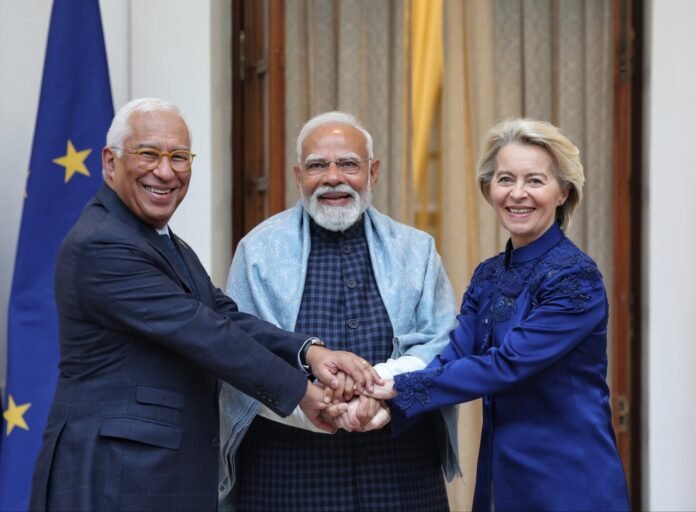
Differences continue to prevail on the geopolitical front between India and the European Union. While New Delhi has refrained from joining the international chorus condemning Russia for its invasion of Ukraine, the 27-country European bloc has, on its part, shown little readiness to align with India on its most pressing security concerns, i.e. cross-border terrorism.
Yet, amid an increasingly fragmented global order, marked by the lack of credible initiatives to steer the world towards a more stable situation, India and the EU have decided to strengthen their bilateral relations.

Its reflection can be seen in the top EU leaders’ visit to India as chief guests at the country’s 77th Republic Day function. Since the formation of the 27 European countries’ bloc in November 1993, this is the first time when President of the European Council António Luís Santos da Costa and President of the European Commission Ursula von der Leyen undertook visit to New Delhi to become chief guests at India’s Republic Day function.
Although it is seen as growth in dynamism in the EU-India relationship, it has taken place largely due to shifts in the US foreign policy under President Donald Trump, who believes in punishments and confrontation rather than diplomacy and dialogue to fulfil his country’s economic and strategic agenda.
For instance, after Venezuela, Trump wants to forcibly acquire Greenland, a territory which belongs to Denmark, a fellow NATO country of which the US is a member. Even as he knows his action on Greenland may result in the collapse of NATO, he is less bothered about any consequences.
Instead, he has threatened to impose hefty tariffs on those who will oppose his Greenland takeover plan. It has thrown the whole of Europe, already fighting a hard battle against Russia, out of gear. Rather than supporting its European allies in saving Ukraine from being completely devoured by Russia, the Trump administration has forced them to stare at their vulnerability—strategically and economically.

Importance of India for EU on defence front
It is in such a scenario, that the EU has decided to deepen its engagement with India, a hugely populated democratic country which wields unique stature in the world. In the fractured world, it brings political and diplomatic weight to a side when it aligns with it.

Although it is seen as growth in dynamism in the EU-India relationship, it has taken place largely due to shifts in the US foreign policy under President Donald Trump, who believes in punishments and confrontation rather than diplomacy and dialogue to fulfil his country’s economic and strategic agenda
This is evident in the case of the BRICS, a major political and economic group which has emerged as a counterweight to American and Western influence in global institutions, and the Quad, the four countries’ informal group, widely viewed as a mechanism to balance China’s growing assertiveness in the Indo-Pacific region.
For the EU, which has signed a new security and defence partnership and a free trade agreement with New Delhi, during the summit between the two sides, India will provide heft to the 27-nation European bloc on multiple fronts. For instance, the security and defence pact will lead to strengthening cooperation in areas such as maritime security, counter-terrorism, cyber-defence, and maritime domain awareness, with a focus on stability in the Indo-Pacific region.
Analysts say India-EU defence and security partnership would result in placing New Delhi within a framework that the 27-nation European bloc has so far extended to Japan and South Korea. It would provide an institutional platform for advancing security cooperation at a moment when both sides are reassessing their long-term security and defence priorities.
A key point of this partnership would be joint defence research and development to reinforce India’s industrial base with the aim to produce advanced defence products. Additionally, to make its presence felt in the Indo-Pacific region, the EU is keen to expand its operational cooperation with the Indian Navy. It has shown a keen interest in having enhanced information sharing mechanisms between its naval missions and the Indian Navy.
Significantly, the EU and India carried out their first joint naval exercise in the Gulf of Guinea in October 2023. They conducted their second joint naval drills in the Gulf of Aden last year on June 18-19. In a nutshell, enhanced military cooperation between the EU and India would now be a routine affair between the two sides, a situation which was unthinkable a few years ago, as the EU used to avoid a meaningful defence engagement with India due to its long-standing reliance on Russia for its military hardware.
However, a shift in geopolitical situation combined with Trump’s unpredictable behaviour, has compelled the EU to bring a change in its outlook towards India. Instead of just maintaining a buyer-seller relationship, largely dominated by France and Germany, the EU-India engagement will now evolve into a structured industrial partnership with long-term implications.
Importance of India for EU on economic front
Yet, the most pressing item which will change the course of India-EU relations during a time when the Europe is passing through its trying moment is the Free Trade Agreement that the two sides have signed. Called as the “mother of all deals” jointly by India’s Minister of Commerce and Industry, Piyush Goel and European Commission President, Ursula von der Leyen, the pact will unleash dynamism in the markets of both India and Europe.
The EU has decided to deepen its engagement with India, a hugely populated democratic country which wields unique stature in the world. In the fractured world, it brings political and diplomatic weight to a side when it aligns with it
While it will lead to elimination of tariffs on more than 90% of traded goods, it will also impart thrust to services and facilitate investments between the two sides. The two-way trade between India and the EU currently stands at $136.53 billion in goods.
With the signing of the long-negotiated FTA, the EU will be benefitted by gaining deeper access to India’s huge market, thus diversifying supply chains, while at the same time expanding services exports. More than this, it will ultimately result in the EU decoupling itself from the US and other unreliable partners such as China. Presently, India serves as the ninth largest trading partner, accounting for around 2.4% of the total EU trade in goods, compared to $845 billion with China and $1.5 trillion with the US.
For India, the FTA will provide it a much-needed opportunity to restore the Generalised System of Preferences (GSP) – which removes import duties from products coming into the EU market from developing nations. India’s garment, pharmaceutical and steel industries in addition to petroleum products and machinery will see a rise in exports to the EU market.
It is estimated that the two-way trade under the FTA could rise to $200-250 billion in goods and services within a decade, building on current figures of $137 billion in goods and $50 billion in services.
Nonetheless, the trade deal between India and the EU has redefined not just ties between the two sides but also global economic alignments, especially when the traditional and old architecture of commerce and trade are facing serious challenges.
In the current global scenario, witnessing growing strategic mistrust, fractured alliances and the erosion of established norms, the India–EU partnership stands out as a rare example of pragmatic convergence.
Despite major differences on several issues, both sides have demonstrated an ability to compartmentalise disagreements and focus on shared long-term interests, strategic autonomy, economic resilience, and a rules-based international order
Despite major differences on several issues, both sides have demonstrated an ability to compartmentalise disagreements and focus on shared long-term interests, strategic autonomy, economic resilience, and a rules-based international order.
The deepening of defence cooperation, unprecedented naval engagement and the move towards joint industrial and technological collaboration signal a qualitative shift in relations that goes well beyond symbolism.

–The writer is a senior journalist with wide experience in covering international affairs. The views expressed are of the writer and do not necessarily reflect the views of Raksha Anirveda
