
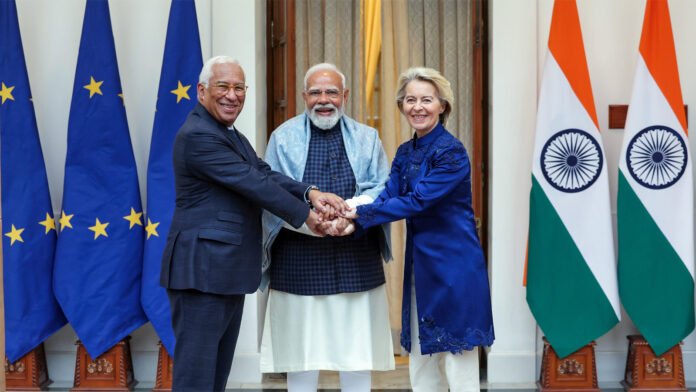
After nearly two decades of negotiations that repeatedly stalled over agriculture, automobiles, data rules, and political hesitation, India and the European Union have finally concluded a comprehensive trade pact. That it was unveiled during India’s Republic Day celebrations, with senior European leaders present in New Delhi, was not accidental. It signalled intent. This was not merely an economic deal, but a political alignment between two democratic blocs that now find themselves navigating a far less reliable global order.
The backdrop matters. International trade today is increasingly shaped by unilateral decisions, domestic political calculations, and strategic pressure. The return of tariff-driven trade policy from the United States has reinforced this reality. India has already experienced the impact through steep duties imposed on its exports, while Europe has faced repeated reminders that even allies are not immune to economic coercion. In such circumstances, certainty becomes a scarce and valuable resource.

The India-EU agreement provides that certainty. It anchors market access within a rules-based framework at a time when exporters and investors are growing wary of sudden reversals. For India, the logic is straightforward. Overdependence on any single market weakens strategic autonomy, compromising national interest. Diversification restores it. This agreement is therefore less about replacing one partner with another and more about widening India’s strategic options.
India and the EU concluded the trade pact after nearly two decades of talks that repeatedly stalled over agriculture, automobiles, data rules, and political hesitation. Unveiling the deal during India’s Republic Day celebrations, with senior European leaders present in New Delhi, was not accidental. It signalled intent
From a trade perspective, the agreement represents the most comprehensive market opening India has undertaken. European tariffs on the vast majority of Indian goods will be eliminated, with immediate gains for sectors that have long struggled against tariff escalation. Textiles, apparel, leather products, marine exports, chemicals, engineering goods, metals, and gems stand to benefit directly. For many Indian exporters, especially smaller firms, this shift is not incremental. It determines whether they can compete at all.
India’s own concessions are significant but measured. Tariff reductions on European goods are phased, allowing domestic industries time to adjust. This sequencing reflects lessons learnt the hard way. Sudden liberalisation without adjustment mechanisms has previously generated political backlash and industrial stress. The present agreement avoids that mistake by combining openness with transition.
India’s decision to reduce import duties on foreign vehicles marks a clear departure from past protectionism. Yet the structure of the concession reveals caution, not capitulation. High-end cars are prioritised, volume caps are imposed, and electric vehicles are given a transition period before being subject to controlled entry
Services form the less visible but more strategic core of the pact. India has opened a wide range of service sectors to European participation, while securing expanded access for Indian firms across Europe. This matters because services now underpin India’s external economic strength. Indian technology and professional services firms have already found Europe to be a critical growth market as they diversify beyond North America. Clearer regulatory pathways and mobility provisions under the agreement support sustained expansion rather than short-term contracting.

Automobiles have attracted predictable scrutiny. India’s decision to reduce import duties on foreign vehicles marks a clear departure from past protectionism. Yet the structure of the concession reveals caution, not capitulation. High-end vehicles are prioritised, volume caps are imposed, and electric vehicles are given a transition period before controlled entry. Domestic manufacturers retain protection in mass-market segments. Consumers, meanwhile, gain access to better technology and safety standards. Competition, though uncomfortable, is likely to sharpen efficiency rather than dismantle capacity.
Beyond automobiles, the agreement delivers quieter but equally important gains. Reduced duties on European machinery and industrial inputs support productivity improvements in Indian manufacturing. Cooperation in pharmaceuticals strengthens supply chains in a sector of strategic importance to both sides. Even sensitive concessions on wines and spirits reflect political pragmatism rather than ideological retreat.

Washington’s criticism of the India-EU deal underlines how trade has become an instrument of strategic signalling. For India, the agreement strengthens negotiating leverage precisely because it demonstrates credible alternatives. Strategic autonomy is not achieved by disengagement, but by expanding choices
The depth of existing India-EU trade reinforces the agreement’s credibility. The European Union has emerged as one of India’s largest trading partners, supported by thousands of European firms operating in India and a growing Indian corporate presence across Europe. Ambitions to raise bilateral trade further are demanding, but not unrealistic if momentum is maintained.
Challenges remain. Steel exports are constrained by quotas that fall short of India’s capacity. Environmental compliance costs linked to carbon regulations will affect certain sectors more than others. The ratification process across multiple European legislatures will test political resolve. These are not minor concerns, but they are structural frictions inherent in any deep trade partnership.
International reactions have been revealing. Criticism from Washington underlines how trade has become an instrument of strategic signalling. For India, the agreement strengthens negotiating leverage precisely because it demonstrates credible alternatives. Strategic autonomy is not achieved by disengagement, but by expanding choices.
The India-EU Free Trade Agreement reflects strategic realism. It accepts that the global trade environment is fragmented, that rules are contested, and that dependence carries risk. In such a world, resilience flows from breadth and balance
The security partnership announced alongside the trade pact adds further weight. Regular dialogue on defence cooperation, maritime security, cyber threats, and counter-terrorism reflects convergence driven by shared interests rather than ideology. As economic and security considerations increasingly intersect, this linkage enhances the durability of the relationship.
Ultimately, the India-EU Free Trade Agreement reflects strategic realism. It accepts that the global trade environment is fragmented, that rules are contested, and that dependence carries risk. In such a world, resilience flows from breadth and balance.
This agreement will not deliver instant windfalls. It will involve adjustment, friction, and negotiation. What it offers instead is something more valuable: strategic space. For India, navigating a turbulent global order, that space may prove decisive.

The author, a PVSM, AVSM, VSM has had an illustrious career spanning nearly four decades. A distinguished Armoured Corps officer, he has served in various prestigious staff and command appointments including Commander Independent Armoured Brigade, ADG PP, GOC Armoured Division and GOC Strike 1. The officer retired as DG Mechanised Forces in December 2017 during which he was the architect to initiate process for reintroduction of Light Tank and Chairman on the study on C5ISR for Indian Army. Subsequently he was Consultant MoD/OFB from 2018 to 2020. He is also a reputed defence analyst, a motivational speaker and prolific writer on matters of military, defence technology and national security. The views expressed are personal and do not necessarily carry the views of Raksha Anirveda
