
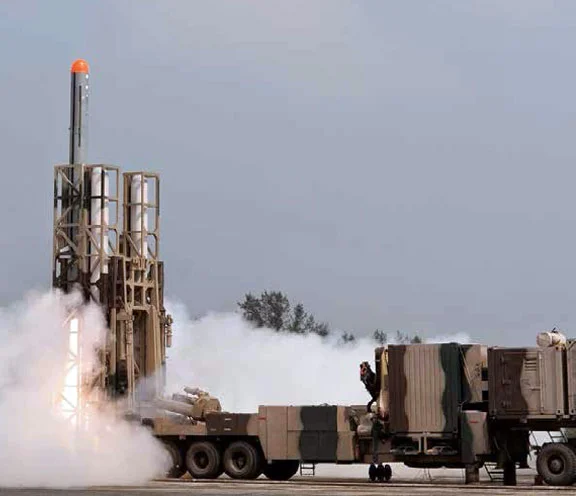
New Delhi: Even as the induction of the Nirbhay subsonic cruise missile into the Indian Army and Indian Navy is to be formally done after the seventh trial scheduled next month, but a limited number of the missiles have been moved to the Line of Actual Control (LAC) where Indian soldiers are locked in a tense standoff with Chinese PLA.

The 1,000 km range solid rocket booster missile has a single shot kill ratio of more than 90 per cent. It has been developed by the Defence Research and Development Organisation (DRDO), sources said hours after India test-fired an extended-range BrahMos surface-to-surface supersonic cruise missile that can hit targets 400 km away.
The Defence Acquisition Council (DAC) headed by Defence Minister Rajnath Singh has cleared the formal induction of the Nirbhay subsonic missile. The military, however, did not wait for the formality to deploy the new missile and has already moved some of them to defend the LAC against China.
The missile, which travels at a speed of 0.7 Mach, has both terrain-hugging and sea-skimming capability that helps it avoid detection and counter-measures.
At the LAC, the PLA’s western theatre command has deployed stand-off weapons up to 2,000 km range and long-range surface-to-air missiles in Tibet and Xinjiang after the Ladakh stand-off started in May this year. The Chinese deployment is not limited to occupied Aksai Chin but is located in depth positions from Kashgar, Hotan, Lhasa and Nyingchi along the 3,488 km Line of Actual Control (LAC).

Officials said on September 30 testing of the 400-km range BrahMos missiles with an indigenous airframe and booster is significant since it clears the decks for India to have the next class of supersonic long-range tactical cruise missile. The Brahmos has a liquid-fuelled booster capable of ranges over 500 km.
These new-age weapons will be based on solid-fuelled ducted ramjet (SFDR) technology that can be used for air-to-air missiles as well as long-range supersonic cruise missiles. The technology has been tested by the DRDO twice – on May 30, 2018, and February 8, 2019.

“The new class of cruise missile will have a solid rocket booster along with supersonic speed using SFDR technology. The range of missiles can be decided on the basis of mission objectives,” said an Indian missile expert.
It is understood that the new class of cruise missiles (yet to be named) will have a better circular error of probability than the BrahMos with a heavy conventional warhead to target airbases and ships of the adversary.