

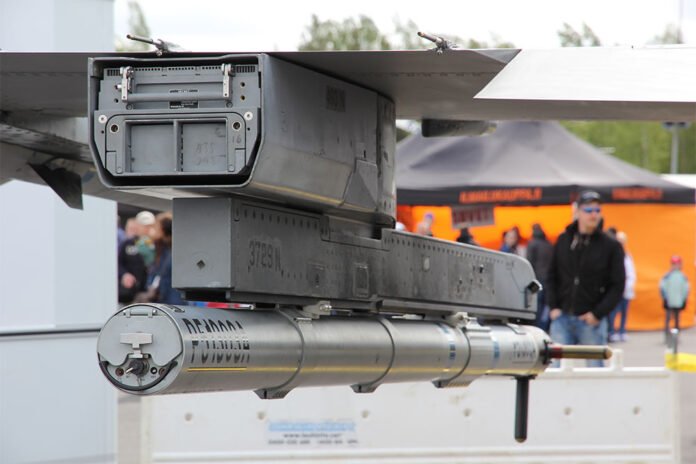
Tel Aviv: The recovery of the US AN/ALE-50 towed decoy debris in Iraq, suggest its use in the ongoing war.
The AN/ALE-50 is a towed decoy system deployed by US forces to counter radar-guided missiles in combat. It has protected aircraft like the F-16, F/A-18E/F Super Hornet, and B-1B Lancer in multiple conflicts.

In order to distract approaching air-to-air or surface-to-air missiles, Raytheon’s AN/ALE-50 uses disposable decoys from wing-mounted launchers that trail behind the aircraft and imitate a larger radar signature. This system has been shown to be reliable in live missile tests and has a 10-year shelf life for decoys.
According to reports, it has saved various types of US air force combat aircraft.
The AN/ALE-50 towed decoy system entices radar-guided missiles away from the host aircraft by using an expendable fiber-optic towed decoy that is launched from aircraft-mounted launchers.
When they sense a threat, pilots deploy the sealed decoy canister, usually from wing pylons.

In order to maintain real-time communication without aircraft-specific threat programming, a towline equipped with embedded fiber optics unreels the decoy 100–300 metres behind the aircraft. The decoy is either sacrificed as a last option or cut free prior to landing.
After being towed, the decoy uses strategies like jamming to interfere with missile radar locks and deception to entice the aircraft toward the brighter target by emitting radio frequency (RF) signals that replicate the aircraft’s bigger radar cross-section (RCS). It increases aircraft survivability in high-threat areas by reacting dynamically to attacks via a fiber-optic data link.


-The writer is an Israel-based freelance journalist. The views expressed are of the writer and do not necessarily reflect the views of Raksha Anirveda
