

Berlin: Germany does not want to pursue nuclear weapons of its own, but is interested in incorporating French and British atomic bombs in a deterrence arrangement reminiscent of NATO’s US-based nuclear umbrella, according to Chancellor Friedrich Merz.
“I don’t want Germany to consider developing its own nuclear weapons,” Merz said in the Machtwechsel podcast, published online. It was the first major interview the chancellor gave this year.

Instead, Merz suggested seeing whether France and the UK could be elevated to the same level as the US nuclear umbrella to shield Europe and ensure NATO’s territorial integrity.
“As with the Americans, the final decision in this case rests with the French and the British,” Merz said, describing employment scenarios for such weapons.
France and the UK both field submarine‑launched ballistic missiles as the core of their nuclear deterrents. Paris additionally maintains upwards of 50 air-launched cruise missiles that can be loaded onto its Rafale fighters, which are both land and carrier-based.
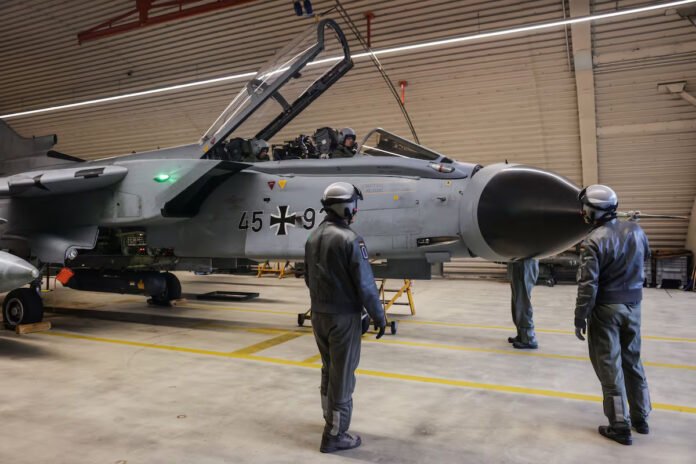
NATO’s current nuclear-sharing doctrine prescribes that German Tornado and forthcoming F-35A aircraft are kitted with the gear needed to deliver US nuclear bombs that are stored in Germany, though Berlin cannot make the call to drop them on its own.

French President Emmanuel Macron has previously offered Germany the option of extending Paris’s own nuclear deterrence to the eastern neighbour.
France has kept its nuclear forces separate from NATO’s command-and-control and decision-making process to retain what the country calls strategic autonomy.

“Times have changed now, and I would like us to at least discuss the offer from the French,” Merz said. “In times like these, an offer like this from the French government cannot simply be left unexamined.”
Macron said in Munich on February 13 he will deliver a speech clarifying France’s nuclear doctrine “in a few weeks’ time,” with local media reporting the talk is expected by the end of February. He repeated a reference to comments by former President Charles de Gaulle that the “vital interests of France” have a European component.
The French president said his country has engaged in a strategic dialogue with Merz and several other European leaders to see “how we can articulate our national doctrine,” including through “special cooperation, common exercises and common security interests with key countries.”
“I think this dialogue is important by itself, but it’s important because this is the way to articulate nuclear deterrence in a holistic approach of defence and security. And this is a way to create convergence in our strategic approach and strategic culture between Germany and France,” said Macron.
France is also in discussion with Sweden, though that is a “very specific discussion, with a very specific approach,” according to the French head of state, who didn’t provide further details.
In light of Russia’s ongoing invasion of Ukraine and the breakdown of relations between European capitals and Moscow, the nuclear debate has gained steam across the continent. Germany is managing a balancing act as it reimagines its military role on the continent and sheds a longstanding pacifist defence and foreign policy.
Berlin is constrained by its own laws and international commitments in what types of nuclear deterrence it can consider, Merz pointed out, citing the 2+4 contract between West and East Germany and the Allies of World War II, and the nuclear non-proliferation treaty, which bans the spread of nuclear weapons to those who did not yet possess them prior to 1967.
Merz described a French-German nuclear weapons partnership as a longstanding option going back to former French President de Gaulle in the 1960s, with discussions springing up now in earnest.
“We are at the very beginning,” the German chancellor said. “The only thing that has happened so far is that the German chancellor has said to the French president, ‘Let’s talk about it,’ nothing more.”
France and the UK agreed in July to increase the coordination of their nuclear deterrents, with both governments repeating a position that they could see no situations arising in which the vital interests of one could be threatened, without the same being true for the other. They agreed that there was “no extreme threat to Europe” that would not prompt a response by both nations.

