
“I am not afraid of an army of lions led by a sheep; I am afraid of an army of sheep led by a lion.” – Alexander the Great
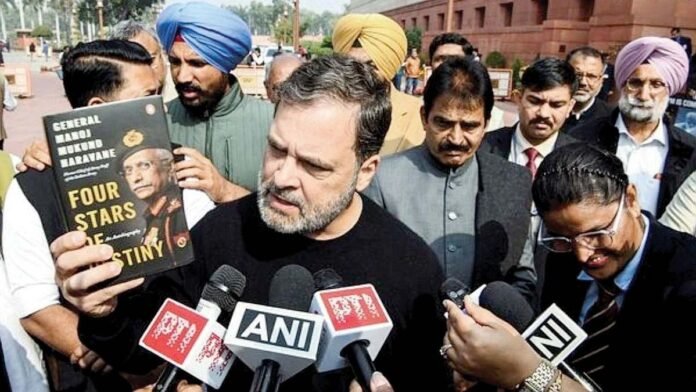
An unnecessary furore was created in the parliament the other day by the leader of the opposition without understanding the full scope of the incident quoted by General MM Naravane in his unpublished book ‘Four Stars of Destiny’. This book has remained unpublished for the last fifteen months for want of clearance from the Ministry of Defence because it contained material concerning national security. Precisely speaking, it was a narration of an event about an alleged/perceived Chinese intrusion across the LAC in Eastern Ladakh on the night of August 31, 2020, when General Naravane was the Army Chief.

The incident is about telephonic communications between GOC-in-C Northern Command, Lt Gen Yogesh Joshi, and General Naravane, about the alleged Chinese intrusion, which involved four Chinese tanks and some columns of Infantry, advancing towards Kailash Range, in Eastern Ladakh on the night of August 31, 2020. It seems Lt Gen Yogesh Joshi reported the said Chinese intrusion to the Army Chief around 2200 hrs (10 pm), who in turn, reported the matter to Defence Minister Rajnath Singh. The matter went to the Prime Minister, who responded by telling the Defence Minister to let the army “deal with it, as deemed fit.”
Rahul Gandhi and his cohorts in the Congress party think that the incident exposed dereliction of duty by the government for not giving clear directions to the Army to deal with the situation. One must note that the 1996 agreement, which prevented the Army from taking decisive action, was signed when HD Deve Gowda was the Prime Minister, who was supported by the Congress party
This definitely was not a dereliction of duty by the Prime Minister or the Army Chief, or even GOC-in-C, Northern Command, if one grasps the provisions of the Sino-Indian Agreement of November 29, 1996, where both sides had forbidden their soldiers from using firearms. It was in this context that Lt Gen Joshi had sought clarification on the use of firearms and firepower against intruding Chinese troops. Earlier, an incident had taken place at Galwan Valley, where India lost 19 soldiers in a hand-to-hand fight, but no firearms were used. The loss of Chinese troops is unknown but estimated to be much higher.
The reported movement of four Chinese tanks on August 31, with some infantry towards LAC in Ladakh, certainly demanded a strenuous response. But use of firepower to stop them could lead to a violation of the 1996 agreement, or even be tantamount to a military conflict, large or small. Therefore, it definitely needed the government’s approval. Army leadership, therefore, acted in the spirit of its ‘brief’. Even the government reacted responsibly when it allowed professional soldiers to deal with the intrusion on their own merit. It later turned out that the alleged intrusion was a false flag, and Chinese troops had backed out. In fact, the Northern Army Commander had spoken to his Chinese counterpart, who had assured him that it was not aimed at confrontation but an exercise. Thus, the matter ended.
As an ex-army chief, General Naravane should have known that the office he had held demanded of him to be discreet in what he said. He should have also known that the issues involving government policies on national defence need approval of the government before publication. It was his bounden duty to submit his manuscript to the government before giving it to publishers
But we must know the context of the ruckus in the parliament. It seems that an article on this incident, as narrated by General Naravane, was published on February 1, 2026, in a magazine called ‘Caravan’. Leader of the opposition, Rahul Gandhi, and his cohorts in the Congress party think that the incident exposed dereliction of duty by the government during the reported incident for not giving clear directions to the Army to deal with the situation. One must note that the 1996 agreement, which prevented the Army from taking decisive action, was signed when HD Deve Gowda was the Prime Minister, who was supported by the Congress party. Someone should also ask Rahul Gandhi what he was doing in the Chinese embassy in July 2017, when the Indian Army was contesting Chinese troops at Doka La, or what memorandum of understanding he had signed with the CCP on August 7, 2008, in Beijing? What had happened to his concern for national security? Was he aware of his duty as General Secretary of a national party, ruling India in 2008?

This incident of August 31, 2020, does not show that the Chinese had captured certain territory across the LAC. But what was the point General Naravane was trying to convey by including this incident in his book? What is its significance? Was General Naravane indirectly hinting that his hands were tied down by the government? As a professional soldier, he should know that if it were any dereliction, it was by the Generals. Naravane and Joshi should have emulated Major General (later Lieutenant General) Sagat Singh’s model of Nathula-1967, who had blasted the Chinese in similar conditions. He should have taken the decision to hit back, rather than acting as a ‘post office’. Passing the buck is unacceptable of a military leader.
As an ex-army chief, General Naravane should have known that the office he had held demanded of him to be discreet in what he said. He should have also known that the issues involving government policies on national defence need approval of the government before publication. It was his bounden duty to submit his manuscript to the government before giving it to publishers. Leaving it to publishers to seek approval is shirking responsibility, which is unbecoming of a person who had retired as the Army Chief. It is even undignified to leak the manuscript to the media, fully knowing that the government has not yet given permission. It is immaterial who has leaked it; moral responsibility dwells upon him to maintain its secrecy. Strangely, he thinks that his job was only to write and not seek permission.

This incident of August 31, 2020, does not show that the Chinese had captured certain territory across the LAC. What was the point General Naravane was trying to convey by including this incident in his book? Was General Naravane indirectly hinting that his hands were tied down by the government? As a professional soldier, he should know that if it were any dereliction, it was by the Generals
It seems the description of the said incident in the unpublished book of General Naravane aimed at exposing the lacunae in the Sino-Indian Agreement of November 29, 1996. If so, it should have been clearly spelled out that the agreement had handicapped frontline troops. But it was not done. It has been left unsaid so as to put the blame on the government. If so, it has some other ulterior motive. Sometimes unsaid statements have deeper motives. The incident, otherwise, is insignificant. Such incursions occur daily, on both Western and Northern borders.
Looking over one’s shoulder is a cardinal sin of a military leader. General Naravane and Lt Gen Joshi, both, must share the blame for passing off the buck. Both of them are taking cover under the 1996 Agreement to explain their incompetence. They should have known their ‘Red Line’ and acted tough in the best interests of their troops, irrespective of response or no response by political leadership. They were both playing ‘safe’ and endangering the lives of their soldiers for want of correct military action. It is sad that such ‘self-oriented careerists’ were making it to the top echelons of the armed forces!
..To be continued

-An ex-NDA and Wellington Staff College graduate, Col Rajinder Singh is a renowned author and security analyst. He has authored four books, two individually and two in collaboration. His best-selling books are Kashmir – A Different Perspective and The ULFA Insurgency. The views expressed are of the author and do not necessarily reflect the views of Raksha Anirveda
