

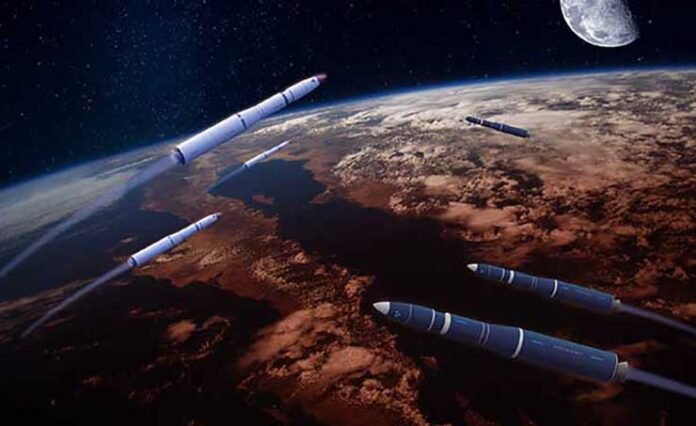
Stockholm: The Stockholm International Peace Research Institute (SIPRI) has issued a stark warning about escalating nuclear risks in South Asia. Its latest study highlights how cyber, space, and information warfare are increasingly blurring the boundaries between conventional conflicts and nuclear thresholds, particularly between India and Pakistan.
Published in January 2026, the SIPRI paper titled “Addressing Multi-Domain Nuclear Escalation Risk” by Wilfred Wan, scrutinises recent global conflicts. It draws lessons from the Russia-Ukraine war, Israel’s operations against Iran in June 2025, and the India-Pakistan crisis of May 2025 to illustrate a rapidly evolving battlefield.

Non-nuclear actions, such as cyber intrusions, satellite disruptions, and precision strikes on critical infrastructure, now carry the potential to trigger unintended nuclear escalation. These multi-domain operations complicate decision-making, as leaders face shortened timelines to assess threats.
The paper points to “Operation Spider Web” in the Russia-Ukraine war as a prime example. On February 22, 2022, a cyberattack targeted the Viasat satellite network, likely disrupting Ukrainian military communications and demonstrating the seamless integration of emerging technologies across domains.
In South Asia, SIPRI identifies India-Pakistan tensions as particularly volatile. Short conventional clashes, combined with limited crisis communication channels and frequent military contacts, heighten the risk of rapid escalation. Nuclear signalling can emerge swiftly in such scenarios.
The May 2025 India-Pakistan crisis exemplifies these dangers. Triggered by terrorist attacks near Pahalgam in Kashmir in April 2025—under Operation Sindoor—AI-driven disinformation flooded the information space. This created a “carnival of sensationalism” with fake narratives of military victories and territorial gains dominating mainstream media on both sides.

SIPRI warns that such AI-enabled disinformation could easily spiral into extended conflict. In the 2025 crisis, it obscured battlefield realities and threatened to upend the strategic calculations of nuclear-armed states. Future campaigns may prove even more sophisticated and disruptive.
For India, the implications are profound. Military actions initially confined to land, sea, or air domains can now spill over into cyber networks, satellite systems, and information warfare—potentially intersecting with nuclear command and control structures. Crisis leaders may have mere minutes to discern intent, amplifying miscalculation risks.

South Asia stands out as one of the world’s fastest-escalating nuclear regions. The paper emphasises vulnerabilities like brief decision timelines and inadequate de-escalation mechanisms between India and Pakistan.
Yet, SIPRI notes a silver lining: nuclear rhetoric remains restrained at the military level. During the recent India-Pakistan clash, nuclear issues did not arise in formal Director General of Military Operations (DGMO) discussions.
Indian Army Chief General Upendra Dwivedi confirmed this restraint. “There was no discussion on nuclear in the DGMO talks,” he stated. He attributed any nuclear posturing to political or public statements, not military channels.
General Dwivedi further dismissed notions of conflicts leaping directly from sub-conventional to nuclear levels. Recent operations, he argued, demonstrate that conventional warfare domains can still be expanded and managed effectively.
SIPRI’s analysis underscores that while nuclear deterrence endures, the proliferation of cyber, space, and information warfare introduces unprecedented volatility. The core challenge has shifted: it is no longer solely about averting nuclear use, but about containing escalations sparked by seemingly limited, non-nuclear actions.
As multi-domain operations become routine, South Asian powers must bolster crisis communication, enhance attribution capabilities for cyber and disinformation threats, and invest in resilient command systems. Failure to adapt risks turning fleeting skirmishes into existential crises.

